Showing posts with label education. Show all posts

Wednesday, April 01, 2026

State of Chicago Youth - 2026 - Our kids need help.

I just read the State of Chicago Youth 2026 report published by A Better Chicago.  


Below is a paragraph from the introduction posted on Page 2 of the report.  It shows that Chicago has nearly 800,000 young people under the age of 25. But, "Opportunity remains out of reach for far too many youth, especially those in Black and Latinx communities on the South and West Sides."


I urge you to visit this page and download the PDF, then read the full report.

Then, take a look at what I wrote last April following the release of the 2025 State of Chicago Youth report.  Everything I wrote then applies now, except that due to ICE immigration raids in Chicago more young people are struggling to find their way through school.  Supportive adults in schools and non-school programs are needed more than ever, but too few still exist.

I think A Better Chicago is doing great work. Since 2010 they have provided more than $50 million in unrestricted funding and management support to help nonprofits in their portfolio grow.  Yet, that's not enough. Chicago (and many suburbs) need great tutor/mentor and learning programs in every high poverty neighborhood.  That means someone needs to be raising funds to help youth programs that are NOT in A Better Chicago's portfolio grow!

In 2011 I obtained data from the Heartland Alliance to create a series of maps showing the number of kids age 6-17 who were living in each Chicago Community Area. I updated that in 2018.  My goal was that planners in each community area would use this information to better understand how many youth-serving programs were needed, and what programs were already available to youth in their area.  


My 2011 (yellow boxes) and 2018 (blue boxes) versions show the total number of youth age 6 to 17 in each community area, and the percent of those youth who were at or below the poverty level.  Based on this planners could determine how many youth serving programs were needed in the area, just to serve a small percent of the kids living there.  

I used the Chicago Tutor/Mentor Program Locator map as the base, then added the yellow and blue data boxes using Power Point.  Then I published the report in this visual essay.

Unfortunately the Tutor/Mentor Program Locator is no longer available.  However, if I had updated data I could re-create this report using the map that I host on this page.  Below is an example.


Using this data and my lists of Chicago youth-serving programs, anyone could lead year-round public awareness campaigns intended to educate potential donors, volunteers and business partners and turn them into proactive supporters of existing, or new, programs.

When we were creating the Cabrini Connections tutor/mentor program in late 1992 we realized that one more great youth-serving program could be life-changing for the few youth and volunteers who become involved, but would have little impact on the more than 200,000 youth living in high poverty areas of Chicago.  So we created the Tutor/Mentor Connection in 1993, to help all programs, including our own, attract more consistent media and donor attention.


I led this two-part strategy until mid 2011 when the financial crisis that started in 2008 finally caused our board of directors to drop the Tutor/Mentor Connection and focus only on the kids program.  I created the Tutor/Mentor Institute, LLC to keep the T/MC available in Chicago to try to help similar strategies grow in other cities.  

However, I led this two-part strategy for almost 19 years!  Imagine how much impact might be generated if A Better Chicago and other youth-serving programs adopted this same strategy for almost two decades! 


The top graphic shows that attention and resources will grow if the same events and "call to action" are repeated quarterly from year-to-year.  The bottom graphic shows how anyone can be the YOU who calls on their stakeholders to get informed, then get involved, supporting tutor/mentor programs in every high poverty area of Chicago.

What it takes:
As long as someone maintains a list of youth-serving programs and makes it available on a website, anyone can build a campaign that draws attention and support to these programs. That's what I have been doing.  You can find my lists on this page

Maybe in a few years one or more intermediaries will be able to create their own version of maps like the one below, which shows participation in the 1994-2015 Tutor/Mentor Leadership and Networking Conferences that I hosted in Chicago.  See the dashboard on this page


For most of the past 30 years I've focused strictly on programs that identified as some form of volunteer-based tutoring and/or mentoring based on this survey.  The programs on my maps are programs that fit this description.  However, I recognized in the late 2000s that I needed to be adding other types of youth-serving programs to my maps, but never was able to do that.  However, I have included many of them on lists found on this page

I'm now 79 and not in great health.  Someone needs to step forward and take ownership of my archives and responsibility for building a new youth-program resource that draws volunteers and donors directly to existing programs.

Until that happens, I'd appreciate any help you can offer to keep my lists up-to-date and to share my posts with more people.  That includes sharing them with people in other cities, where there also are concentrations of persistent poverty and too few youth-serving programs.

You can reach me on LinkedIn, Facebook, BlueSky, Mastodon, Twitter and Instagram.  See links on this page.

And, if you'd like to help me cover expenses, visit this page and make a contribution.

Saturday, April 23, 2022

Is Public Education in a State of Crisis?


Often in past years I shared articles from the UCLA Center for Mental Health in Schools via articles on the TutorMentorConnection.org site. That's an archive now so I'm not able to add new articles there.  Thus, from time-to-time I will share on these blogs.  Below is there eMail from April 21, 2022.

----- begin -----

From the Center for MH & Student/Learning Supports at UCLA 


Is public education in a state of crisis?

We note that a great many folks are stressing that public education is in a state of crisis. (Google the matter for a sample of what the media are saying.) And most of the statements are better examples of problem-naming than problem-solving.

At the same time, Secretary Cardona notes: “We are at the doorstep of a new chapter in American education.” And he has some things he is asking to happen to make things better. However, who will make it happen is not clear from what he says.

How are most of you perceiving the current state of public education?

And if you think public education is in crisis, what do you think would turn things around?

Our view is that the key mechanisms for stimulating the magnitude of fundamental and transformative changes needed reside at the state level. Such changes require sophisticated and unified policy actions by state legislators, chief state school officers, and boards of education, with support from a wide range of public education leaders and stakeholders.

We suggest that three fundamental changes in state education policies are needed to counter the factors threatening public education and the inequities experienced by so many schools, students, and families. These changes involve

 (1) increasing school budgets so that are competitive enough to attract and maintain a high quality professional work force (i.e., teachers, student/learning support staff, administrators),

 (2) transforming the policy framework for school improvement and accountability to include a primary focus on establishing a unified, comprehensive, and equitable system of student/learning supports that weaves together available school, home, and community resources,

 (3) supporting the establishment of structured school-community collaboratives designed to facilitate the weaving together of school, home, and community resources (e.g., collaboratives that bring together the resources of complexes of schools, a broad range of family representative, and a wide range of community stakeholders to work on unifying mutually beneficial efforts and blending resources).

These and related matters are detailed in

 > Improving School Improvement 

 > Addressing Barriers to Learning: In the Classroom and Schoolwide

 > Embedding Mental Health as Schools Change
   Access at http://smhp.psych.ucla.edu/improving_school_improvement.html

 >Improving Teacher Retention, Performance, and Student Outcomes    http://smhp.psych.ucla.edu/pdfdocs/newteach.pdf

Finally, it would help if the many advocates for specific initiatives temporarily moved their lobbying efforts to deal with an agenda that addresses a big picture for school improvement policy and practice. The reality is that they currently are competing for the same sparse resources, and the winners are pursuing initiatives that cannot have more than a marginal impact in countering the factors threatening public education.
 ___________________

We don't have email addresses for all who we hope will read this, so please share this with your colleagues. And as always, we ask that you share with us whatever you think others might find relevant. Send to Linda Taylor at Ltaylor@ucla.edu

------------------------- end ---------------------

Visit the http://smhp.psych.ucla.edu and get to know the many resources in their web library.  

6-15-2022 update - the UCLA Center is planning a national online summit focused on unifying student/learning supports with mental health concerns fully embedded.  Read more in this PDF issues by the Center on June 15, 2022.

9-15-2022 update - Here's most recent "Rethinking Learning Supports" PDF from the UCLA Center for Mental Health in schools.  click here

8-8-2024 update - Here's another PDF from the UCLA Center, titled "A Brief Guide for Moving in New Directions".  It's from 2022.  It's full of charts and visualizations.  

Thursday, March 24, 2022

20 years of failed education reform - SSIR article

Last week I posted an article talking about the "Social Determinants of Education" and how important it is to look at the conditions of the community outside of a school to understand influences on performance of youth in the school. 

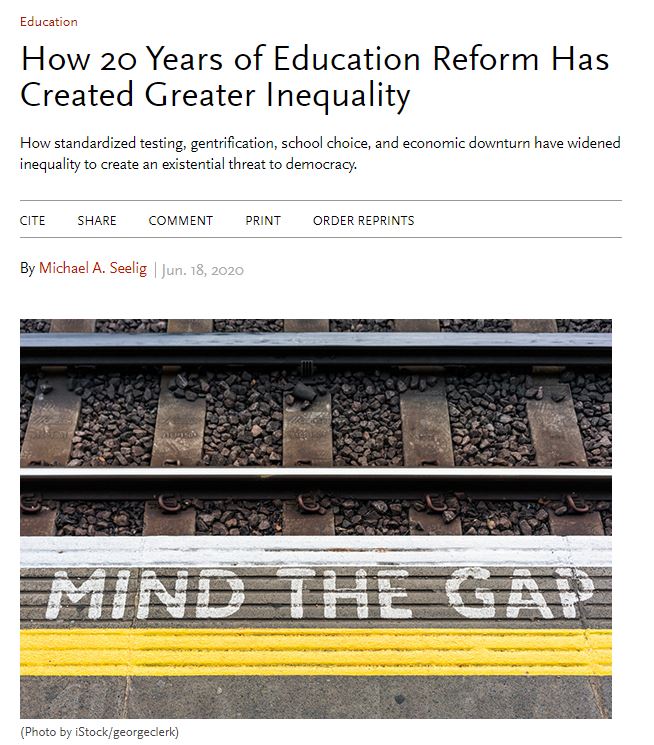
Today I read a 2020 article on the Stanford Social Innovation Review titled "How 20 Years of Education Reform Has Created Greater Inequality," written by Michael A. Seelig, Ed.D, the education policy director and senior advisor to the president of Medgar Evers College of the City University of New York,


This is a long article that shows "four major forces that converged since 2000 to shape how the school reform movement widened inequality: standardized testing, gentrification, school choice, and household economic downturn."

I highlighted text from the fourth factor:  


The highlighted text reads, "What renders so many education reform efforts futile from the outset -- so much so that we avoid talking about it -- is the fact that a student's academic achievement, with few exceptions, is completely tethered to the family's income and the opportunities it can provide."

Below is a paragraph from the conclusions part of the article:


The highlighted text says "We need much better measurement of organizational performance that both recognized the wider geography of schools and communities and accounts for the collateral damage we are leaving in the wake of our efforts." 

A process that collects information related to the "Social Determinants of Education" and a dashboard that measures progress toward goals would be a starting point. Take a look at the webinar that I point to in this article


This gap in opportunity between rich and poor was the theme of Dr. Robert D. Putnam's "Our Kids" book, which I wrote about in several past articles, starting in 2015. 

This gap can be shown on maps, which again is why I encourage you to read the article about "Social Determinants of Education" and look at the dashboard being suggested.  Since 1993 I've used maps to show the geographic gap between rich and poor in Chicago and other cities. I keep looking for other leaders to do the same on a consistent basis. 

Below I show a graphic that I've used since the mid-1990s to show the potential for non-school, volunteer-based tutor/mentor programs to help build a richer, more diverse community of support for kids in high poverty areas.  


Here's one article where I use this graphic.  This presentation shows it in another format. 

I recall one of my volunteers looking at this once and exclaiming, "You're trying to build a support system for these kids similar to what is already available to kids in wealthy, and more affluent neighborhoods!" 

Yes. That's been my purpose for more than 40 years, although I did not really begin to understand what it was that I was doing until the mid 1990s.  And it's taken many years of reading hundreds of articles like this SSIR article, for me to understand why this is so important.

I added the article to the research section of my library, where it joins more than 100 other articles. 

The problem, which I've focused on since forming the Tutor/Mentor Connection in 1993 is that "too few people really care" enough to make the changes needed.  

In fact, it may be that the self-interest of too many people means they work actively, or unconsciously, against needed reforms. 

Dr. Seelig's article ends, saying "We must recognize the existential threat a system that enhances inequality poses to democracy and need to push through the inevitable fatigue that emerges when we see something before us as too big, or too ambitious."  He ends with "American democracy depends on it."

If you've read this far, and you care about this issue, become the YOU in this graphic and share the article, my library and other articles like this with people you know and encourage them to do the same.

Keep doing it for the next 20 years.

I share my articles and highlight those of others on Twitter, Facebook, LinkedIn and Instagram.  (see links here).  I hope you'll follow me, share my posts, and introduce me to others who may be doing work similar to what I do.

Furthermore, if you are able, I'd appreciate a small contribution to help me continue doing this work Visit this page to learn more. 


Wednesday, January 30, 2019

Connecting People and Ideas to Help Youth in Poverty Areas

Last Sunday I posted about "Nudging the Network and pointed to connections I've made since 2013 with educators from around the USA and the world via the Connected Learning #clmooc Network.

Today I found this Tweet from Terry Elliott, a college professor from Kentucky, in my feed.


Last week I had sent Terry and a few others a post card that I'd created from a cMap, to thank him for his personal encouragement, idea sharing,  and for his 2018 financial support.

view cMap here
I opened Terry's blog to read his article and saw that he had created the video below, to guide viewers through my cMap.


Terry did what I keep hoping many others will do. 
1) he read my post; 2) then he wrote something about it on his on blog; 3) then shared that via his social media.

4) And, he sent me a contribution in 2018 to help me pay the bills!

So, let me put this in context.  


Below are two images I found yesterday on the America's Promise Twitter feed. The first shows that the US high school graduation rate flattening out over the past two years, at around 84%.  .

View Tweet here
The second shows that the groups still not graduating at the national average, or who represent that other 16%, are kids from poverty areas, minority groups, ESL groups, and those with special needs.

View Tweet here

I've been using maps since 1994 to try to focus attention and resources to areas where these student are most concentrated. Between 1994 and 2015 (when I ran out of money) I used conferences held in Chicago to try to bring people together to talk about ways to build and sustain youth tutor/mentor programs in high poverty areas. Since 2005 I've used this blog to focus attention on these areas and to stimulate thinking of ways people who don't live in poverty can help build systems of support that help kids move more successfully through school and into adult lives, with jobs, and free of poverty.

Work of Interns 2006-2015

Between 2006 and 2015 interns from various universities spent time looking at the ideas I have been sharing, then created their own interpretations, just like Terry Elliott has been doing.

I created this cMap to highlight work that was done.  I point to it as an example of what many could be doing, not just Terry Elliott and a few others.

Build using Tutor/Mentor Program Locator

After seeing the posts about high school graduation, I posted a few Tweets asking "does anyone have maps showing individual schools, not just aggregated state-level information?"  The map at the right shows 2007 low-performing public schools and  was created using the interactive Tutor/Mentor Program Locator, which we built in 2008-9. It is an example of what I would like to find in 2019. Here's an article where I use this map.

Built  using ESRI GIS
While we built the Program Locator to enable anyone to create map views, this was designed to copy what we were doing with an in-house GIS mapping capacity, which used ESRI donated software, to create more sophisticated maps.  The one at the left is an example, and was included in a 2011 article titled: Where Each Chicago Mayor Candidate Stands on Education and Mentoring  View the article

Maybe someone can use this to ask questions of the candidates running for election in 2019.

The point of this article is this:

First, I don't find many people digging into my articles the way Terry is and my interns did.  I created another cMap to point to other articles by Terry, along with some by others who are taking a similar role.

Second, I don't find groups of people in on-going conversations, using many platforms, the way the #clmooc network does, to discuss issues like high school graduation, and who include maps showing where schools, and kids, need more help, or that map out steps to build the public will and funding needed to bring needed help to more places, and then keep it there for many years.

Third, I can't find many blogs using maps in stories, that have the same goals as the maps you'll see on this blog, or on the MappingforJustice blog.  (send me links and I'll add them to my Inoreader archive)

Finally, I don't find any people looking at my maps, and then talking about how to rebuild the Tutor/Mentor Connection mapping platform (which is now out of date), conferences, and on-line network building efforts. And as people launch new initiatives intended to improve graduation rates, reduce violence and inequality, etc. few are reaching out to learn from ideas I've been sharing or to ask for my advice.

So, thanks Terry and others in #clmooc for your efforts and your financial support.

If you've read this and want to add your own support, click here for information.

Saturday, December 08, 2018

Can we imagine a future without traditional schools?

Last week I stumbled upon a Twitter chat which includes school superintendents from the Chicago area. I added the hashtags #suptchat and #k12prchat to my hashtag map, with the goal of going back this weekend to review all of the posts.

I'm glad I did. I'm not through my review but found this post:


I followed the link  and read this article, titled "School’s Out: Who Takes Responsibility for the Education of Young People?"

The article uses words to visualize an idea that I've used graphics to communicate. What I was seeing in my mind was the graphic at the top of the visualization shown below.  It shows the community of people surrounding kids as the grow up and lead their adult lives.  The spokes lead to different work/life experiences which offer different forms of learning and career opportunities.


In the lower part of this graphic I show a map of Chicago, with poverty areas highlighted. To the left of this is a circle, representing "all the knowledge in the world" that is available to young people and adults.  To the left of that circle and in the smaller circles below, I visualize the idea of gathering people together to discuss this information, and to learn how such learning is less available to kids in high poverty areas due to the lower diversity of people with different types of jobs, careers and incomes.

Thus, the goal of the discussion is to find ways to make this type of a learning environment more available throughout Chicagoland, Illinois, the USA and the world, so that at some point you could look at maps and see a distribution of mentor-rich learning opportunities distributed like Christmas lights on a tree. Hopefully, no spaces are left uncovered.

This is one of many articles where I show uses of maps.

Total Quality Mentoring (TQM) 
I first created this graphic in the 1990s to visualize the type of non-school tutor/mentor program I had led in Chicago since 1975 and to show a program design that others might duplicate.

At this link you can see this idea in more detail.

Below is another Tweet from the #suptchat thread.  Twitter chats enable people from schools, non-school organizations and all sectors to engage in conversations that focus on the well-being of youth, families, our communities and the world.


We just need to find ways to draw more people, from more places into these conversations.  That's why I've encouraged people hosting events and chats to create participation maps, like the one shown below, which is for the 2017 #clmooc, connected learning group.


With participation maps we help people connect with each other. We also enable a conversation of "who's here, and who's missing".  For instance, if you zoom into this map, you'll find few people from the Chicago region and other metros, which serve large numbers of low-income kids.  The data can encourage discussions of why, and what can we do about it.

The #CLMOOC group has been going since 2013 and their web site is a rich archive of ideas for helping people connect and learn from each other. Here's an activity from 2016 under the heading of "What if we Cultivate Connections and Strengthen our Networks",

To me, this is part of the learning that is available to those who spend time connecting and looking for ideas.

That's what I have been doing since I started leading a volunteer-based tutor/mentor program in Chicago in 1975.  Initially, I built a library of books and tutoring ideas and encouraged volunteers to use this to support their own work with kids.

In 1993 when I created the Tutor/Mentor Connection, I began expanding this library, while also building a list of Chicago non-school tutor and/or mentor programs. Then I shared this with others, via a quarterly print newsletter, and bi-annual conferences.

In 1998 I launched the Tutor/Mentor Connection web site, and in 1999 the Tutor/Mentor Institute web site. Both enabled visitors to connect with a wide range of information, ideas, program models, philanthropy resources, and more.

I'm still doing this, but without a non-profit organizational structure or reliable revenue stream. Thus, I share this FUND ME campaign page, inviting any who have read this far to make a contribution to support this work.


Friday, October 13, 2017

Helping Youth Through College - Solving Other Problems

I attended the University of Chicago Urban Education Institute's To&Through Project's briefing this week and shared some ideas on the MappingforJustice blog site. I hope you'll take a look, and take time to get to know the information on the To&Through web site.

In my comments I emphasize the use of maps to show where schools are located, with overlays showing demographics of the neighborhood as well as non-school support organizations and assets, such as business, colleges, hospitals and/or faith groups.

There's a strong emphasis on collaboration on the To&Through Project site, engaging members of the community not just people within each Chicago Public School. That commitment is visualized with this graphic.

To&Through goals are visualized using a time line starting in 9th grade and continuing through high school graduation. The data on the web site for each school shows eight to 10 years of history, showing changes in student success and progression through school from year-to-year.

I use a different set of graphics to show the long-term support kids need, starting as they enter school and continuing past college and/or vocational school, and leading to jobs and adult lives free of poverty.  I use geographic maps and concept maps to emphasize the need for great support systems in every neighborhood. 

I created the graphic below today to illustrate that the commitment, and actions, leaders need to make and take to help youth move through school to adult lives is the same commitment needed if they were focusing on other issues.


Let me break this down for you.  Below is the strategy map shown in the upper left of this graphic. In this blog article I describe this vision and the information shown on this map. 


If you open the links under the yellow box at the top left on this map you'll find a village map, which emphasizes the need for leaders in business, religion, higher education, hospitals, media and other sectors to adopt this commitment and help Chicago's kids grow up safely and thrive as adults.

However, there are other causes people care about, and similar commitments are needed in each issue area.  On the graphic I show above I've enlarged the left part of the Race-Poverty map shown below.

Race-Poverty Cmap - http://tinyurl.com/TMI-Race-Poverty-Map 
Every node on the map represents a complex problem affecting how kids perform in school and affecting people in many parts of Chicago, the US, and the world.  Someone could create a "my goal is" strategy map similar to mine, to show their own vision of steps to reduce these programs and they could share that map on blogs, the same way I do.

In every one of these areas, the "what do I know" and "where can I find more information" and "who else is working on this?" questions are being asked.  In the graphic I started with I show another concept map in the lower left, pointing to a four-part strategy. You can see the map below and find a description in this article.
 
I have a link to the To&Through project in the research section of the web library I've been building for more than 20 years.  Tha's all part of step 1 of this strategy map. I constantly add new links to the library because new information is being generated all the time. Navigating this is a huge challenge.

To help more Chicago students move through school, college and into jobs and careers many more people will need to dig deep into this information and find ways they can offer time, talent and dollars in many places.  That's step 2 and step 3 on this 4-part strategy.  Too few focus on these steps.  

Step 4 uses maps showing where help is needed, where schools and non-school organizations are located and seeks to motivate on-going actions that draw talent, attention, ideas and dollars to each area of the map where indicators show more help is needed. 

So that leads to one final graphic for this article.  Daily media stories and social media posts remind us of tragedies affecting lives of Chicago youth and families. When people read these stories there are steps they can take to be part of solutions. the ENOUGH graphic is described in this article


Would be great if someone would create a data entry form where people could document good deeds and actions they take, and code them by one of the steps shown on my graphic, as well as what address or neighborhood on the map was intended to benefit. Such maps could be on many web sites documenting who's involved and what they are doing and helping people who are involved find and collaborate with each other. 

Thanks for reading.  If you are interested in these ideas I look forward to hearing from you.

Sunday, April 23, 2017

21st Century Skills - Are These Modeled In Your Youth Organization?

Below is a graphic from an article on the World Economic Forum web site, titled, "What are 21st Century Skills Every Student Needs? I encourage you to read and share this with others.

Graphic from World Economic Forum article

As I looked through the list, these seem to be skills and habits that apply generically to all of the situations a young person will encounter as he/she travels through life. Anyone working with young people should be looking at these lists and thinking of ways the programs and services they provide reinforce one, or many, or these goals.

However, I'd encourage two other forms of learning.

One is "content".  This concept map includes pie chart graphics, that show different issues and challenges facing Chicago and the world, which need to be understood, and solved. Building understanding, solutions and them developing on-going actions requires the skills and habits suggested in the WEF article. However, learning about problems and solutions, requires on-going learning, drawing from content libraries that focus on specific issues.


The second is "process" or "systems thinking".  What are all the things you need to know to solve a complex problem. That would include habits and skills, and content. However, knowing how to sequence steps to achieve a goal, and how to build the public will and on-going support to stay focused on a problem for many years, and in many places, is also a skill that needs to be learned.


This concept map illustrates steps in the thinking process that need to be included in order for mentor-rich, non-school, tutor, mentor and learning programs to reach k-12 youth in more of the high poverty neighborhoods of Chicago and the world, and for more of those programs to have on-going strategies that help kids move through school and into jobs and careers free of poverty.

The also steps apply to other issues.

I point to nearly 200 non-school Chicago area youth serving programs in this list and to many others in Chicago and around the USA in this, this and this sections of the Tutor/Mentor Connection web library.

They all need to have one or more people reading my articles and sharing them and the links I point to with others in their organization, as part of their own on-going learning and process improvement.


Sunday, March 13, 2016

ESL/EFL resources from Webheads network

I've been following a group of ESL (English as Second Language) educators from around the world for over 10 years. The group is called Webheads and it's open to any who want to follow and/or engage.

Last week one member asked if others could offer a list of recommended resources and the list below was submitted.  I'm sharing it since many of these resources could be useful to tutors, mentors and educators working with other learners.

General
Pronunciation
Materials to Use in Class
http://www.handoutsonline.com/index.php

Video 
EdPuzzle - http://edpuzzle.com


The primary facilitator of this group is Vance Stevens, located in Abu Dhabi. This image is from a 2012 session where I shared some of the Tutor/Mentor Connection strategies with the group.

I'll add additional links to this as they are suggested and will add this web page to my web library, rather than adding each of the individual links. 

Thursday, January 09, 2014

Educate your Mentors - Turn them into Advocates

Today is "I am a Mentor" Social Media Day!!! If you've been a volunteer in a tutor/mentor program share your story on places like the Illinois Mentoring Partnership's Facebook page or the Tutor/Mentor Institute's page. As the photo to the left shows, I've been mentoring inner city youth in Chicago since 1973. I've led a program since 1975.

I started building a list and network of peers in 1976 and formalized that into the Tutor/Mentor Connection in 1993. In this role I mentor leaders of other programs, and mentor resource providers so they become more consistent in making the operating dollars, talent, space and other resources needed, available to tutor/mentor programs throughout big cities like Chicago.

Yesterday I attended the Polk Bros Foundation's 25th Anniversary celebration and the keynote speaker was Robert Reich, who was Secretary of Labor in the Clinton administration. I'd never heard him speak before and I was really impressed. During the Q&A session he was asked "where to start" in balancing the need for improving education outcomes while also reducing poverty. He said "Everywhere".

When I created this Four Part Strategy in the 1990s and pdfs like this that say "what are all the things we need to be doing" it was with the idea that unless we addressed this as a complex problem with many entry points we'll never solve the problem.

I spent a few moments this morning looking up Robert Reich. Here's his home page, with an article titled: "Why the Republican's old divide-and-conquer strategy, setting working class against the poor -- is backfiring". Here's a Facebook page where you can engage.

As National Mentoring Month motivates volunteers and youth to show their roles in mentoring I encourage all of us to find more ways to educate our volunteers and youth so they become leaders and advocates to solve the problems of the poor and working middle class of America.

During the panel discussion Barbara Byrd-Bennett, CEO of Chicago Public Schools, Evelyn Diaz, Director of Chicago's Department of Family and Support Services, and Alex Kotlowitz, recognized author, each spoke in glowing terms about the power of mentoring. This session was recorded, so as soon as the video is published I'll put the link here.

Yet few leaders have yet outlined a business strategy to make k-16 mentor-rich programs available to youth in every high poverty and working class neighborhood of Chicago and its suburbs, with the funds and leadership needed to help each program grow and constantly improve its impact on youth and volunteers over the next 20 years.

I challenge these leaders and mentoring leaders everywhere to engage your youth and volunteers in research, brainstorming and visualization activities where a blueprint and strategy for this might emerge and become fully supported by a new coalition of the working class, the poor, and the 1% who care.

Thursday, November 21, 2013

Mobilizing Resources for "Birth to Work"

If you search Google for the words "tutor mentor strategy" my web sites will be on the first page. If you click on the images feature you'll see dozens of graphics that I've created since the mid 1990s to visualize a "birth to work" strategy that would help more kids in high poverty areas have an infrastructure of adult support and learning opportunities helping them move from birth to work without detours in the juvenile justice system, high school drop out system, or other negatives that are more common in high poverty areas than in more affluent communities.

Last spring I posted an article showing that Chicago Mayor Rahm Emanuel's anti violence program potentially was taking corporate funding from some neighborhoods and shifting that money to other places.

Recently I've connected with a new initiative from the Mayor's office, called the Chicago Thrive Initiative, which is modeled after the STRIVE Partnership initiative in Cincinnati. Below is the DRAFT visualization of a "roadmap" intended to lead more youth in Chicago from birth to work. I've not yet found a web site where this or other planning documents are posted. I'll provide a link when I do.


I post this because I've wanted leaders to show support for a "birth to work" mentoring strategy since I launched the Tutor/Mentor Connection in 1993. Here are a few of the visualizations I've created to illustrate this concept.

I created this graphic to show the types of age appropriate support youth require as the move from one grade level to the next. This concept map represents an attempt to aggregate information specific to each grade level that people could use to make programs that work in some places available to youth in more places.

This graphic is intended to illustrate the need to provide age appropriate services in all neighborhoods, not just a few. Otherwise, like plumbing, there is not a smooth flow from one point to the next. Use your imagination to think of what the result might be.


These are just a few of the visualizations you'll find if you do the Google Search I suggested, or if you view some of the graphics I've posted on http://www.pinterest.com/tutormentor/ Many of these have been created by interns, illustrating my belief that youth in high school, college or within existing tutor/mentor programs could be involved in interpreting these ideas and communicating them to the adults in their own neighborhoods and networks.

In my articles I focus on what people in business and who don't live in poverty, need to do, not just what non profits, families, schools and youth in high poverty areas need to do. In fact, people living in concentrated high poverty areas can't do a lot of what everyone wishes because of the poverty surrounding them. Thus, I created this ROLE of LEADERS PDF and this STRATEGY MAP.

I've also used maps to illustrate a need to distribute resources, and programs, into every high poverty neighborhood, and keep them there for many years. I started building a map capacity in 1993. I launched an on-line program locator in 2004. Instead of investing in what I've been building the city and others have been building their own map based program locators, yet not necessarily with the same goal of connecting resource providers to programs, or of making mentor-rich programs available in more places.

It is great that the Thrive Chicago team is visualizing this road map and working get everyone on board, and that this visualization of "birth to work" is now coming from the Mayor's office. However, until more leaders from business, religion, philanthropy, universities, entertainment, media, etc. adopt the strategy and support it consistently with their own actions we'll still reach too few kids, with fragmented strategies, and too little impact.

In April 1997 I was a Chicago delegate to the President's Summit for America's Future. The Tutor/Mentor Connection was one of 50 Teaching Examples selected to host a booth at the summit. Mayor Daley spoke at the Tutor/Mentor Leadership and Networking Conference in May 1997. However, he never embraced the strategy or became a spokesperson or champion for the ideas. The Summit did not result in reinforcements coming to my organization and others already in the field. Instead it resulted in a new group of people and organizations launching a new planning process, with new ideas and new resources.

We need new ideas and new resources, but we don't need to reinvent the wheel. But I encourage leaders to reach out and support those already in the trenches, at the program level, and the intermediary level. Use the Chicago Programs Links to find existing youth organizations. Use this concept map to identify other intermediaries that you can support.

What level of talent is needed? Read this Deloitte report about "transforming the supply chain". As you do, imagine the talent and costs involved in this process. Poverty costs America billions of dollars every year. American industry faces a huge talent shortage. What will it take to bring the type of talent described in this report into the work of designing a new supply chain supporting birth to work strategies throughout the country?

Ask "How can I help you?" If the Mayor and other leaders demand this of those getting city contracts and getting wealthy doing business from managing money of the poor, or of philanthropic organizations, perhaps we'll build the flow of operating resources and talent needed to sustain and constantly improve the organizations needed in every high poverty neighborhood to help more youth move from birth in poverty to jobs and careers within Chicago industry.

We'll need this fuel on any "road map" that leaders put in place.