Monday, June 13, 2022

29 Years Later - Children's Needs Still Not Being Met

 Like 20 million others, my wife and I watched the first Jan. 6th Congressional Hearing last week, and I watched the second session this morning.  I'm following many conversations on Twitter and many paint a distressing picture of the future, as one group of Americans seems to want to take the country back to the 1950s and impose a minority rule over the rest of America.  

At the same time I'm following the war in Ukraine, and conflict in other parts of the world.  And these are just a few of the challenges facing us daily.  

I created this concept map a few years ago to show challenges facing the US as POTUS46 became president. I've added new challenges, such as Covid19 and Ukraine since then. 


With all of these issues facing us daily, how do I continue my focus on helping kids living in high poverty areas get the extra support needed to help them move more safely from birth-to-work?

I've written about how we keep focus amidst these challenges several times since 2005.  Below are parts of an article written in 2017, with the headline "24 years later - ---" 

----------------------------------

While the US focuses on the tragedy unfolding in Texas and Louisiana, I keep thinking of what will be needed for decades to help people in these areas recover from these disasters.

I also keep adding links to this Climate Crisis article, showing that disasters like what's happening in Texas are unfolding throughout the world.

Since 2005 I've written a few articles following natural disasters. They all have the same pace. Urgent need and huge attention and outpouring of help as the tragedy unfolds.  Few using maps, so many areas where help is needed get little attention. In the years following one tragedy another happens and attention goes to a new crisis. Keeping attention and resources flowing five, 10 and 15 years after the tragedy is almost impossible.

That same flow of attention follows urban violence.

I've been reducing my paper trail and am scanning some of my news stories into my computer. Added this one from 1993, which is a letter to the editor written to the Chicago Tribune by Florence Cox, President of the Chicago Board of Education

I highlighted one section where she says:
"We must begin to realize that the needs of Chicago-area children are not being met, and in neglecting those needs, we neglect our own future as a prosperous and safe city."


Here's another article with some quotes from other stories, showing how difficult it is for this nation to focus on complex problems that require long-term attention and resources to be solved.

When I started the Tutor/Mentor Connection in 1993 one of four strategies was to generate more consistent attention to issues of poverty, violence, inequality, etc. drawing needed support to all of the non-school tutor/mentor programs operating in the Chicago region. I started using maps to show where they were most needed and where existing programs are located.  

I found another set of notes, with quotes I'd written down during speeches given during the 1997 President's Summit for America's Future, held in Philadelphia, PA.  I was there as a delegate from Chicago and the Tutor/Mentor Connection was there as a Teaching Example exhibitor.

In the letter to the editor and in the Summit speeches, leaders are calling on Americans to become involved in solving complex problems.  The problem is, they have not made this call for people's involvement every day since then, and they have not pointed to web libraries and directories showing information people need to learn from, and lists of existing programs who need their help.

That's still a problem.

Every week for the past 40 years I've spent time trying to connect inner city kids with workplace volunteers in organized, non-school tutor/mentor programs that help these kids move through school and into adult lives.

At different times, like right now, keeping attention focused on this has been more than difficult.  The COVID19 virus seems to be never-ending. The impact on poor people, who can least afford it, will be greatest. 

Maybe the current political divide and growing religious extremism is to be feared even more.  These are people who have never given up on the ideas of one race dominating another, of men, controlling women.  Of one religion over all others. Of minority rule.  

Yet, while we struggle through these challenges and disasters, I feel we still need to look long term. Kids living in high poverty area will need the extra support of non-school youth tutor, mentor and learning programs even more in coming months and years.  So let me share to graphics that visualize strategies I feel we need to focus on.

We all want the same outcomes: More youth stay in school, are safe in non-school hours, graduate, and move to jobs and careers.


To get the result we want we need to do the work shown at the bottom of this pyramid.
At the bottom of this pyramid I show that we need to build a knowledge base, then draw people together to use this information in an on-going planning and actions cycle.  This article describes this diagram.  It can be used in an area as small as a few blocks, or as large as an entire country.

This pyramid could be used to outline steps to overcome the COVID19 virus. Or to deny the agenda of far right conservative activists.

At the top would be results we want. At the bottom should be information aggregated from all over the world to help us understand these issues and how to fight them.  A sub section of that library should be a collection of information focused on specific topics. Visit the Tutor/Mentor web library to see how I do this. 

The second graphic I'm sharing focuses on INFLUENCE.
We must influence what resource providers do; not just what non-profit leaders do.

Having led a non profit youth program for 20 years I know that I was expected to operate a great program, get outstanding results and find the money to pay for all the work that needed to be done.  Think for a  moment of a fish bowl, with hundreds of small fish. When you put a little bit of food in the bowl there is a frenzy of every fish trying to get some of the food. Not all succeed.  That's the problem with how our non -profit funding system works.

In this graphic, which you can read about in these articles, I show t hat we need to Influence what resource providers, business partners, media and policy-makers do, not just what non profit programs do, so that there is a consistent flow of resources to every program, in every area where tutor/mentor programs are needed, so they can all become great at what they do to help kids safely through school.

Here's two more graphics to consider:

If you're at an event, how well can you share your ideas?
I created this graphic as a result of attending large gatherings for many years, where there were great speakers, but there was little interaction between the speakers and individuals in the audience, or between the people who sat at different tables. My goal was to encourage event organizers to create on-line activities that paralleled what was happening in the room, and that kept participants engaged and interacting after the event ended.

Hashtags of Twitter chats
I created this concept map to archive Twitter conversations that I've been part of. Many are on-going. A few are archives.

All of these in some way relate to efforts by different groups of people to help build support systems for kids living in high poverty neighborhoods.

You can click the link at the bottom of each node and join the conversation yourself.  Some of these should have much greater involvement than they have had so far. It's up to event organizers to encourage this, as well as the rest of us.

Very few do this well.  Even after two years of COVID19 and countless ZOOM meetings, I find few event organizers trying to create some form of online interaction that continues after the event.   

Yet, there have never been so many opportunities to grow a single event into a year-round community.

Look at the issues map at the top of this article, and my hashtag map.  Who's talking with others around these topics?  Yesterday on Twitter I saw a post that visualized people within a conversation, defined by a hashtag.  I created my own version, showing interaction with @tutormentorteam.

Mapping conversations is one way to know who is connecting with whom. It's a step toward trying to get more people and talent connected into on-going conversations.  That's the big challenge.  Read some of the articles I've written about this in the past.

Let's turn this negative into an opportunity to learn more ways to bring people together into year-round learning, idea sharing, relationship building and collective action that leads to brighter futures for all kids living in high poverty areas of the US and the world.

I'm on these social media pages. Let's connect.

Tuesday, June 07, 2022

Show the love of mentoring bonds

It's the end of another school year and celebrations of tutoring and mentoring are being held all over the country.  In most of them there will be many testimonies of the "love" that forms during the year-long, often multi-year, cycle of weekly meetings.  

That reminded me of two projects created by interns in 2012.

The graphic shown above is from an animation created by Song Mi Lee.  She used photographs of students and volunteers from the Cabrini Connections program that I had led until 2011 to create this image. Can you find me in the group? 

The video below shows how Song Mi integrated some of the photos from the heart graphic into a video on her final day with us.


Another heart shape project was created by Song Mee Lee and Sung Hee Jung, and is described in this article. This was animated, and you can find it in this video.

The work space for these projects is in the Tutor/Mentor Connection forum. Visit and you can see how the forum was used to coach interns and engage others.

Our interns were part of a partnership with Illinois Institute of Technology (IIT) in Chicago that lasted from 2007 to 2015. Students came to IIT from South Korea and China for a semester and spent the last six weeks in an internship with a local business or non profit.  During this period we also had student intern volunteers from Hong Kong Baptist University, the University of Michigan, Loyola Chicago, DePaul and Northwestern.

This wiki page describes our goal of recruiting students from many high schools and colleges to do this work. This page shows how students doing this work can be acting as the research team for universities trying to build a better understanding of the Tutor/Mentor Connection and Tutor/Mentor Institute, LLC.

On this page of the Tutor/Mentor Institute, LLC web site I post a list of interns from 2006 till 2015, with links to articles they wrote to introduce themselves at the start of their internship, and then links to final reflection articles.  Some provide more information than others, but all show an intent that the intern learn new ideas and new skills from working on their projects.

As I interviewed students for these internships I emphasized that one of my goals is that these students continue to stay connected to the Tutor/Mentor Connection library of ideas and to each other, so that in future years they become a community of people who help each other, and who apply these ideas to making the world a better place.  I'm still connected to many through LinkedIn and Facebook.


I created this presentation to show a goal of having student-led Tutor/Mentor Connection-type teams growing on high school and college campuses throughout the US and the world.  Anyone who takes a few moments to view my blogs and then shares what I'm writing about, as Simon Ensor has done on his 2016 blog article, is providing inspiration and motivation for one or many people to take this roll.

I'm still waiting for the first university or high school to adopt this strategy, and for the first corporation or benefactor to endow it with 10 years of funding, but as they say "Rome was not built in a day."   

I created this concept map to illustrate this vision. If you start writing about my ideas and/or creating your own visualizations, share the link in the comment box and I'll add you to this map.


Better yet, create your own map, and add my blog articles to it.  

Through the collective effort of many, we'll gather the bricks needed to build the "Rome" of this vision.  Thank you to Song Mi and Sung Hee and all the other interns who helped share ideas and strategies during the time they spent with us in Chicago.

If you'd like to become involved just join the Tutor/Mentor Connection forum and introduce yourself.


Thursday, June 02, 2022

Impact of 100+ years of segregation in USA


I've been building a learning library for over 40 years, intended to support my own efforts as a volunteer tutor/mentor, beginning in 1973, and the efforts of hundreds of students and volunteers in programs I led from 1975 to 2011.  When we created the Tutor/Mentor Connection in 1993 we systematically expanded the information being collected, and began sharing it with leaders, volunteers, donors who were part of organized tutor/mentor programs throughout Chicago.  In the late 1990s we began putting this on the Internet, sharing it with the world.

I created the graphic at the right more than 20 years ago to visualize the type of information I was collecting and sharing.  Since 2005 I've used concept maps, like this one, to show sections of the library. 

I've always focused on "why" tutor/mentor programs were needed, not just, how to be a good tutor or mentor, or how to organize an effective programs.  And, I've tried to inspire others to follow my own path, from volunteer, to leader, to advocate.  

Thus, one section of the library focuses on race, poverty, inequality, social justice, etc.  It includes several hundred links.  I added one more yesterday, after watching a webinar hosted by the Albert Shanker Institute, titled "Segregation and School Funding: How Housing Discrimination Reproduces Unequal Opportunity."


You can read the Executive Summary at this link, and find links to the full report, and case studies of seven cities featured in the report.

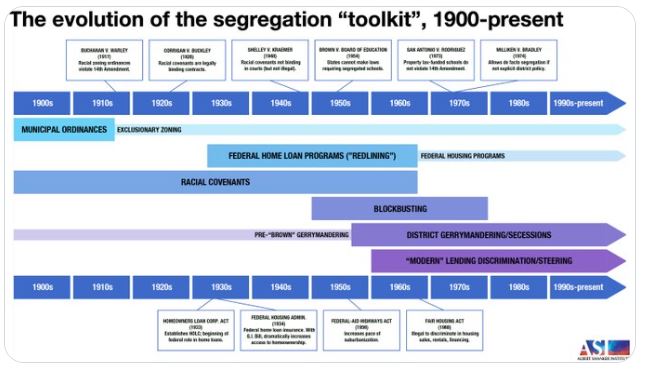
As I wrote above, I've been collecting links to websites that talk about segregation, inequality, racial justice, etc. for many years. Thus this is an old problem that has never been solved.  During the webinar the speakers introduced a section of the report, titled "The Evolution of the Segregation "Toolkit": 1900 - Present" that detailed tools that have been used for more than 120 years to create and maintain housing segregation in US cities. This starts on page 8 of the full report.


The authors write, "The discussion of this section takes the form of a narrative of sorts, one that unfolds over 120 years, in which individuals and institutions, public and private, display remarkable (albeit destructive and inhumane) agility and creativity in crafting new segregative strategies and adapting old approaches to rapidly changing circumstances. These efforts were so effective that the impact of policies and practices from a century ago are still evident today."

The graphic below was used to visualize the information in the "Toolkit".   


Note that while various laws were passed to end housing segregation, creative efforts were used to bypass those laws.  This is described in detail in the report.

Below I'm going to share a few Tweets that highlight some of the information in this report, including maps.  


These are just a few Tweets posted by the Shanker Institute yesterday.  As I listened to the webinar, I tried to amply what was being said through my own Tweets. I posted the Tweet below on Monday. The message applies to what you need to do to share the Shanker Institute report and motivate more people to read it and the other research in my library. 120 years of not solving this problem is far too long. 

I've posted Tweets in many of my previous blog articles with the goal that you'll go to Twitter and follow these threads, then gather people you know to discuss what you're reading and ways you can get involved in solving some of the problems these Tweets point to. At minimum, you can seek out local youth tutor, mentor and learning  programs and offer them your on-going support. 


This photo shows myself addressing students and volunteers at one of our year-end celebrations. I did this every year for 35 consecutive years.  Every time, while I congratulated people for work done during the previous year, I encouraged them to dig deeper into the information in the library, to know more about where and why tutor/mentor programs were needed, and ways volunteers, and students, could take active roles in changing those conditions.

Around the country thousands of leaders are doing the same as myself, as they end programs for the current school year and begin planning for the next. Some are already actively recruiting volunteers for next year!

I hope you'll read the Shanker Institute report, especially the part about the "toolkit".  People have intentionally created the conditions that elevate White people and devalue people of color for over 120 years.  That won't stop until others are just as creative, and just as persistent, in efforts that counter those efforts. 

As you dig through the library, take a look at the articles about social capital that I've posted on this blog.  Expanding the "who you know" networks of kids and families living in segregated, high poverty areas, is one way to expand the network of those who need extra help achieving the American dream. 

Thanks for reading my posts.

I'm on Twitter @tutormentorteam and can be found on Facebook, LinkedIn and Instagram.  Please connect and help me amplify these ideas. 

Thursday, May 26, 2022

Enough is Enough - Fix How We Elect Leaders

Yesterday I started writing my Memorial Day post and included this front page from the October 1992 Chicago SunTimes.  Before I finished posting I saw the tragic news of another mass murder, this time in a Texas elementary school.

What's the connection? Our elected leaders have done almost nothing to reduce gun violence in America over the past 30 years, even though there are on-going tragedies reminding us that something is very, very wrong.

It's not the huge number of guns, or easy access, though that is one problem.  

It's really how we elect people for Congress and state legislatures.  Until we elect people who are not paid for by wealthy donors or corporate lobbies, like the NRA, we'll never have enough people who provide the type of governance needed to make difficult decisions that help solve the complex problems facing America. 

I've been building a web library since the mid 1990s but only in the past six years have I been aggregating links to websites and articles that focus on fixing our broken Democracy.  

Click here to go to that page. Below are a few websites I'd like to highlight:

Final-Five Voting - Get rid of the party primary - click here
Here's how it's described on the website: "In a Final-Five Voting primary, all candidates running for Congress will appear on a single ballot, and all voters can participate in the primary regardless of whether they are registered with a party." The Final-Five Voting site includes a description of how this differs from Ranked Choice Voting.

Yes, our political system is badly broken. But it doesn't have to be this way.   In this article, Katherine Gehl makes a case for Final-Five Voting


11 Ways to Fix our Broken Democracy - click here
This Sept. 2020 article starts saying,  "The United States has a president who received nearly 3 million fewer votes than his Democratic opponent. Currently, over half the country lives in just nine states, which means that less than half of the population controls 82 percent of the Senate. It also means that Republicans hold a majority in the Senate despite the fact that Democratic senators represent more than half of the American people."

Reclaim the American Dream - click here
From the website's issues page: "Knowledge is power. Change doesn’t happen on its own. It takes ideas. It takes know-how. It takes the confidence you gain from tapping into a network of experience and learning from models of success forged by others. This is what our civic action tool box gives you."

What I value about this website is that it not only clearly shows issues, but it also shows progress being made in different states to pass needed legislation.  Thus, if you're interested in any of the issues they focus on, such as "tools for expanding voter rights" you can find models of legislation that you can bring to your own local representatives. 

These are just a few of the 80+ websites that I point to from this section of the library.  You need to take time to visit these sites, learn about the issues and recommendations, then work to elect people who will make the needed change. 

I've been pushing this boulder uphill for three decades. Not much has changed. Too few are making time for deeper learning that support solving complex problems.

Yet, if we want to stop mass murder in schools, churches, grocery stores, or on the streets of Chicago and other cities, or protect women's rights, minorities, LGBTQ rights, unions, and healthcare, we must have elected leaders willing to stand up to the gun lobby and to wealthy special interests donors.

I'm just a small voice, not heard by many. Here's a Twitter post showing NBA basketball star/coach Steve Kerr, demanding action. He needs to finish his rant by saying "go here for more information".  

Too few people are voting, especially in primaries.  This needs to change. There are people smarter than I am who are posting ideas. Visit their sties. Give them your support.  

I dream of a day when we don't wake up to headlines talking about some of these issues. 

Wednesday, May 25, 2022

Memorial Day - Remember by Your Service to Others

I spent three years in the US Army from 1968 to 1971, following my graduation from college. I was no hero. I was lucky not to be in a combat zone. I was fortunate to spend time in Baltimore, Washington, DC and in Seoul, South Korea, where I expanded my understanding of the world.

When I returned from South Korea, with my tour of active duty completed, I spent six months working at the Woolco department store in the DeKalb, Illinois area, then came into Chicago and joined the Montgomery Ward company as a retail advertising copywriter.  Over the following 17 years I rose through the ranks and held various management roles in the advertising department between 1980 and 1990.

Leo & Dan - circa 1974
Shortly after joining Wards I was recruited to be part of the company sponsored, volunteer-led, tutoring program that connected employee volunteers with 2nd to 6th grade kids living in the Cabrini Green housing complex, which was located near the Wards headquarters complex where I worked.

I was assigned to work with a 4th grade boy named Leo, and at the end of the first year his mother said to me "He talks about you all the time. You've got to tutor him again next year." I did, and we've stayed connected for the past 45 years.

I've given this 'get involved"
message every year since 1975
At the end of my first year I was also recruited to be part of the committee of volunteers who led the program, then the next year, I was tapped to be the leader. I held that role until 1992 when I and a few others left the original program and formed a new program  (Cabrini Connections) to help kids who aged out of the first program after 6th grade have a support system that helped them from 7th grade through high school and beyond.  I led that until 2011.

As we were launching the new kids program a 2nd grade boy named Dantrell Davis was shot and killed in Cabrini Green and the media headlines were demanding that "everyone take responsibility". 

I had been building a list of Chicago non-school tutor/mentor programs since becoming a leader in 1975, using it to invite peers to connect and share ideas on a regular basis, so I knew that no one had a master database of existing programs, thus, no one could lead an on-going communications effort intended to help great tutor/mentor programs reach k-12  youth in all high poverty areas of Chicago. 

So, as we created the new kids program we created the Tutor/Mentor Connection.  The graphic below visualizes our local commitment to youth in one program and our global commitment to help youth connect with volunteers in other programs throughout Chicago.

I started trying to find ways of using maps in 1993

Over the past 28 years I've continued to lead that effort, with various degrees of success in different years, and also with an on-going series of set-backs and struggles, that ultimately led to the creation of the Tutor/Mentor Institute, LLC in 2011, and a decline in what I've been able to accomplish in the years since then. 

Yet, I still maintain a web library and use my blog and newsletters weekly to draw attention to this information and try to motivate others to take meaningful, on-going roles, in helping youth tutor/mentor programs grow in multiple locations.

I created this concept map to show milestones from 1992 through 2019.  In the upper left corner you can find this link, showing milestones from 1965 to 1992.

1990-present time line - open map

The goal of this work has been to help well-organized, mentor-rich, non-school youth programs grow in all high poverty areas of Chicago and other cities around the country. The strategy applies to rural areas and reservations, too, but with different challenges driven by the size of the geography and the low density of the population and pool of potential volunteer mentors.

I'm writing this the week before Memorial Day, which celebrates the  ultimate sacrifices service men and women have made in all wars.  I've posted Veteran's Day and Memorial Day themed articles often since 2005. They all focus on what we can do to honor the sacrifice of those who gave their lives in foreign wars, from many countries, not just the USA.

I have received various awards and recognition for my years of service, ranging from the Army Commendation Medal in 1975 to an honorary PhD from Illinois Wesleyan in 2001. 

However, the best reward is the "thank you" messages I've received, such as this, and this, from kids and volunteers.

I don't find many people who have been in leadership roles at youth tutor/mentor programs for as long as I have been. I find even fewer who have spent as much time every week for 25 years or longer to help youth tutor/mentor and learning programs grow in every high poverty neighborhood of Chicago or any other place in the country, or the world using the four part strategy I have piloted since 1993.

I keep looking for such people. I also keep looking for a benefactor who will recognize my efforts and provide more than a "thank you" to help me upgrade everything I've been doing, while embedding the Tutor/Mentor Connection/Institute in one or more  universities and/or think tanks.

Thus, this is my Memorial Day 2022 message:

Remembering the sacrifices of those who have given their lives, bodies, spirits and loved ones to this country can be best done by making daily commitments to actions that reduce poverty, strife, inequality, conflict and destruction of Mother Earth and other forms of life.

I hope you've read this and will share it with others as you do your own remembrance.

Here's my FUNDME page. I hope you will help me continue doing this work. 

Friday, May 20, 2022

Combatting extremism in USA - social capital thinking

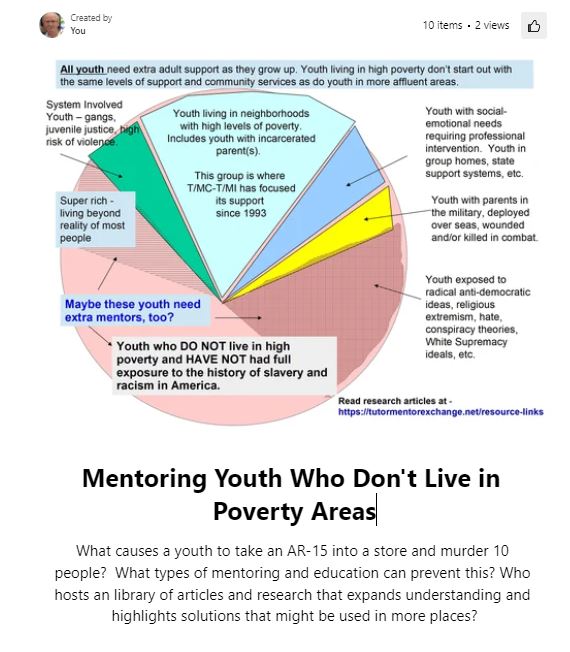
On Monday I included this graphic in an article titled "Kids not living in poverty need mentors, too."

This was in response to the most recent mass murder of 10 people in Buffalo, NY by a teen who had adopted White Supremist beliefs, was able to purchase an automatic rifle, then acted upon his beliefs. 

What caused this? What might prevent it? 

I'm going to point to a lot of information in this article, so I hope you'll bookmark it, then refer to it often.

At the right is a graphic that I've used for more than 25 years to show the role of mentors and extra adults in "pushing" kids through school and into jobs and careers and the role of businesses,  universities, hospitals, philanthropy and government in "pulling" kids through school, using mentoring as one important strategy.   Providing part-time jobs and internships is another. View the graphic in this article


Over the past 30 years I've used maps to focus attention and resources on high poverty areas of Chicago, where tutor/mentor programs are a place where kids can connect with volunteers from many different backgrounds and help kids on their journey through school, while also opening doors to jobs and college opportunities for many.  

I've come to understand this as a form of "bridging" social capital, and have been influenced by writers such as Robert D. Putnam.  In this article I point to several articles where I've written about Putnam's "Our Kids" book and "bridging" social capital.  

In all of these efforts, I've focused on expanding "who you know" for kids who's family and personal network has too few people modeling the many types of careers they might aspire to if they had a college degree, or advanced vocational training after high school.  

Here are three more articles that show this strategy:

Mentor Role in Larger Strategy - click here

Transforming Adults Involved in Volunteer-Based Tutor/Mentor Programs - click here

Understanding and Creating Bridging Social Capital - click here

Much of my motivation has come from seeing stories like this 1992 Chicago Sun-Times article in Chicago media, over-and-over, since the late 1970s.  Too many inner city kids are losing their lives.  Street killings are just the  most visible sign of this. Poverty leads to more stress, more severe illnesses, poor performance in school, involvement with juvenile justice, and other things, all which reduce future opportunities. 

Yet, most of the mass shootings have not been black and brown kids killing people of other races. Those have mostly been done by White kids.  (see data)

So far I've written about strategies that reach and benefit kids living in high poverty areas, who might be less prone to acts of violence against each other if they had more hope and opportunity.  Providing these opportunities continues to be my focus.

However, we have a problem in America.   In the graphic at the top of this article I ask "What about kids who don't live in high poverty?"

In the third extra reading articles above is a link to a paper titled "Social Capital: The Bonds that Connect", written by Michael Woolcock.   He provides clear definitions of "bridging" and "bonding" social capital.  So far, I've focused on "bridging".

Now let's focus on "bonding".

Woolcock writes "Bonding social capital refers to connections to people like you. For example, classmates, work colleagues, and neighbors.

The lives of the poor are largely characterized by a rich set of bonding relationships, but little by way of bridging and, especially, linking ties."

If you are poor you might not be able to place names of people you know in some of the categories on this chart, but you do have many close ties among family, high school, faith group and neighborhood.


What if these close ties are people who model anti-social, racist, anti-democratic, and/or religion-based extremist views?  In this article I quote Bob Pearlman, who wrote an article about social capital in the early 2000s.

He wrote "But the most significant finding in the study was that a student's social network can have a significant impact on his/her career choice. Students whose parents are both in high-tech careers are more likely to be interested in technology careers themselves. In addition, 83 percent of students rely on personal connections for career-related information and guidance.

Youth emulate the beliefs of their parents.  Strong bonding ties, without bridging ties that expose kids to a wider range of thinking, can be a negative.

I'm now getting into areas where I don't have enough expertise.  In the article I wrote Monday, I asked "What should I do?"  I answered, "Collect information about this topic". 


I don't have a section in the Tutor/Mentor library that focuses on extremism so started aggregating a few links using Wakelet. Click here to see what I've collected so far.

I've been building a web library for 20+ years. It's organized by category. Here are a few examples:

Poverty & Crime Mapping - click here

Race, Poverty & Inequality - click here

Saving our Democracy - Political Resources - click here 

I'd like to find a web library with a similar set of links, focused on extremism and solutions. 

Now let's look at a some maps:

This is a Washington Post map showing segregation in Chicago and throughout the USA. Click here to view. 


This is a map showing faith groups in the Chicago region.  Open this link, then zoom into the Chicago region. 


Below is a map created using the same platform, but I've clicked on an area, then hit the "profile" button. I then get maps showing different demographics, income levels, etc.  The faith groups in the area are still shown. If I zoom in, I can identify individual groups.


Using the two data platforms, and others with similar information, we can see where more affluent people live and where poorer people live. We can also see the faith groups within these areas.  You can do this for any city in the USA.

Further research (by someone else) would need to determine which of these groups might be more fundamentalist in their teaching and beliefs, or might be among the groups that strongly support the former President.  What can be assumed is that children growing up in these faith groups are being "groomed" to the same beliefs as their parents and the rest of the congregation.

That could be a problem.

There are plenty of stories showing far right religious beliefs affecting state legislation and restricting voting rights.

Across the country certain groups are now beginning to ban teaching of certain topics in school and are banning certain books from school libraries. Over the weekend I saw that someone is suing a Barnes & Noble bookstore for carrying a specific book.   Will burning books in the streets be next? 


Now, please go back and read more of the articles, like this one, that I wrote following the release of the "Our Kids" book by Robert D. Putnam. 

Poverty reinforces poverty and affluence reinforces affluence.  Kids in affluent areas are not building much empathy for kids in poverty areas because they don't have close ties, or "bridging ties" to kids who are economically different from them, or who have different religious beliefs.  That influences how they see the world and what they will do as adults to solve problems in the world.

Kids who are part of faith groups that support radical right-wing conspiracy theories and White Supremist world views are being "groomed" to carry those beliefs into their adult lives, and to force their beliefs to others.  

Without some strategies to expose these kids to a wider range of ideas and beliefs, starting as early as pre-school (because that's when religious indoctrination is beginning), the tragedies like Buffalo are likely to grow even more frequent.

The challenges to our democracy are likely to become more dire. 

Are these things you're thinking about?  Have you found good, extensive, online resources that I can point to, or people with solutions that I can point to?

I'm on Twitter, Facebook, Instagram and LinkedIn. I'll look forward to connecting with you. 


Monday, May 16, 2022

Kids not living in high poverty need mentors, too

If you've followed my work for any length of time you see how my focus has been on helping kids living in high poverty areas connect with adult volunteers in organized non-school tutor, mentor and learning programs.  Open the graphic at the left and you can see a 10-point strategy developed in 1993 that I have followed for over 20 years.

For the past few years as I've watched horrendous tragedy of youth using AR-15 rifles to murder groups of people, as in Buffalo this past weekend, I've begun think that there is another category of young people who need a lot of extra mentoring and adult support.


Since launching the first tutor/mentor survey in January 1994 I've tried to build a segmented understanding of existing tutor/mentor programs in Chicago, sorting by age-group served, type of program and location. 

At the right is a graphic showing a vision that I've had for many years, of creating a much more detailed understanding of what types of programs are available within a geographic area.  You can see this graphic in this blog article

Below is a view of the Tutor/Mentor Program Locator which we launched in 2004, based on the printed Directory we had published since 1994.  It enabled people to search by type of program, age group served and location, to find programs in different parts of Chicago.


This has been an archive since 2018. You can read about it here.  If someone creates a segmented understanding of programs in their area, this is a way to share that information and help those programs attract volunteers, donors, students and media attention.

Below is an updated version of the graphic shown above.  


I've added another sub-category focusing on youth growing up surrounded by adults who have adopted anti democratic conspiracy theories, religious extremism, White Supremacy thinking, etc.  


At the left is a graphic that I include in a presentation titled "Defining Terms".  The graphic shows five categories of youth who could benefit from help provided by volunteers in organized, on-going, tutor, mentor and learning programs. The large light blue area in the middle, showing youth living in high poverty areas, has been where I've focused my efforts for more than 40 years.... helping kids in high poverty areas get extra support that aids them in the journey from birth-to-work.

I updated this graphic yesterday.  

I added a circle to show "all youth" need support of mentors and extra adults. This is similar to the graphic at the top of this article.  I included elements from the original graphic, showing youth with special needs and youth living in high poverty areas.

However, I added two more shaded areas. One focuses on children of the super-rich, who grow up living in a far different reality and level of experiences than do most other kids.  Can they empathize with the challenges other kids face, and use their wealth,  power and influence to help society overcome these challenges?

The second shaded area is more troubling. This includes all youth who are growing up surrounded by adults who have adopted anti democratic conspiracy theories, religious extremism, White Supremacy thinking, disinformation from FOX News and other sources, etc.   The terrorist who murdered 10 people at a Buffalo supermarket was clearly influenced by such an environment.

In an organized, non-school tutor, mentor and learning program youth can connect with a wide range of adults and experiences.  Not all programs have this design, and few offer all of the possible learning opportunities that might attract kids and keep them coming back every week for many years.

But that's the goal I've shared for 20+ years.
Now I think we need to be finding ways to reach kids who don't live in poverty (without reducing our on-going efforts to provide more and better programs and support to kids who DO live in poverty areas).  

I don't even know where to start.  

Well, I do, really,  I need to find a place where someone is collecting articles and research about this and also aggregating links to organizations working to combat the formal and informal grooming that is turning so many young people into disenchanted, destructive human beings. 

The graphic below shows categories in the Tutor/Mentor web library at https://tutormentorexchange.net/resource-links.  I can add another category but I'm not sure what to name it yet.  


I'll share this article on my social media posts and look for suggestions and recommended links from my network.  I don't intend to make this the primary focus of the library, but hope to be able to point to others who do make this the primary focus of their work.  

This page shows links to my social media pages, such as LinkedIn, Twitter, Instagram and Facebook.  I look forward to connecting with you there. 

Wednesday, May 11, 2022

View the Tutor/Mentor Institute, LLC Video Library

Over the past 35 years many videos were created showing the work done at tutor/mentor programs I led in Chicago and sharing the ideas and strategies of the Tutor/Mentor Connection, which I launched in 1993.

While you can find these on YouTube I've created an archive of these on my main website

There are two pages with videos I created, interviews that I was part of, and videos from the conferences I organized in Chicago between 1994 and 2015.  

There is also one page with projects done by Interns. 


I had been hosting these on a different site, which I'm no longer able to edit. Thus, by building new pages on my main site I can add new videos as more are created.


Most of the videos that I'm pointing to focus on the Tutor/Mentor Connection part of the two-part Cabrini Connections - Tutor/Mentor Connection strategy that I led from 1993 to 2011.  In this panel I point to a Vimeo site with 49 videos focusing on Cabrini Connections.  There's also a YouTube channel for Cabrini Connections/TMC.

While I've piloted my strategies in Chicago I feel that any major city in the world, where there are pockets of concentrated poverty, could apply the ideas in these videos to their own community.


That means students from middle school, high school and/or colleges could be creating their own versions of these presentations, using maps of their own city and pointing to youth programs that already operate in those places.  They could also use any of the blog articles I've posted since 2005 as content for their own blogs and videos. 

By doing so students build creative communications skills and learn roles leaders need to take over, and over, for many years in order to help kids born  in poverty move from birth-to-work, or to solve any of the other complex problems facing our world.

If you create new versions, just point to where you got your ideas, and send me a link so I can help you draw attention to them.

Thank you to those who make small contributions to help fund my work and keep these sites alive on the Internet. If you'd like to help, visit this page