Wednesday, January 10, 2018

Drawing More Attention to Youth Serving Organizations - Since 1993

When I and six other volunteers created a new direct service tutor/mentor program serving teens in Cabrini-Green in 1993, we also created the Tutor/Mentor Connection. Our goal was to gather and share information that people could use to help mentor-rich programs (like our own) grow in every high poverty area of Chicago.

We launched a four-part strategy in January 1994 with a survey to locate other tutor/mentor programs in Chicago and build a master data-base, which I still update on an on-going basis.  This was the heart of what has become a huge web library 24 years later.

Having led a volunteer based tutor/mentor program since 1975 I knew how much work program leaders had to do to attract and retain volunteers. Having started a non-profit in 1990, I was learning how hard it was to attract and retain donations and operating dollars.  However, from 1973 to 1990 I held retail advertising jobs in the corporate headquarters of Montgomery Ward. I knew what people on different functional teams were doing to help all 400 of our stores get the resources and talent each needed to be great (and profitable).

Thus, while step 1 of the 4-part strategy was focused on collecting and organizing information, step two was focused on generating more frequent media stories intended to draw attention to all of the tutor/mentor programs in our data base, and to motivate people from throughout the region to adopt programs and support them on an on-going basis with time, talent and dollars.

Between 1994 and 1996 we developed an event strategy, anchored by conferences in May and November, and  a citywide volunteer-recruitment campaign in August/September. These drew programs together and drew volunteers and donors to programs, while also motivating media to write more frequent stories about the work we were doing.  Visit this page and you can view print stories generated over 24 years.  Below is an example:

Chicago Tribune, May 1995
In 1998 we began putting our library and stories on web sites and as we struggled from 2000 through 2010 to find funds to support our kids program and the T/MC we relied more and more on the Internet, blogs and social media to attract attention to programs, and our web library, since we had far fewer dollars and greater expenses after losing Wards in 2000 as host for our activities and our major donor.  I've had even fewer resources since 2011 when I created the Tutor/Mentor Institute, LLC to keep the T/MC operating after support the strategy was dropped by the original non-profit.

Chicago SunTimes, 1994
If you browse through articles on this blog, which I started in 2005, or the MappingforJustice blog, which was started in 2008, you'll see a consistent use of maps and visualizations and a consistent invitation for the T/MC strategy to be adopted and led by many leaders, in Chicago, and in other cities with similar problems.

You'll find many stories where I show that students as young as middle school and as advanced at PhD programs, could be duplicating my efforts to build a web library of local youth programs and create an on-going effort to draw needed resources to all of those programs.


I recognized in 1993, and continue to understand, in 2018, that unless we find ways to build and sustain public interest and involvement we'll not make much of a dent in the poverty, segregation, class and race-related issues that are the root causes of many of our problems.  I also recognized that without a map we would provide millions of dollars and still be missing most of the kids needing consistent, on-going help.

Since 2011 I've not not had the money to organize events and host the mapping, or have a team of people working with me on this. I've not drawn a salary. I've cut expenses to site hosting and use my time to continue to maintain the web library and list of programs and to draw people to my blogs, web library and list of  youth serving organizations.

View blog article
I've been interviewed often over the past 20 years. At the right is screen shot of talk about empathy, between myself and Edwin Rutsch who created the Center for Building a Culture of Empathy.

At this link you can find a few other interviews.   And, if you look at the links that I point to on this concept map,  you'll find many others who have been helping tell the stories I'm telling.


I keep looking for leaders who are thinking and acting the same way I do. They could be in Chicago, or in any other city. You'd recognize them by reading blog articles they write, looking at their web sites, and seeing what they post on social media.  There are many who do part of what I do.  I can't find any who apply the four-part strategy.  If you think you know one, send me the link to their web site and send them the link to my blog.

For 24  years I've gotten out of bed in the morning and spent the day doing whatever I could to draw attention and resources to youth serving organizations in Chicago so more kids could have the support they need. I'm still doing that, just with a lot fewer resources.

You can help change that by creating your own stories, using my blog articles and visualizations as thought-starters.  If you're in a business, university, hospital or faith group, you can form a group and adopt the T/MC strategy. If you're really ambitious you can reach out and form a partnership with me, that will lead to your ownership of these ideas and commitments over the next few years.

Connect with me on one of these social media platforms. I look forward to hearing from you.

Saturday, January 06, 2018

Connecting Rich and Poor in America - Follow-up to Reeves & Putnam

I just read an article by Richard Reeves, titled "Trickle-Down Norms" which talked about the growing gap between rich and poor in America and how the practices of the affluent often influence the habits and behavior of the rest of American society.

In the article he referred to Dr. Robert Putnam's "Our Kids: The American Dream in Crisis" book, which I've written about in several past articles.

I've supported organized, on-going, volunteer-based #tutor and #mentor programs for nearly 40 years because of their potential to build connections between people who don't live in poverty and young people and families who do.

As I said, I've written a series of articles that refer to Dr. Putnam's book. I'd like to highlight a few here.

March 24, 2015 - Closing Opportunity Gap in America. Making All Kids "Our Kids.  I included this graphic in the article, which I created in the  mid 1990s to show a vision of a tutor/mentor program with volunteers from many different business/professional backgrounds.  This depicts the expansion of mentors and learning experiences in the lives of kids who participate in these programs. It also shows the multi-dimensional support of programs by volunteers and donors from many different industries. It focuses on muti-year support, from first grade into jobs.  It also includes a map, showing that such programs need to reach kids in every high poverty neighborhood.

Putnam and Reeves both posted several suggestions. One was "invest in well organized mentoring" programs.  I'd like to see more of a road map that shows how we do this. How do we get to where we are today to a future when this opportunity gap has been significantly diminished.

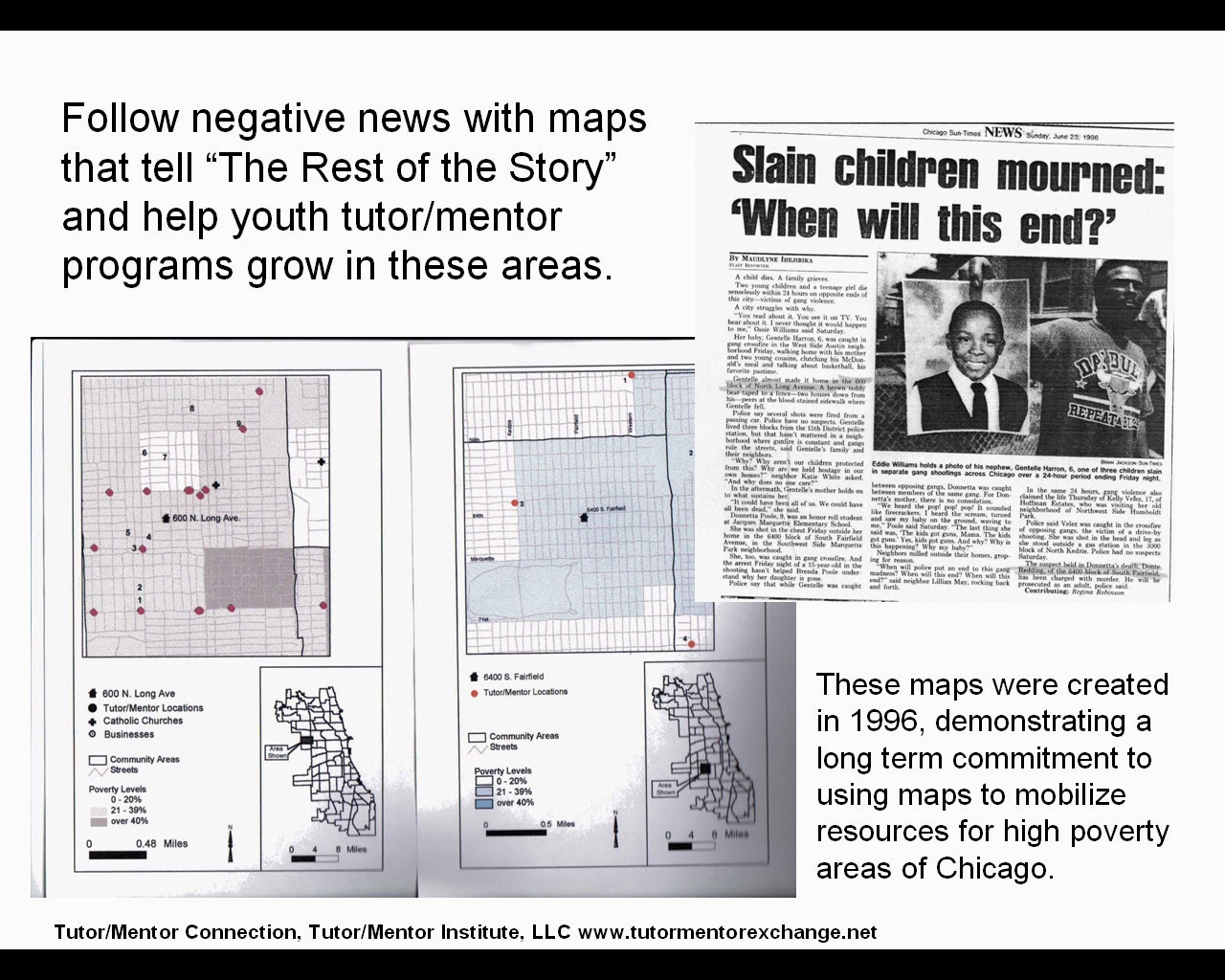
May 5, 2016 - Follow up to Putnam Talk in Chicago.  I included this map story, which was first created in 1996, to illustrate a need to use maps to show the gaps between rich and poor, to show all of the high poverty areas of the Chicago region, and to force (and guide) a distribution of needed resources and mentor-rich programs to more of those neighborhoods.  I also demonstrate using map-stories as part of an on-going effort to draw more attention and to increase the flow of volunteer and donors to individual tutor/mentor programs.  I still don't see any leaders in Chicago using maps this way .

See at this link
March 16, 2015 - Making All Kids "Our Kids".  I've been reading books and articles like those by Putnam and Reeves for more than 25 years, along with other information that focuses on "What are ALL the things we need to know, and do, to help all kids born in poverty be starting jobs and careers by mid 20's".

As I've found articles like "Trickle Down Norms", I started putting them in a library I was building, which was originally intended to support myself and the leaders and volunteers in the single Chicago tutor/mentor program I started leading in 1975. When we formally formed the Tutor/Mentor Connection in 1993 we created an intentional process for finding this information and sharing it with leaders and supporters of tutor/mentor programs throughout Chicago. When we built our first web site in 1998 we began sharing this library with the world, while also finding ideas from other cities that could be applied to building new solutions in Chicago.

See at this link
October 27, 2016 - Understanding and Applying Social Capital Concepts.  Reeves and Putnam are writing about social capital.

In this article I wrote about the difference between the terms "bridging" and "bonding" social capital. This page on the Saguaro Seminar at Harvard University site provides those definitions

In my work, I focus on "bridging" social capital, or social ties that link people together with others across a cleavage that typically divides society (like race, or class, or religion).


There are several more articles that refer to Putnam's book on this blog and many others that focus on learning, network building, media, leadership, etc.  You can't read all of these in one day, or a week. Why not form a learning circle in your business, faith group, college or family, and read and discuss one article a week? Why not connect with myself and each other on Twitter, the way the #clmooc group has been doing since 2013?

Chicago Tribune 1994
This was the front page of a 1994 Chicago Tribune. Note the use of "Kids at Risk" and a MAP and the sub head "240,000 kids in poverty's grip".  I've been pointing to stories like this for many years, but following with a four part strategy that and a leadership commitment that can be used and supported by leaders in Chicago and any other city and state in the country.


I've shared ideas like these, since forming the Tutor/Mentor Connection in 1993, with most of the candidates running for Governor of Illinois, and with the current and former Mayor of Chicago.  Yet, if you visit their web sites you don't see any concept maps similar to those I've shared, nor a mobilization and learning strategy similar to the four-part strategy that I've shared.  You don't see their support on anything I've done. I'm not part of any of their planning committees, nor funded as a consultant to their own efforts.

I wonder if they have read Putnam, or Reeves, or any of my articles.

Nothing will change until more people read, reflect, share and then apply these ideas, and the many resources I've aggregated in the Tutor/Mentor Connection web library, using their own personal, and professional, time, talent, dollars and votes.

Search "Putnam" on this blog to find all articles where I've referred to the "Our Kids" book and talked about bridging and bonding social capital. 

Note: Since 2011 I've kept the Tutor/Mentor Connection operating under the structure of Tutor/Mentor Institute, LLC.  If you'd like to support me, click here for information. 

7-20-2023 update - Read new report showing importance of relationships and intentional building of social capital via organized programs, and funding challenges of creating and sustaining such programs. click here

Wednesday, January 03, 2018

Help Me Help You - podcast

I've been sort of depressed the past few days because my year-end "fund me" campaign was not as successful as last year. Then yesterday Emily Drevets,  @drevets ,sent me the edited podcast of an interview she did with me a couple of months ago.  You can listen to it on iTunes at https://tinyurl.com/DB-interview-iTunes-1-18

Emily is one of the talented people who gather weekly at ChiHackNight which is held in the Braintree offices at Chicago's Merchandise Mart. I've attended off and on for several years (see article) and am constantly thrilled by the talented people who introduce themselves at the start of each weekly event. My wish has been that some of them would do exactly what Emily has done and use their talent to help me upgrade the technology and share the ideas from this blog and my web sites with more people.

Last summer she announced to the group that she was launching a Podcast and wanted volunteers to practice with. I offered and in preparation she took some time to look at my sites. Then she interviewed me via Skype, and then created the podcast, which now shares my ideas with people in her own network.

What makes this special is how Emily asks leading questions or helps create shared understanding of ideas I was sharing in the interview. It makes more sense to others because of the work she did.

If you look at the graphic at the right, Emily and I are the two people to the left of the big circle. Her podcast is sharing ideas I've been putting on this blog and my web sites for more than 20 years.  It's potentially going to reach many people who I don't know, and some of them my create their own blog or video to share it further.

In the podcast I describe the graphic at the right, showing how an idea launched by one person can spread, through the efforts of others.

I feel many can, and should, take this role, not just to support what I do, but to amplify and support the work that others are doing.

I look forward to hearing from some who will listen to this in the coming moths.

Maybe a few of those will go to this page and send some financial support to help me do this work in the coming year.

Tuesday, January 02, 2018

So Many Problems. Building Networks for Solutions

It's a new year, with new hope and opportunities. Yet, the same problems that we faced last year, and in previous years, are still with us.

I created this graphic several years ago to illustrate the many different problems that people face, and the role of people like myself who try to draw people from different sectors into learning, networking, innovation and actions that try to solve one or more of these problems.

For more than 20 years the problem I've been trying to solve is filling high poverty neighborhoods with non-school, volunteer-based tutor, mentor and learning programs that help kids move through school and into adult lives.

I've created dozens of visualizations to help communicate this idea, which you can find in this blog and my web site.  Or do a Google search for "tutor mentor" and add one more word, like youth, or strategy, or mapping. My web sites are often on the first page of the search (at least for me) and if you look at the images feature, you'll see many of my visualizations. With each you can link to a story where that graphic was used.

I've created a huge knowledge base that I keep adding to, which includes a list of non-school tutor and mentor programs operating in the Chicago region.  I show these on maps with the goal of helping people find programs to offer help or to get kids involved, and to show where more programs are needed.

The big problem is attracting people to this information and helping them use it in their own efforts to solve the same problems I focus on, or on other problems which they care about.

That would be a problem if I were a wealthy person, or a celebrity.  I'm not. I'm just a person with a vision and a message and a library of other people's research and ideas.

I've never had much money to do this. I and six other volunteers started the Cabrini Connections site-based tutor/mentor program in 1993 and spent that entire year researching and planning the Tutor/Mentor Connection, which we launched in January 1994. We had no money, nor deep pocketed friends, so we had to raise the money to pay salaries, rent, insurance and other expenses at the same time as we did the work. We started from zero every year and never knew for sure where the money was coming from. Since 2011 I've led the Tutor/Mentor Connection via the Tutor/Mentor Institute, LLC, and I've had even less money, so have kept this work going by drawing down my own savings. That's a recipe for disaster.

What motivates me is the daily reminders of how much kids living in high poverty areas need an expanded network of support and the understanding that "almost anyone can help".


That means that today, or on any other day, someone who might help me do this work is looking for information and will find my web sites. That someone could be a Bill Gates type, or a Jeff Bezos, or someone I've never heard of. They could take time to learn what I've been trying to do, and reach out to say "I will help you with my time, talent, and my money."

While I need help to continue to do the work I do to connect people to information in my web library and to organizations in Chicago and other cities who work directly with youth, the graphic below illustrates how such help is needed in thousands of places.


I've been writing this blog since 2005, so there are a lot of stories. I invite you to browse through these over the coming year and if what I do is important to you, reach out and connect with me on Twitter, Facebook or LinkedIN, and help me draw attention to the resources in my web library and the youth serving organizations already operating in Chicago and other cities.

Help me draw people into conversations that start with a map, and a "how do we fill all of these areas with needed programs?" question.  Or help me find places where others already are leading that conversation and where I'd be welcome.....even as a paid consultant!

If you want to invest, or take a role and carry this forward into the future, let's connect. Or, visit this page and send me a contribution to help me keep doing this.

Thursday, December 28, 2017

Stopping the Violence. Invest in the neighborhoods.

Today's front page story in the Chicago Tribune focused on the increasing use of rifles and assault weapons by gang members in Chicago. It's a terrifying escalation of a long-festering problem.

I've been following these stories for over 30 years, as some of the media stories shown at the left, illustrate.  If you open the "violence" tab on this site you can scroll back through 10 years of stories. In all of these I've proposed non-school tutor/mentor programs as a prevention strategy, not as a stop-the-shooting strategy.

If you're concerned about this problem, here's a web site that provides a running score on the shootings and homicides in Chicago. It's aptly named "Hey Jackass".

While homicides and shootings in Chicago were much higher in the 1980s and early 1990s, there have been a steady flow of shootings and deaths, every year for the past 35-40 years. The violence of the past few years actually distorts a reality that overall, crime is on the decline.

I started leading a non-school, volunteer-based tutor, mentor and learning program in 1975 and continued to lead such programs through 2011. I've always advocated for a program model that drew volunteers from different backgrounds into the program, and into the lives of kids and neighborhoods.  This model depends on programs being able to sustain themselves for many years, so a youth joining in middle school years can stay involved through high school...or for six to eight consecutive years.

That's why much of my four-part strategy focuses on public education and drawing needed resources to programs.

What troubles me is that when a shooting takes place, I have difficulty offering tutor/mentor programs as a short term solution that would motivate a youth to leave a gang, or choose not to pick up a pistol, or rifle, and get in a car with the intent of going out and killing another person.

I created this graphic to illustrate what I propose as a long-term solution, with short term actions.

This arrow shows a timeline of birth to work, which stretches up to 25 or 30 years for some people.  When a shooting takes place, involving a young person between the age of 16-34 (with victims much younger and much older), the immediate response is triage. How do we get the guns off the street? How do we get kids out of gangs? Or how do we get gang members to stop shooting, wounding and killing each other? How do we heal the wounded, or counsel the relatives of the dead? How do we help kids focus on school and their future when they don't know if the next stray bullet will hit them?

That's the yellow highlighted portion of this timeline.

Dr. Gary Slutkin and CureViolence offer an answer with their program.


A popular solution is the MyBrother's Keeper program supported by President Obama and Youth Guidance


Earlier in 2017 I pointed to a WBEZ story about the cost of a jobs program targeting boys and men in high violence neighborhoods.  Read it here.

However, if we only invest in programs focusing on the people in the high risk pool, or in gangs and the justice system, we're going to be dealing with this problem many years from now, because we've not put in place a prevention strategy intended to reduce the number of young people who go into this risk group.

On the opposite end of my timeline are advocates for robust pre-school programs (highlighted in light grey).  Dr. James Heckman, a Nobel Prize winner in Economics, posted this Tweet, saying the "achievement gap starts at birth".

Voices For Illinois Kids has been an advocate for early childhood programs since the 1990s.  I encourage you to dig through their web site to find ideas and resources. Look at the data offered in the KidsCount data book, published annually.

If we build strong pre-school programs and strong re-entry and opportunity youth programs, we've addressed both ends of this problem, but still need to address the support kids in high poverty and distressed situations need from first grade through high school, post high school and into adult jobs and careers.

In the hub-spoke graphic I posted above, I describe a strategy where a youth program, or a school, are places where kids connect with adults, experiences and support systems that extend far beyond what they normally see in their family or neighborhood. This strategy presentation (PDF) visualizes that idea and shows the role of business and professional groups to help make such learning opportunities available in every high poverty neighborhood.

In the Tutor/Mentor web library you can find links to dozens of different types of youth serving organizations. Each could provide ideas that might be duplicated in other places. You just need to spend time looking at these sites.

I've been writing stories like this for more than 20 years, but too few people are reading and responding. Thus, I'll end with another tweet, where a young Chicago women is calling on adults to provide the resources kids need to grow up safely and become part of the American dream.


I hope you'll take some time over the next few weeks to open the links, view the videos, and then share this and other articles I write with people in your own networks, in Chicago, and in other cities throughout the world.

Note that in the graphic I posted above I included a map showing poverty in Chicago. Here's a different version. Youth support systems need to be fully available in every one of these neighborhoods. You can't have some pieces on the North site, some on the West side, few on the South Side, etc. and expect the system to deliver the outcomes you want.

It will take the consistent, long-term involvement of people from many sectors to build and sustain this system and make it available in every high poverty neighborhood of every city and state in America....as well as in other countries.

Ideally, people would have started building this system 25 years ago. The next best time to start is NOW.

12-11-18 update - gun violence in Philadelphia - web site.  The ideas I share can be used in any city, because every city has some of the same problems

12-11-18 update - gun violence articles on MappingforJustice blog

If you value what I write please make a contribution using the PayPal button on my "go fund me" page. Click here.


Saturday, December 23, 2017

Work Together To Solve Chicago's Problems? Maybe. Common Goals? Yes.

I've been seeing some high profile community leaders post articles calling on people to "work together" to solve problems of Chicago. While this sounds right, the reality is that there are too many problems,  in too many places, and too many of us to be all "working together".

Put your name in the BLUE box.
Instead, I invite leaders, and individual citizens, to frame a vision for solving any of Chicago's complex problems, that is big enough for many, many people to provide time, talent and dollars, individually, or in groups and collaborations.

This strategy map is one vision that I'd like many leaders to adopt. If you read from the top blue box it says "my vision is".... Here's an article where I zoom into different sections of this map. Most of the articles on this blog and on the Tutor/Mentor Institute, LLC site provide ideas that people and organizations could adopt to achieve this vision.

On the right side of the above map you'll see a box that says "in comprehensive programs". If you open the link you'll see the map at the right. This shows that at every age group kids need a wide range of supports. Most of these are naturally occurring in affluent communities. Many are not readily available in high poverty neighborhoods.

It's the role of organized programs to help make more of these available.

It's the role of donors, policy makers and business leaders to make good programs available in every high poverty neighborhood.


I've been using maps since 1993 to focus attention on all of the neighborhoods of Chicago (and now its suburbs) where concentrated poverty makes life difficult for youth and families.

What makes "let's all work together" unrealistic is that groups of people need to adopt different neighborhoods and work to make needed youth supports available to kids from when they are born to when they are starting jobs and careers, and then until they are able to choose where to live and raise their own kids.

Piloting strategies in one or two places, or supporting one or two high profile programs, leaves generations behind. We need a cavalry charge supporting problem solvers in every neighborhood, with a learning strategy that connects us in ways that we're constantly learning from each other.

How do we mobilize and/or empower people, teams, groups, organizations, etc. to help make this happen?   I wrote about this last week in this article.

As a matter of face, I've written about these ideas hundreds of times since starting the Tutor/Mentor Connection in 1993 and the Tutor/Mentor Institute, LLC in 2011.  Unfortunately, too few are listening and too few are helping. It's not too late. You can start reading through these articles at any time.

Many say the new tax law will remove the motivation for many to make tax deductible donations to non profits.  I think this is a test for our society. Do we help poor people and people with disabilities or health disparities because it's the right thing to do, or because you get a few dollars back from your donation?

I've not had a 501-c-3 tax status since 2011, but I'm still doing work I started in 1993, and still dependent on others for help.  Because I'm no-longer a 501-c-3 organization, my level of donations have dropped to just a few thousand dollars a year. Yet, those people who have continued to provide $100 to $750 a year have done so because of what I'm trying to do, not for the tax deduction.

If you'd like to join them, click here and use the PayPal button. You can do this at anytime of the year. You don't need to wait until you're preparing your taxes.

However, you don't need to support me to use the ideas I share and apply your own time, talent and dollars to help solve complex problems facing your community. 

Wednesday, December 20, 2017

Black Families Fleeing Chicago - Ending in Segregated Suburbs

An article in the current Chicago Reporter shows how thousands of Black families are leaving Chicago, but only are ending up in the suburbs, with some of the segregation and problems of poorly performing schools that they are trying to escape.

The map at the left was created in 2007 when we held a Tutor/Mentor Leadership and Networking Conference in the South Suburbs at the Olympia Fields Country Club.  This article shows our goals then were to find leaders who would adopt Tutor/Mentor Connection strategies and help non-school, volunteer-based tutoring, mentoring and learning programs grow in these areas.

Had leaders stepped forward to take this role the areas kids are moving to might have more support systems in place than they have now.  If leaders step forward in 2018, perhaps the systems of support available in 2018 will be much stronger.

It does not happen over night. There are no quick fixes.

Visit MappingforJustice blog and find additional articles about poverty moving to suburbs. click here

Update - 10/23/2019 - article in The Economist titled "American poverty is moving from the city to the suburbs".  This article says "there are now more poor people in Chicago’s southern suburbs than in the city itself." and "Unlike urban poverty, which has long been associated with destitute blacks, suburban poverty is more pronounced among poor whites and Hispanics." click here to read

Update - 6/18/2020 - #PovertyNarrative conference (on-line) hosted by University of Michigan includes researcher talking about poverty in the suburbs. In this Tweet I point to her research.


Sunday, December 17, 2017

What Do We Need to Do to Achieve this?

As we move into 2018 I want to focus on two ideas that I've championed for more than 20 years, but without much traction or support.

This graphic represents the first:

This concept map shows supports kids need at each stage of schooling as they move from pre-school toward adult lives, jobs and careers.

Mentoring Kids to Careers - support needed for 12-16 years
We all know how architects and engineers use blueprints to show all the work involved in building a building or an airplane. Consider this concept map a blueprint for what help kids need as they grow up. Most kids have these supports naturally within their family and community. However, kids living in high poverty have fewer natural supports, or family and community wealth, thus it's up to others to help make these supports available.

Don't agree with my concept map? Create your own. Share it. We can learn from each other.

Here's the second idea. Below is a map of Chicago, created a few years ago. The shaded areas are high poverty neighborhoods.


I led a single volunteer-based, non-school, tutor/mentor program serving 2nd to 6th grade kids in one Chicago neighborhood from 1975-1992 and created a second program in 1993 to help these kids move from 7th grade through 12th grade and beyond. I led that till mid 2011. As we created the new program in 1993, we also created the Tutor/Mentor Connection (T/MC), to help our program, and similar programs throughout the Chicago area, get the resources each need to constantly improve and stay connected to youth and volunteers over a multi-year stretch.  

Since 2011 the T/MC has been part of Tutor/Mentor Institute, LLC.  Same goals. Just different funding structure. 

The T/MC started using maps, like the one above, to show where our single program was located, and to show where other programs in Chicago were located, using overlays of high poverty, poorly performing schools, and incidents of violence, or health disparities to show where these programs were most needed. Browse articles on the MappingforJustice blog, written since 2008, to see uses of maps. Click here to see a current map and list of Chicago area tutor and mentor programs.

Here's the question I've been asking for 20 years. If we know what supports kids need, and understand how organized programs help create greater access to some of these supports (like a local grocery store provides access to fresh food), then what do businesses, foundations, volunteers, donors, policy makers and others who don't live in high poverty areas need to be doing on a regular basis to  help local community leaders fill every high poverty neighborhood with the entire range of needed supports?

An engineer or an architect knows that if you leave out one or two components, like wiring for the 4th floor, or a few screws in the side of an airplane, the end product is not going to work. Without building a full range of supports for kids in every high poverty neighborhood why should we expect different outcomes than what we're getting?

While my maps primarily show Chicago, similar maps need to be created that show other cities and regions of the US....and the world.

The only way to show that you've an answer to my question is to put a map on your web site showing where you're providing resources to support needed programs in one or two neighborhoods, or an entire city, along with a concept map, or blueprint, to show all of the supports you think will be needed as each youth moves from birth to work over a 20 to 25 year period.

I've been building a web library for over 20 years with links to programs operating in Chicago and other cities, as well as links to research and to process improvement, innovation and collaboration sites. Send me links to show how you're bringing people together to discuss these ideas, or that show solutions you and others are already implementing. I'd be happy to add them to the library so I and others can learn from what you are already doing.

If you value this idea and my web library and maps, become a patron and support my work. Visit this page and use the PayPal button to contribute.

Thursday, December 14, 2017

Hey Mr. Rich Man, I'm Over Here

I read an article yesterday about multi billionaire Jim Simons and a think tank he has created to support work that benefits society. As I read it I recalled this graphic, which I first shared in this 2014 article.


Simons and other wealthy people have begun setting up "institutes" where talented people work on complex problems.  In Simons' case, he's not creating new raw data, but is digging deeper into data collected by others.

I've been doing something similar for the past 24  years, but with less than $150,000 in my best year and with almost no money for the past six years.

I created the Tutor/Mentor Connection in 1993 with the goal of "gather and organize all that is known about successful non-school tutoring/mentoring programs and apply that knowledge to expand the availability and enhance the effectiveness of these services to children throughout the Chicago region.".


This map shows four sections of the web library I've been building since 1998.  Click on the box at the bottom of any of the nodes on the map, and a new map will open, with links to sub sections of my web library.

At the heart of this library is a list of Chicago area non school volunteer-based tutor, mentor and learning programs operating in different parts of the city. Click this link to see the map and list of programs.

While I've been building a list, I've not had the resources do dig deeper into this information. However, by sharing this online, anyone could be taking a role of building a deeper understanding of what these programs do, what works, what does not work, what could be improved, what the challenges are, how could they be overcome, etc.

My Chicago Tutor/Mentor Program Locator and list of Chicago programs can be found in one section of the library I've been building. The other three sections, the larger part of the library, consists of links to articles and web sites of others involved in helping kids, or of solving complex problems.

In the mission statement above I wrote "collect all that is known", which is an on-going process. We'll never have "all that is known" but we can have much more than most people have at their disposal. By aggregating this information, others can learn ideas that people are applying in some places and find ways to improve them, and apply them in many other places. When we have access to a wide range of descriptions of the problem and of potential solutions, we can make better decisions and hopefully build and sustain stronger solutions.

Collecting this type of information, making sense of it, and  helping others find and use it would be the role of the team that a billionaire might fund if they were to create a Tutor/Mentor Institute in their name and support it's growth the same way Simons is supporting his research institute.


Collecting information is just the first step in a four part strategy that a billionaire might support, which I've piloted since 1994.    In this map I show the four steps, and point to  work needed to make each step work more effectively.

A well funded institute could not only make better sense of the data, but do much more to recruit other wealthy supporters, and to draw resources to community led initiatives in every neighborhood who are using the information and resources to do work that helps kids and families overcome the many challenges of poverty as they move more successfully through school and into adult lives, with jobs and careers, and laws, that enable them to raise their own kids with fewer of these challenges.

While a wealthy man or woman might create a stand-alone institute, he/she might also endow a Tutor/Mentor Institute on one, or more, college campus, where student-led teams might apply the T/MC strategy to support the growth of mentor-rich non-school programs in the area around a university, or in neighborhoods where students come from. Read more about that.

A first step of any group should be to spend time reading what I've been posting in printed newsletters, web sites and blogs for the past 23 years, so they know what I'm describing and are better able to improve it over the next 20 years.  I will coach that process as long as I'm still alive.

In the short term, if you want to help me, visit this page, and send a contribution.


Monday, December 11, 2017

Building teams to support youth tutor, mentor & learning programs in multiple places

I've been sharing ideas that are intended to help volunteer-based tutor/mentor programs grow in high poverty areas for nearly 40 years. My goal has always been that the people who receive my messages will then pass the idea on to people in their own networks. If this were working effectively, people from throughout Chicago, the U.S. and the world would now be using these ideas.

For the past week I've been trying to create a presentation showing how teams of volunteers from business, faith groups, colleges and national organizations like Teach For America, Rotary Club, etc. could be doing planning intended to support tutor/mentor programs in cities where members live and work.  I uploaded that to Slideshare today and you can see it below.


I am not totally happy with this yet. I'm sharing it with the goal that others might create their own version and tell this more effectively than I do. At the same time, I'm seeking web sites showing how this process may already be taking place in different parts of the U.S. or the world.

Below is a video I created last  year to show an animation done by interns in 2010-11.


In the video I repeat the invitation above. Students and/or volunteers from many different places could create versions of this and other visualizations that I've launched over the past 20 years, with the same goal as I have.

Interested? Make my holiday great by sending me your own interpretation of this or other articles I've posted on this blog, or by sending me links to web sites that describe how others are already engaged in this type of work.

Monday, December 04, 2017

Applying Public Health Strategy to Support Youth in Poverty

The Democracy Collaborative is hosting a Hospital Anchor Network Convening in Chicago this week.  I've been interested in hospitals as leaders in building and sustaining networks of mentor-rich non-school programs in their trade areas since learning about the Hospital Youth Mentoring Network in the late 1990s.

I created this concept map to point to some of the articles and resources that I've collected and shared, with the goal that hospital and university leaders would become anchor organizations, and include a Tutor/Mentor Connection component in their strategies.

Open links at bottom of each node and dig into these resources

At the top of this map are ideas I've shared and links to articles I've posted on this blog since 2005. There's also a link to articles about the Hospital Youth Mentoring Network, which was active in the 1990s, but I don't think has been active, as a network, since about 2003.

At the bottom are some new resources, from the past few weeks.  One points to one page of a presentation by Marcella Wilson, PhD, who spoke at an event in Chicago hosted by Advocate Children's Hospital.  Marcella talked about "Treating the condition of poverty with a client centered community based continuum of care."  She talked about "understanding and treating the condition of poverty" using the same condition-specific practices that health care providers use.  Dr. Wilson speaks of "HOPE" as one of the most important medicines we can give to the youth and adults we work with.

I've a link to her book on the map.

The map also includes a 2010 video, in which "Jeff Duncan-Andrade draws from Tupac Shakurs powerful metaphor of the rose that grows from concrete, as well as research in fields such as public health, social epidemiology, and psychology, and explores the concept of hope as essential for developing effective urban classroom practice."


The map also includes an animated video that shows poverty as a river with many contributing streams and talks about hope, and the upstream roles that social entrepreneurs can fill, to reduce poverty and inequality and turn the river into a flow of "enough".  I found it on Facebook, created by Amanda and Brandon Neely, social entrepreneurs of own the Overflow Coffee Bar in Chicago and lead a support program for social entrepreneurs.

That's a lot to look at, but the condition of poverty is not something that can be solved without doing some deep thinking and on-going learning.

I won't be attending the the Healthcare Convening this week due to lack of funds (and no invitation). However,  my long-term friend, Steve Roussos, from Merced, California, will be attending .  Steve was doing PhD work at the University of Kansas when he introduced himself to me in the late 1990s. This led to him becoming a speaker at several Tutor/Mentor Leadership and Networking Conferences between 1998 and 2002 and to creating Tutor/Mentor Connection's on-line documentation system that I used between 2000 and 2013.

the circle is "information

My role since 1993 has been to gather information, such as the articles I've pointed to in my cMap, then to take actions that motivate more people to look at the information, and to build understanding, via various forms of discussion and facilitation.

Steve and I had dinner last night and I told him  how I'd learned about on-line annotation from a network of educators who I'd been meeting on-line since 2013.  I used this Jan 2016 article to show some of these annotation tools, and demonstrate their use by the #Clmooc network.

Imagine if organizers of this week's event were putting presentation documents on-line and encouraging people at the event, and those who are not there, to do joint reading and discussion in the margins.

That's today's #Monday Motivation from the Tutor/Mentor Institute, LLC.   I've been sharing these ideas for over 20 years and wish leaders from every sector had been reading them regularly and had been applying the ideas since 1994.

However, if you did not plant that tree then, now's the next best time to start.

Maybe in 20 years treatment of the condition of poverty will be much more sophisticated and fewer people will be dying or losing their futures as a result.

8-26-2018 update - here's related article titled titled "Bringing Together Resources Students At Risk Need to Succeed".

3-5-2021 update - University of  Michigan Poverty Narrative panel discussion on Confronting Inequality in Public Health. Panel discussion on YouTube.  The video breaks at several points but the audio is fine. Worth listening to. click here

4-2-2021 update - Redlining and Neighborhood Health - National Community Reinvestment Coalition article. click here

12-2-2021 update - The Future of the Public's Health - article on Deloitte Insights website. click here