Wednesday, December 15, 2021

Cabrini-Green - Broken Promises

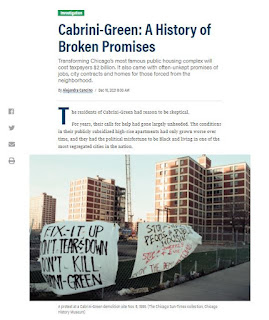
This story about Cabrini-Green was published today by the Better Government Association (BGA).  It tells of the re-development of the Cabrini-Green area of Chicago and the broken promises that government leaders made to residents who lived there before the development began.  Click here to read.

4/20/2022 update: Alejandra Cancino, the author of the BGA report spoke at the 4/19 ChiHackNight event. The video will be found here in a week or two. 

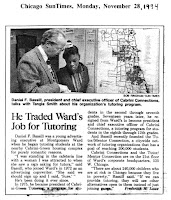
I came to the Cabrini-Green area in 1973 to be a retail advertising copywriter with the Montgomery Ward Corporate Headquarters, bordering  Cabrini-Green's West border.

I joined the company sponsored tutoring program that fall and was matched with a 4th grade boy named Leo Hall. A year later I became part of the volunteer leadership team, and in 1975 I became the program's volunteer director. I led this program until 1992 then formed a new version, called Cabrini Connections, which I led from 1993 to 2011.  

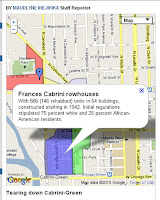
The map of Cabrini-Green, shown at the right, was part of a story I wrote in 2010 about the re-development of the area.   I talked about the promises that were being made and the prospect of them not being kept.

Below I show the front page of the Chicago SunTimes, from October 1992, following the shooting of a 7-year old boy in Cabrini Green.  The headline reads "7-year old's Death at Cabrini Requires Action".


I've kept a copy of this story for the past 32 years as a reminder of the commitment I and others need to make to kids born or living in high poverty neighborhoods of Chicago and other parts of the country.

I've used it in many blog articles, such as this from 2008,  encouraging others to get involved. 

Today's BGA story reminds me to repeat this call to involvement.

As we formed Cabrini Connections to help a small group of teens, we created the Tutor/Mentor Connection to help a city full of kids living in high poverty areas. I've used maps since 1993 to emphasize the need for investment in every high poverty area, not just the Cabrini-Green area.

Thus, the broken promises that affect kids and families who once lived in Cabrini Green, are broken promises affecting thousands of people.

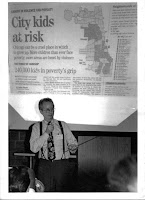
Look at the photo of me standing in front of a map, with a microphone in my hand.   Then look at this article with a map in the background. 

If you read my blog articles or some of the printed newsletters from the 1990s, you'll see a constant invitation for others to take a lead, sharing the same call to involvement, using their own media, talent and visibility.

As we head toward Christmas, remember how Jesus recruited 12 disciples and told them to go forth and multiply.   I've been trying to have the same influence for many, many years.  

Today's story is just another reminder that we've a long way to go. 


I'm not the only one working to help kids and families in poverty areas, not the only one calling for others to be involved.  But I'm one of the few using a map of Chicago and calling on people to support tutor/mentor and youth development programs in every high poverty area, not just the program I led in one small part of Chicago.

We need more leaders using maps like this, to draw people they know to places where those people can help. 

Use my articles as a template. Then create your own.


Thursday, December 09, 2021

What you don't see when you visit a Tutor/Mentor Program


Every year about this time between 1990 and 2010 I was writing grant requests, hosting site visits, and writing final reports to gain the operating dollars needed to support the annual activities of the site based tutor/mentor program I led in Chicago called, Cabrini Connections, and the Tutor/Mentor Connection, which I now lead through Tutor/Mentor Institute, LLC. 

It’s amazing how many people assume that getting teens and volunteers to Cabrini Connections each week was a simple process, and wanted to focus on how many kids are now college graduates because of the $5,000 to $25,000 they have provided in the past year. 


In October 2008 I thought I’d write and article to reflect on this. That article is posted below, with some updates.  


I called it “Below the Ice” because when you see an Iceberg, all you see is what’s above water. Most of it is below water and out of site. When you see a student and volunteer meeting at Cabrini Connections on a Tuesday or Wednesday evening, you'd you see what was happening for these two hours. You wouldn't see the infrastructure and program support it takes for the student and volunteer, or Cabrini Connections, to simply be here to make this connection.

So, what are we not seeing, or taking for granted?  This is a long article. In the first section I write about the thinking that goes on to make a program like this available to kids and volunteers.  

In the second section is a list of elements that must be in place to support this process. 

a) Someone had to make a commitment to start this organization, and keep it going. Cabrini Connections was not created by some government initiative, with a bundle of up-front dollars. It was started in October 1992 by seven volunteers who saw a need. They created Cabrini Connections to provide a 7th grade through high school support system for kids who were aging out of the 2nd to 6th grade Montgomery Ward/Cabrini Green Tutoring Program. They had no money. They had no space to operate. During the spring of 1993 there was no paid staff, and volunteers and kids met each week in the day-room of St. Joseph’s Church on Orleans Street in Chicago, and once a week at Wells high school.

b) Space is needed. We operated from the dayroom of a church for the first six months of 1993. Then the Montgomery Ward Corporation donated an entire floor of their corporate tower (almost 20,000 sq. ft. of space), along with desks, cabinets, parking and security. We operated from there from August 1993 until June 1999. Then we moved to rented space as Wards went out of business. We actually spit into two buildings, 8 blocks apart. The Cabrini Connections program operated at Holy Family Church on Larrabee, while the T/MC, and Fund Raising, operated from a room at 1111 N. Wells. In 2001 we moved into our current 4,000 sq ft location at 800 W. Huron, just a few blocks from Cabrini Green. 

While we had donated space we could devote all funds raised to our programs. And we had a $40,000 annual grant from Wards. This really helped us get off the ground because in 1993 we only raised $50,000 and in 1994 we only raised $114,000. Without the help from Wards the program would never have built any kind of following. However, since 1999 space, utilities, and insurance expenses were over $70,000 per year. This was a fixed expense that was necessary for us to continue to offer the program to kids in Cabrini Green. Without funds for the space, insurance, equipment and utilities there is no program.

c) If you want good results, you involved talented people. Volunteers can do tremendous things. I led the tutor/mentor program at Montgomery Ward for 15 years while holding a full time retail advertising job. We had more than 300 kids and 300 volunteers participating by 1990. We had nearly 50 volunteers involved in various leadership roles. Many of these volunteers came from companies beyond Wards. However, to support this type of volunteer involvement I spent my lunch, evening and weekend hours, plus at least one week of vacation each year, doing the work of leading this organization. I had tremendous freedom to take phone calls and work on this during the day, as long as my own work was being done to an outstanding level.

And while we did a great job of keeping kids and volunteers connected, I think we could have done much more if I or another leader had been able to devote 40 to 50 hours a week on this. At Cabrini Connections the glue that keeps the kids and volunteers coming is the lead coordinator, who is a paid staff person. In 2008 we had 70 kids and more than 90 volunteers participating weekly and a more than 400 alumni. We had two full time staff people, one full time e-learning coordinator, and myself. To keep the lead coordinators in place we needed to reward them with decent compensation and benefits, and try to surround them with extra help (staff and volunteers) so they don’t burn out and leave after a couple of years.

d) Volunteers are critical to success of this organization; but they need support, too. We have volunteers in a variety of leadership and organizing roles, not just on the board of directors. Many of them have been involved for five or more years. They represent the organizational knowledge, in addition to my own. However, these lead volunteers need to be recruited, supported and mentored by our lead staff.

e) Volunteers are customers. The need to be recruited. They are not standing in line waiting to be your tutors and mentors. The best way to recruit new volunteers is to provide a great experience for your current volunteers. We started with seven volunteers in October 1992 and added new volunteers each school year from 1993 till I wrote this in 2008. We grew Cabrini Connections, and before that the Montgomery Ward/Cabrini Green Tutoring Program, by converting volunteers into ambassadors who go out and recruit other volunteers. Many of these people are also recruiting the dollars we need. However, this is not something that happens by accident. It takes lots of time, and a consistent effort to provide a well-organized experience, and to mentor volunteers as they attempt to build relationships with kids. It takes a constant external communications (see below) to attract new volunteers to replace those who leave the program during every year.

f) Kids are volunteers, too. This is not a court mandated program, or a program for failing kids who are sent here by schools. We focus on kids who can succeed in school and life if they just get the support the need to overcome the obstacles poverty put in their lives. These kids did not start Cabrini Connections. Our founders saw a need and invited kids to participate. Each year our customer service intends to provide an experience that motivates kids to come back each week, and each year. Each year our outreach aims to recruit new students who don’t know about our program, but might participate if given the chance.

g) Our volunteers are the CEOs of this effort, not the staff. Each volunteer is different and each youth is different. The strength of a one-on-one program is the ability of a volunteer to tailor his/her mentoring and tutoring to the needs of the student and the talents and time available from the volunteer. The longer someone stays involved, the more experienced and effective they become. And while 25% of our volunteers will stay 3 or more years, many only stay one year, and some do not complete their first year. This means the volunteer work force is in constant need of mentoring and coaching from other volunteers and from experienced staff.

h) Finding space, finding staff, setting up a structure and a recruitment campaign to get kids and volunteers to participate is just the beginning. Each week during the school year there is constant follow up and coaching of each student/mentor pair. There is constant planning to develop activities to support the weekly tutor/mentor sessions. There are mountains of details required to track attendance, keep information current in databases and on email lists, and to stay in touch with parents, teachers, social workers, as well as volunteers. There are new volunteers to be interviewed. There are 70 kids, and 70 different sets of personal and family issues to deal with each week.

i) Communications is hard work and takes time. Creating the training materials, writing the weekly email newsletter, maintaining the web site and on-line documentation systems, and creating brochures to recruit new students and volunteers requires time and talent. The less talent you have at writing, the longer it takes to write a letter, or a brochure. We are required to multi-task because we only have 3 people. Yet, if we do not provide these communications, we cannot mentor and guild the process of our kids and volunteers.

j) Does it work? We say kids and volunteers vote with their feet. Thus, if they come most of the time (80% is our goal), and most return from one year to the next (kids goal: 80% return; volunteer goal: 65% return) then we feel they are telling us that they like what we are doing. However, donors want to know more. What impact does this have on grades, test scores, social and emotional behavior. We can say from observation and feedback that it benefits some kids more than others and that some volunteers have had life changing experiences because of their involvement. That’s enough to keep me working on this every day.

However, we can’t quantify this via traditional research and evaluation. Why? We barely have the manpower to do what we’re doing. That’s why.  Furthermore, the impacts of this type of mentoring are long term. The benefits accumulate over time. An evaluation would need to cover many years and extend into the years after kids have finished high school to paint a true picture of our impact. Such research is not being done in very many places because most programs have the same problem we have of not being able to stay connected to kids or volunteers once they no longer attend the program.

(visit my page on Facebook and look at my friends list. Many are alumni. If you look at the posts on their own timelines you'll see stories of their success, and the success of their own children who are now finishing high school and entering college.)

k) The money does not come out of thin air. It took six months to find donated space at Montgomery Ward, along with a $40,000 grant, that enabled the program to hire part time staff, and purchase needed office equipment. Every year since then, the organization has started the new fiscal year (Jan. 1) needing to raise all of the money for the program’s operations (rent, utilities, insurance, staff, etc.) as they also provided coaching to kids and volunteers. During the 10/7/08 Presidential campaign debate one question asked was “what level of sacrifice will you ask from Americans”. I don’t think either candidate answered that question. If you read my blog I think that for there to be programs like Cabrini Connections in hundreds of places, lots of people are going to need to go beyond 2% annual donations, and a few hours of volunteering. Our men and women in the armed forces give 100% for our freedoms. Each person needs their own personal barometer, but hopefully our leaders can light a fire so some people will go beyond the call of duty for citizen service.

l) And we cannot attract donors without good communications and consistent outreach and evidence of impact. Many larger non profits have full time development directors and staffs with many people. They can farm out creative work to ad agencies and creative services because they have the money to do that. One potential donor, who was worth about $500 million, once asked me why I needed to spend $70,000 a year on fund raising. He said his charity did not need to do that. He could just call someone and get the money they need. He gave me $1,000 one year and nothing after that. My budget for Cabrini Connections was about $200,000 in 2008. How did he think we were finding the other $199,000? If we’re spending all of our time coaching kids and volunteers, where do we find time to market and do fund raising?

m) The answer would be to have people with high net worth adopt Cabrini Connections. Then they could call themselves up each year and say how much good work we are doing, and ask for a donation to cover the budget. A CEO of a real estate company once said “that’s a tax deduction” when talking about the $4 million it would take to purchase a building for our operations.

n) Another answer would be to build a network of 1000 people with modest means who would each provide $250 per year to support the program. That has more potential. $250 is really just $5 a week, or, maybe the cost of one latte at Starbucks each week.  Is the potential future of an at-risk child worth a cup of java to you?


What Basic Conditions need to be met, to attract students and volunteers to a site based tutor/mentor program?

Listed in order of priority are the organizational needs that had to be met each week for CABRINI CONNECTIONS to maintain the high quality level for which it has earned a reputation of excellence.

1) Create positive environment for tutors and students to spend time together. 

    • Clean, orderly area (70 desks, 100 chairs)
    • Pencils, paper, calculators, scissors, attendance lists, and other needed supplies stocked in cabinets
    • Learning resources, such as library, worksheet binders, and geography materials in place and orderly.
    • Coffee and snacks in stock and prepared for distribution. 

2) Provide a structure and support that offers an opportunity for a satisfactory experience. Focus primarily on tutors because if volunteers were to stop coming, the program would not survive.

    • Annual evaluation, review and plan which incrementally builds on previous year accomplishments
    • Regular communications program (newsletters, email, blogs, web sites, bulletin boards, etc.)
    • Informational and historical record (Annual Report, brochures, etc.)
    • Information on community resources, field trip activities, etc.
    • Motivation activities such as parties, field trips, and writing contests

 3) Provide a broad base of resources from which individual children and tutors can build activities.

    • Library, with reference materials and motivational activity worksheets 
    • Internet Library with home work help, suggested activities, tips for tutors/mentors, networking opportunities.
    • Student history file with report cards
    • Teacher referral forms from local schools
    • School supplies, learning resources, library
    • Computers, with dedicated work area
    • Speaker/Role Model Program
    • Field Trips to business and college sites
    • Parties and informal social gatherings for kids and volunteers 

 4) Ensure frequency and consistency of participation. Focus on student attendance because if students come inconsistently tutors will eventually stop coming. Focus on tutor attendance to improve relationships and quality of tutoring/mentoring children receive.

    • Preparation of weekly attendance record, with volunteers to do check in
    • Maintenance of tutor and student address data-base with up-to-date info
    • Tutor contact network with weekly follow-up
    • Weekly calls and letters to children with 2+ absences
    • Perfect attendance recognition and reward for 10 weeks without absence
    • Recognition for volunteers with 90% or better attendance
    • Marketing and maintenance of Point Bank system

5) Provide training and other motivational resources to enable tutors to have more satisfying and effective experience.

    • Written Handbook, plus regular handouts
    • Organized training sessions (Orientation, Fall Workshop, Jan. Workshop)
    • First Year tutor orientations every 6 weeks
    • Encourage participation in program committees and after-tutor activities
    • Files full of math and language-skills worksheets, to be used as individual lessons
    • SVHAT20 on-line support system for students and volunteers

 6) Provide direct service benefits to children.

    • Safe environment in which to interact with caring adult.
    • Role models to spend time with
    • Extra learning activities such as arts, technology, writing clubs
    • Computer and Internet access for homework  help, networking, communications with volunteer
    • Learning materials (books, pencils, reference books, dictionaries, etc.)
    • Books to check out and take home to read.
    • Snacks at sessions
    • Experience and enrichment activities (field trips, etc.)
    • Parties, with gifts and treats 

 7) Involve parents in tutoring activities and children’s education.

    • Parent Orientation at start of year
    • Involvement of parents in weekly sessions
    • Informational literature provided through program
    • Auxiliary parent-education programs on subjects such as nutrition, or reading to children at home

8) Involve teachers and social workers in tutoring activities and children’s education.

    • Teacher and Social Worker  Orientation or Introduction at start of year
    • Involvement of teachers and social workers in developing mentoring and tutoring strategies
    • Informational literature provided through program
    • Report Card permission from parent so school can release information directly to program
    • Coach volunteer to contact teacher or social worker directly

 9) Involve business in tutoring and mentoring activities and children’s education.

    • Through the Success Steps engage business in providing training programs to prepare students for work
    • Create a pool of part-time and summer jobs for qualified students, at companies which commit to also “mentor” students while on the job
    • Create scholarship pools from Success Steps companies which help student obtain advanced education.
    • Invite businesses to Career Day activities
    • Teach volunteers to be ambassadors for tutor/mentor within their company or industry

The leaders of Cabrini Connections needed to be thinking about all of the things listed above, every day, every year. Finding people who understand this, and can recruit volunteers and donors to help do some of the work, and who can relate to kids and families, and who will stay with this five or ten years, is the biggest challenge we faced. 

We can overcome part of this challenge if we can find donors who understand what's under the surface and who will help us have the operating dollars to try to make this type of program available to teens in this part of Chicago.

If you've read this far, thank you.  I led this process every year from 1975 until mid 2011 (as a volunteer from 1975 till 1990).  

The original program I led is now Tutoring Chicago.  Cabrini Connections became Chicago Tutoring Connection around 2013. Sadly, they stopped operating around 2023.  They and each other youth tutor/mentor program in the Chicago area need your contributions this year, and every year. 

If you lead a non-school youth program, what are the elements that make your volunteer-based tutor/mentor program a success. Do you share this on your web site so others can learn from you?

What I described above only showed work we did weekly to operate our youth-serving tutor/mentor program.  At the same time we were working to make our program successful, we were trying to help more than 100 similar programs located in different parts of Chicago get the ideas and resources each of them also needed. And we were trying to build and share a library of information that our volunteers and leaders could use, as well as leaders from other programs.

We were doing that with no more than 2 full time staff. 

I only am responsible for the Tutor/Mentor Connection now, via Tutor/Mentor Institute, LLC. This blog is one of the resources I use to share information others can use.    While I no longer lead a direct service program I share my 35 years of experience in posts like this to help other programs grow throughout Chicago and in other cities and states.

Feel free to borrow and share the ideas.  

If you'd like to connect I'm on Twitter, Facebook, Instagram and LinkedIn.  

If you'd like to help, see my FundTMI page, or my 75th Birthday page. 


Friday, December 03, 2021

Building long-term mentoring support

 Former President Obama is in Chicago today.  I saw a Tweet showing that he made a surprise visit at a South Side YMCA.  It prompted me to create the graphic shown below.


The former President's visit gets a lot of attention, but it is just one small dot on the 12 year timeline from 1st grade through high school, or the even longer timeline of birth-to-work.  


If kids live in areas of highly concentrated, segregated poverty, there are too few people in their lives daily modeling all the careers they might have when they are adults, and helping them do the work every day to reach those careers.

I'd love to see a blog by President Obama where he talks about his visit, and then shows a map like the one on the left, and says, organized non-school programs that connect kids and volunteers from many industries and professions need to be in every high poverty area of Chicago, for many years.

Maybe more people would listen and begin to figure out how to make such programs available and keep them in place for 10 to 20 consecutive years.

He could borrow ideas I've been sharing on this blog since 2005.

Heck, he could even adopt the Tutor/Mentor Connection and make it a program of the Obama Foundation and the new Obama Library in Chicago.  

I'm on Twitter @tutormentorteam if he wants to reach out to me.


I share ideas I've developed over the past 40 years on the http://www.tutormentorexchange.net website.  

If you visit, take a look at my "FundTMI" page and my "75th Birthday" page.  

Help me keep sharing this information in 2022 and beyond, or until someone like President Obama decides to take ownership. 


Tuesday, November 30, 2021

It's Giving Tuesday.

It's GivingTuesday today. My email inbox, Twitter and Facebook feeds, have been filled with appeals from youth serving programs.

I made small contributions to a few, but in no way can I support them all. Yet, they all need support, not just today, but every day, throughout the year.

That's why this graphic is important.


Through this blog, and my social media posts, I'm encouraging people I know, or who follow my posts, to visit the lists of programs I host at http://www.tutormentorexchange.net and look at the websites of various programs located in different parts of the Chicago region.

Pick one or two programs and send them contributions today. Do it next year, and the next, and the next.


Why? Because it takes 12 years to move from 1st grade through 12th grade and a few more to be anchored in a job.  Kids in high poverty areas need consistent extra support, not just a little here, and a little there.

And that requires on-going funding of those organizations who are trying to provide some of that support.

I hosts a Chicago list.  I also maintain Twitter, Facebook and Instagram lists. This makes it easy for anyone to get to know programs operating in the Chicago region.

I encourage people in other cities to build and share their own lists.  That enables anyone else to use their communications talent and social media to draw people they know, to the lists, and to youth serving programs who are working to help kids.

Note: Including a program on my list does not mean I think they are a great program or offer any endorsement, other than to say "they are there" and "look at their website to get to know them".  In other articles on this blog I invite people to help me maintain the lists, and to dig deeper to build a better understanding of what services are offered, what age groups are served, etc.

I created this PDF as a tool people could use as they look at youth tutor/mentor program websites. What information should they be seeing that would convince them to become a volunteer or donor or get their child involved?  


Very few organizations provide all of this information on their websites.  Unless donors ask for it, and do so by providing donations to those who do, and providing donations to help others collect this information and post it to websites, few programs will show this much.

My role is to spread ideas and inspiration and influence actions of others.  Today, the goal is that you choose one, or many, youth serving organizations to support with GivingTuesday donations.

Thank you to all who read this and to all who make donations today.


Friday, November 26, 2021

Creating service and learning organizations

If you've read some of the messages I've posted to this Blog since 2005 you'll see that I led a small non profit from 1993 to 2011 that connected workplace volunteers with children and youth living in neighborhoods of highly concentrated poverty.


This graphic shows some of the people who we connected to each other. These were from 10 to 25 years ago. I'm still connected to many via Facebook. I'm now seeing some posting pictures of their own kids as they finish high school or head to college. That was the goal.


While we led one small tutor/mentor program (called Cabrini Connections) we also led the Tutor/Mentor Connection, which aimed to help similar volunteer-based programs reach k-12 kids in every high poverty area of Chicago. I'm still leading that via Tutor/Mentor Institute, LLC.

Since forming this two-part strategy in late 1992 our goal has been to create an organized framework that encourages volunteers to serve as tutors, mentors, coaches, advocates, friends, leaders in on-going efforts that make a life-changing difference for these kids. By life-changing, I mean that the kids will not be living in poverty when they are adults because they will have the academic, social/emotional and workplace skills needed for 21st century jobs, plus a network of adults who can and will open doors to jobs and mentor them in careers.

This graphic visualizes the type of programs I've tried to encourage, based on the ones I led.


We recruited volunteers from various business backgrounds to be on-on-one tutor/mentor support and many of these began to organize extra learning, such as a computer lab, a video club, a writing club and a college access group.

I have spent time almost every day for more than 40 years trying to figure out better, more efficient, and lower cost ways to accomplish this goal, first by leading one small program at the Montgomery Ward corporate headquarters in Chicago, starting in 1975, then by leading the T/MC since 1993.

I have learned to mine the knowledge and experiences of others to innovate strategies for tutoring/mentoring, rather than trying to develop my own solutions to problems. Using T/MC web sites, on-line networking and regular face-to-face training and mentoring, I am trying to share what I know, and the process of learning and service that I apply in my own daily routine, so that there are more people in more places accepting this role and responsibility.


This graphic visualizes a service-learning loop formed when a volunteer enters an on-going tutor/mentor program. This video shows the graphic.

So how do we make this vision a reality? We create a "learning organization", which is also the ideal of many of the best businesses in the world. We also create a "service culture" modeled after the work of heroes like Cesar Chavez, whose core values included sacrifice and perseverance, commitment to the most disadvantaged as well as life-long learning and innovation.

In a learning organization, everyone is engaged. In the world of Cesar Chavez, everyone is willing to make huge commitments, and sacrifices of time, talent and treasure to help disadvantaged people move to greater health, and greater hope and opportunity.

Our goal is to find ways to draw a growing number of our stakeholders into this learning process and to build an on-going commitment to service (as opposed to random acts of kindness). This process is intended to include our students and volunteers, our staff, donors and leaders, and members of the business, education, faith and media in the communities where our kids live. It also aims to engage leaders and volunteers from other tutor/mentor programs in Chicago and in other cities, plus people and organizations in the communities that don't have high poverty, but benefit from a world envisioned by Dr. M. L. King, Jr. as well as a 21st Century America where there are enough skilled workers to meet the future workforce needs of American industry.

I use concept maps like this to visualize this goal.


Anyone can adopt this vision and lead it using their own talent and resources.

The Internet is our meeting place. It's a virtual library of constantly growing knowledge. On T/MC web sites we collect and host information that shows why kids in poverty need extra help, where such help is needed, who is providing help, and what volunteer-based tutoring/mentoring programs can do to connect adults, kids and learning in an on-going, constantly improving process of mentoring kids to careers.

If we can find ways to increase the percent of our kids, our volunteers, and our leaders and donors who are drawing information on a weekly basis, and reflecting on this information in small and large groups, the way people in churches reflect on passages from the Bible each week, we can grow the amount of understanding we all have about the challenges we face and the opportunities we have. We can innovate new and better ways to succeed in our efforts.

This process has already started. We need to nurture and grow it in 2022.

Can you help?

Browse the articles shown in the list on the left side of this blog and start your own learning.  I tagged this article with "learning" just as I have more than 300 previous articles.  I encourage you to read some of these on a regular basis. I also encourage you to read some of the Power Point Essay I've written, such as the one that shows our Logic Model. 

This and other PPT essays in the Tutor/Mentor Institute library illustrate the T/MC vision and the community of organizations that we seek to engage. Then share your own knowledge, time, talent and dollars to help us build this service and learning organization.

Thank you all for reading my messages. I hope you share them with others. May God Bless you all with peace, good health and happiness in 2022 and beyond.

Daniel F. Bassill
Tutor/Mentor Connection (1993-present)
Tutor/Mentor Institute, LLC (2011-present)

Monday, November 22, 2021

Imagine if this support had continued beyond one year

In 2007 Cabrini Connections-Tutor/Mentor Connection received a $50,000 grant from the Oprah Angle Network. Below is a story that appeared in the Angel Network newsletter, which is now only available through the Internet Archive.

That same year we received a year-end gift of over $55,000 from HSBC international as the North American recipient of their annual Holiday Charitable Giving. This was combined with a $50,000 grant from HSBC North America's charitable giving program, and an anonymous $50,000 grant to support rebuilding of the geographic mapping project and Chicago Tutor/Mentor Programs Directory. 

We entered 2008 with momentum and optimism.  

Then the financial markets collapsed. HSBC did not repeat its giving after 2009. The Angle Network grant was for one year only.  There were no more anonymous gifts. Funding took a deep dive that continued through 2011 and ultimately caused the Board of Directors to discontinue support for the Tutor/Mentor Connection, even though it was responsible for these major gifts in 2007. 

I created the Tutor/Mentor Institute, LLC in mid 2011 to give organizational structure and identity to my efforts to continue the Tutor/Mentor Connection after the split with Cabrini Connections. I did not have a team of volunteers to help me form a new non profit, and have not found one since then.

I've launched an annual appeal to ask people to help me to continue to provide "Hope and Opportunity" to kids in all high poverty neighborhoods of Chicago and other cities, and by drawing from my savings I have been able to keep the Tutor/Mentor Connection resources available.

But over the last 10 years I've had to discontinue some activities due to lack of financial support. The last Tutor/Mentor Leadership and Networking Conference was held in May 2015.   The interactive Program Locator, Program Search Page, Map Gallery and Organizational History and Tracking System (OHATS) are now only available as archives.  


Yet, I still show Chicago area volunteer-based tutor and/or mentor programs on a map that you can zoom into to see small sections of the city. 

I host a list of Chicago tutor/mentor programs on the Tutor/Mentor Institute, LLC website, along with lists showing the Facebook and Instagram pages used by some of these programs.


In addition I host a list of Chicago programs on Twitter which you can use to easily see what information programs are sharing (when they do). 

I've begun a migration of the entire web library from the tutormentorconnection.org site to the tutormentorexchange.net site. You can see a page with links to youth serving organizations beyond my list of tutor/mentor programs at this link.


I continue to share information about using maps in planning in articles on this blog, and the mappingforjustice.blogspot.com site. 

Plus I continue to share strategy essays on SlideShare and Scribd.com as well as on this page.   In addition I share images on Pinterest.com/tutormentor


I started sharing  ideas for helping inner city kids by helping organized volunteer-based tutor/mentor programs grow via a  printed newsletter in 1993. I began putting this information on a website in 1998 and started using YahooGroups and an email newsletter around 2001.

I started this blog in 2005 and the MappingforJustice blog was started in 2008. 

I continue to share information daily reaching people throughout the world.  

Imagine how much more I would have done over the past 12 years if the grants of 2007 had continued each year since then, by the original donors, or by new donors who would replace them each year.   

Now, imagine how much more would have been done to help inner city kids if hundreds of other people in Chicago and other major cities had been writing articles similar to mine for the last 15 to 20 years!

I'm sure you've heard this quote:

“The best time to plant a tree was 20 years ago. The second best time is now.” – Chinese Proverb

Look through my archives and find ways to adopt the strategies I share as you begin 2022. Start telling the same stories as I tell, in any creative ways you can think of.  Do it weekly, monthly and yearly, for the next 20 years.  Change the future since we cannot change the past.

My websites and archives will remain available as long as I'm still alive, and will be available through the internet archive after that, unless some institution decides to take ownership and anchor the strategy for the future.  

I'm thankful for all of the people who have helped me since 1993 when we formed Cabrini Connections and the Tutor/Mentor Connection, and even before that, since 1975 when I became the leader of the tutoring program at Montgomery Ward, which I led till 1992. 

I'm thankful for being allowed to be part of the lives of so many young people over the past 40 years and love seeing many post success stories on Facebook.  

Finally, I'm thankful for the small group of donors who continue to provide contributions at the end of each year (click here) or to support my December 19th birthday (click here).

Enjoy your holidays. We've much work to do.


Wednesday, November 17, 2021

Role of Leaders in Birth-to-Work

Today on Twitter I shared this graphic showing three of my concept maps. I put numbers on the maps so I could refer to them in my Tweet and in this article.

These three are the top tier of my collection of cMaps, which you can find at this link.   Let's look closer.

Below is the strategy map.  I explain its components in this article.


If you follow the lines to the left and the right it shows a goal of helping kids born in poverty move safely through school and into jobs and careers by their mid 20s.  This is a goal that any leader can adopt. It's not a strategy with any single leader, or where everyone is following my lead.  It's a shared vision, showing steps anyone can take to help kids in every high poverty area in the country (and the world).

I shared it with the Presidents of the 12 Federal Reserve Bank in this Tweet.

Any leader can create their own version, putting their picture and/or company logo in the blue box at the top of the concept map, then sharing it on their own website.

In the middle of the graphic I point to the "mentoring kids to careers" concept map (#1 on the graphic), which you can find if you open the node at the 3 o'clock point of the strategy map. 

This cMap shows supports all kids need as they move through elementary school, to middle school, high school, college or vocational training, then into jobs and careers.  Kids in high poverty areas don't have access to all of these supports.  Adults who get involved in their lives, as tutors, mentors, coaches and teachers can be advocates who help motivate others to make these supports available in different places.  

Businesses who invest in tutor/mentor programs and encourage employee involvement can be strategically pulling kids through school and into jobs in their industries. Too few do this in enough places, or starting when kids are in elementary school where learning motivation and critical thinking skills begin to develop. 

Imagine if the Presidents of each Federal Reserve Bank adopted this commitment in 2022. Much would look different in 2027, 2032 and 2037 if they embraced the strategy and encourage leaders in other sectors to do the same.

Then I point to the 4-part strategy map (#2), which can be found if you open links from the middle node on the strategy map.  

In this article I describe the four steps shown on this concept map.   Step 1 focuses on collecting and sharing information that anyone can use to build and sustain needed programs that help kids through school and into adult lives.   I've been building a web library since before the Internet, from the 1970s when I started looking for ideas I could use to be an effective tutor/mentor, or support youth and volunteers in an organized non-school program.  We formalized the information collection process in 1993 when we formed the Tutor/Mentor Connection.  

The web library contains my list of Chicago non-school tutor/mentor programs. It also points to a list of other youth programs beyond Chicago.  It includes an additional 2000 links pointing to research about where and why kids need extra support, to tips on building and sustaining programs, and finding money to fund programs.  Among the links I point to the Federal Reserve Bank #RacismandtheEconomy website.  (I'm currently migrating the library to a new hosting platform).  

You can see a list of the 12 Federal Reserve Banks at this site.  

Below is the featured Racism and the Economy page from the Minneapolis Federal Reserve Bank website.  I had to dig through the site to find this page. It's included in "events" but not in "research". 

Below is the events page from the Atlanta Federal Reserve Bank. Note that two images point to the RacismandtheEconomy webinars.  However, it's not mentioned in the research page on the website.


I don't point to each of the 12 banks in my library, but maybe I should. It looks like they each collect and share their own research, based on their own priorities.  And, they give different emphasis to the RacismandtheEconomy webinars.  However, my goal is not to have links to "everything" on my website, but to point to other websites who aggregate information about specific topics, or specific groups of organizations.  Thus, I'd encourage each of the Reserve Banks to point to the research and events pages on each other's websites.


Here's the good news! Each Reserve Bank is doing Step 1 (collect & share information) and Step 2 and Step 3, which focus on increasing the number of people who look at the information, and help people understand it, and what solutions need to be implemented to improve the economy and quality of life for all Americans. 

The only thing the don't seem to do is Step 4, which points people to places where they can apply what they learn and support organizations with time, talent and dollars.

This graphic shows a shared goal of "helping kids safely through school and into adult lives" at the top and an extensive information base at the bottom.

While I aggregate links in my library, others are doing the same, but not with a duplication of information collected. Thus, leaders who adopt the strategy map can also adopt the commitment to collecting and sharing locally relevant information.

What should be included in information libraries?  The concept map below might offer some guidance.


This map shows a wide range of challenges facing all families, but that people in high poverty areas have fewer resources to overcome the challenges and face additional barriers not common in more affluent areas.  Research libraries should focus on each node in this map, showing what the problems are, where they are most concentrated, and how some people are solving the problems in some places, which are ideas to stimulate creative solutions in many other places.

Solutions should use maps to assure a distribution of resources, and solutions, to EVERY PLACE, where the maps indicate that people  need extra help.

That's the purpose of the library. Learn from what others are already doing rather than start over from scratch.  At the heart of each library should be lists of organizations, like my Chicago tutor/mentor program list, who need to be continuously supported in order to do needed work.

Many leaders are already doing part of this strategy. I point to hundreds of websites with research sections on their libraries. I point to many who are holding events to draw attention to that information. I love how the Federal Reserve Bank presidents took an active role in these webinars and how they encouraged people to post questions and ideas at #racismantheeconomy.  

I asked, "do these presidents personally review the Tweets that are posted."  I received the response below from Raphael Bostic, President of the Atlanta Federal Reserve Bank.

That's encouraging and it's a great example of what other leaders can be doing. 

Note. As I write this I'm watching today's To&Through Chicago webinar, talking about using maps and data.  

This webinar recording will be available on the To&Through website. I encourage leaders to view it.

By writing about this on my blog, Tweeting about it, and including these in my web library and eNewsletter I'm modeling what other people might do.

Since there's so much information on my site and I've been thinking about this for nearly 40 years I don't expect anyone to do a quick read and understand everything.  That's why I encourage leaders to appoint people who dig deeper into my websites then share what they learn via their own blogs or videos.  If you view this site, you'll see that I had interns doing this for many years. 

Imagine if the Federal Reserve Bank, or any foundation or philanthropist, launched a funding program that encouraged youth in every city and state to do similar work, helping make sense of all the information that's available in web libraries, and motivating a growing number of people to take actions regularly that build and sustain needed solutions, in many places, for many years. 

I describe this idea here.

Thanks for reading this far. It's a long article focusing on a complex problem.

I'm on Twitter, Facebook and LinkedIn (see links  here) and hope you'll follow me and share my posts with others. I'd be happy to connect via ZOOM and discuss these ideas with you.

If you value what I'm sharing, consider helping me with a  year-end contribution.  Read more here.

Thank you.  


Sunday, November 14, 2021

Helping kids through school: How can we do this better?

This graphic is one I've used often to visualize the goal of helping kids from elementary or middle school through high school and into adult lives through support provided by organized, volunteer-based tutor and/or mentor programs located in all high poverty areas of Chicago and other cities.

For this to happen volunteers need to go beyond being one-on-one and/or group tutors and mentors. They need to help build capacity and get other volunteers involved.

I wrote this article a few years ago to show how volunteers who are well-supported in a tutor/mentor program often grow into leaders. 

Below is a version of the featured graphic from that blog article, using Thinglink to focus on the four elements of the graphic.


Open the concept map at this link.

I first created this graphic for a 2009 article. Than an intern from the University of Michigan, working with a public interest program fellow from Northwestern, created an animation to share this information. That can be seen in this video.

In addition, the Service Learning Loop animation was updated by an intern from South Korea who was part of a program with IIT in Chicago.

You can see the animation in this video.

All three of these graphics and videos are intended to show youth program leaders the importance of recruiting volunteers from many different backgrounds then providing on-going support, training and learning opportunities, so that many stay involved for multiple years and some become leaders and capacity-builders.

I've been posting articles on this blog since 2005 and on this web page since 1998 and in printed newsletters from 1993 to 2003.  From 2006 to 2015 interns from various colleges, including from South Korea, China and  Hong Kong, were encouraged to review these strategy ideas and then create their own interpretations. The two shown above are examples.  See many more at this page.

All of these focus on the "how can we do this better" idea shown in the visualization shown below:


This graphic includes the birth-to-work message, a poverty map, and a leaders wanted message. Leaders are needed in every program, in every high poverty neighborhood, in Chicago and every other big city, to help kids living in concentrated poverty move more safely through school and into jobs.

Here's another article showing the expanded role volunteers need to take to help kids in poverty move through school.   There are many more like this on this blog.

Please read and share them. Create your own versions.

The work interns did for me in the past should be an example and inspiration for youth and leaders in any school or non-school program to create and share their own interpretations of these ideas.  I hope as you head into this holiday season you'll look at these ideas and make a commitment in 2022 and beyond to share them with others.


Thursday, November 11, 2021

Benchmarking: Comparing your youth program to others


 I created this graphic nearly 10 years ago to visualize the process of comparing your own tutor/mentor program to others, to see if you're doing what you should be doing to help kids and support volunteers, or to find new ideas that might make your organization better.

I tagged a few articles with Benchmarking and encourage you to skim through them.  I also created this "Shoppers Guide" to suggest some things people might want to see on your website. 

To aid this process I've been maintaining a list of Chicago area, non-school organizations that include various forms of volunteer-based tutoring and/or  mentoring in their core strategies.  

In October I posted this article showing that the website where I've hosted this information since 2006 will be no longer available after December 31. I showed some ideas I was thinking about of where the move the library.  

Below are two screenshots showing the first, and most important, stage in that migration.

The Chicago area Tutor/Mentor Programs links can now be found at this site.  I continue to organize my list by sections of the city and suburbs.  I added a new category of "college access" programs to focus on some who focus on getting kids through high school and into college and draw kids from multiple neighborhoods.   Actually many programs have this goal, but these focus their strategies more completely on this strategy. 

The next graphic shows a second set of links to youth programs that include volunteer based tutoring, mentoring and support for youth.  


The links in this section point to youth programs throughout the USA and around the world as well as many who include a focus on STEM, Arts, Dance and/or music.

Using this resource anyone can learn more about what different youth programs offer and can borrow ideas for starting new programs and/or improving existing programs.

I hope you find this useful.  Use the links to compare what you're doing to what other people are doing. If you see something you like, show it to your donors and ask them to help you incorporate that idea into your own program.  If what you're doing seems superior to most of what you see, show that to your donors, too, and say "keep funding us".


I continue to share maps in my articles to encourage communities to determine what level of program availability they have.  If they see a need for more programs, or for specific types of services, they can borrow ideas from the other programs in Chicago or around the country. There's no need to start from scratch.

That's the goal of all of this information. We need to have great, mentor rich programs, serving K-12 youth in every high poverty neighborhood.


I make the information I share available at no cost because I want to help every high poverty neighborhood in Chicago and its suburbs have great programs helping kids through school and into adult lives.

However, there's a cost to doing this and for the most part, I have absorbed that myself since 2011.  If you want to help, make a contribution as a year end gift. I'm not a non-profit, so your gift is not tax exempt.  However, it helps keep this information available.

Thank you. 

Sunday, November 07, 2021

Veterans Day, 2021 - Do the Planning

That's me, in South Korea, in 1971.  I was in my third year with the US Army.  I was part of the Army Intelligence unit stationed in Seoul, having completed training for collecting information that leaders could use to support US force distribution in any war that might be fought.

That was in 1970.

Since Veterans Day is this week I encourage you to visit articles I wrote on past Veterans Day celebrations. 

On many you'll see this graphic. It shows the planning needed to make resources available in every high poverty area of Chicago and other places, to help kids through school and into jobs, where they can raise their own kids free of poverty.


You can find this graphic at http://tinyurl.com/TMI-Planning as well as in these blog articles.  

If you're on active duty or in the military reserves, or a veteran, I salute you for your service. I encourage you to use the skills you learned to help neighborhoods and communities build a map-based planning process that draws an on-going flow of talent, dollars, technology and ideas to every high poverty area and sustains that support for many years.

If you're on social media I hope you'll connect with me on one of these sites.