This week I'm honored to be the the featured interview on the Blau Exchange, hosted by Paul DiPerna.
The Blau Exchange Project is no longer active. The interview can be seen here.
The Blau Exchange Project was a web-based initiative intended to be an intermediary for professional groups interested in how information and communications technologies (ICTs) affect society, with particular focus on the Internet and World Wide Web. This project honors Peter Blau, one of the 20th century's most influential sociologists.
Tuesday, March 27, 2007


Sunday, March 25, 2007
Talent Volunteers Make a Difference in Non Profits
Last week we added a new video to YouTube, which does a great job of showing the benefit of the Tutor/Mentor Leadership and Networking Conference. You can view the video at http://www.youtube.com/watch?v=5vv_khWZSf4
In April the nation will be celebrating National Volunteer Week in a variety of publicity efforts. I'd like to encourage people to give recognition to those who volunteer their talent to help a non-profit organization expand its capacity.
So many of the images of volunteerism are direct service, such as mentoring a kid, building a house, cleaning up trash, or feeding the hungry. Millions of people are needed in these roles, but many others may be left out of volunteerism because these roles don't appeal to them, or they can't work them into their schedule.
Yet, these people have a huge reserve of TALENT that could be helping create videos for non profits, or doing fund raising, or building web sites or maintaining web server networks, or doing accounting.
Most non profits are constantly challenged to find the money needed to pay for these talent roles, and many donors only want to fund direct service. Thus, if our volunteer recognition can begin to also recognize the talent volunteers offer, we can open up a new channel of service opportunities.
Do any of you know of public service campaigns that seek to recruit talent volunteers? If so, please share that information.
If these ideas appeal to you, why not try to attend the Tutor/Mentor Leadership and Networking Conference on May 17 and 18 in Chicago.
In April the nation will be celebrating National Volunteer Week in a variety of publicity efforts. I'd like to encourage people to give recognition to those who volunteer their talent to help a non-profit organization expand its capacity.
So many of the images of volunteerism are direct service, such as mentoring a kid, building a house, cleaning up trash, or feeding the hungry. Millions of people are needed in these roles, but many others may be left out of volunteerism because these roles don't appeal to them, or they can't work them into their schedule.
Yet, these people have a huge reserve of TALENT that could be helping create videos for non profits, or doing fund raising, or building web sites or maintaining web server networks, or doing accounting.
Most non profits are constantly challenged to find the money needed to pay for these talent roles, and many donors only want to fund direct service. Thus, if our volunteer recognition can begin to also recognize the talent volunteers offer, we can open up a new channel of service opportunities.
Do any of you know of public service campaigns that seek to recruit talent volunteers? If so, please share that information.
If these ideas appeal to you, why not try to attend the Tutor/Mentor Leadership and Networking Conference on May 17 and 18 in Chicago.
Wednesday, March 14, 2007
11- year old boy shot while riding bike
Page 5 of the March 14, 2007 Chicago SunTimes printed the photo of an 11 year old boy who was shot Tuesday afternoon while he was riding his bike. Four boys were being questioned about the shooting, according to the report in the paper.
This story was not important enough to the editors of the SunTimes to make the front page, or the editorial page, but we'd like you to know the REST OF THE STORY.
The neighborhood where this shooting took places is in the 60619 zip code, in the far South part of Chicago. If you search the Program Locator of the Tutor/Mentor Connection web site, you an find listings for park districts and other youth serving organizations in this area, but little evidence of comprehensive, volunteer-based tutoring/mentoring programs such as Chicago Youth Programs, Inc, which operates in three park district locations in other neighborhoods of Chicago, or the Midtown Center which hosts programs in the central part of Chicago.
Stories of shootings are reported in the Chicago papers almost every day. Seldom do they get feature attention, or editorial attention. Seldom do the papers feature editorial columns which encourage volunteers, donors and area businesses to mobilize volunteers and resources to help every neighborhood have a full range of programs that are as comprehensive as Midtown or Chicago Youth Programs, Inc.
I mention these two programs not because they are the best, but because they have web sites that I can point to where they show what they do, and that others can learn from in building similar programs in different locations. In the Chicago Programs Links you can find links to other programs in the Chicago region. Unfortunately, we can't find many programs on the South Side of Chicago, or in the South Suburbs, with web sites that show a range of mentoring, tutoring and enrichment services.
This can mean there are programs, but they don't have web sites. Or it can mean their are no programs, and this is a reason kids are out on the streets shooting at each other.
If the shooting of an 11 year old boy is something that angers you, and you want to do something to prevent this in the future, search the Program Links and review the concept essays in the Tutor/Mentor Institute . Use this information to begin to learn more about tutoring/mentoring in Chicago and where your time, your talent and your dollars can help build programs that provide more positive alternatives to the choices kids have now.
This story was not important enough to the editors of the SunTimes to make the front page, or the editorial page, but we'd like you to know the REST OF THE STORY.
The neighborhood where this shooting took places is in the 60619 zip code, in the far South part of Chicago. If you search the Program Locator of the Tutor/Mentor Connection web site, you an find listings for park districts and other youth serving organizations in this area, but little evidence of comprehensive, volunteer-based tutoring/mentoring programs such as Chicago Youth Programs, Inc, which operates in three park district locations in other neighborhoods of Chicago, or the Midtown Center which hosts programs in the central part of Chicago.
Stories of shootings are reported in the Chicago papers almost every day. Seldom do they get feature attention, or editorial attention. Seldom do the papers feature editorial columns which encourage volunteers, donors and area businesses to mobilize volunteers and resources to help every neighborhood have a full range of programs that are as comprehensive as Midtown or Chicago Youth Programs, Inc.
I mention these two programs not because they are the best, but because they have web sites that I can point to where they show what they do, and that others can learn from in building similar programs in different locations. In the Chicago Programs Links you can find links to other programs in the Chicago region. Unfortunately, we can't find many programs on the South Side of Chicago, or in the South Suburbs, with web sites that show a range of mentoring, tutoring and enrichment services.
This can mean there are programs, but they don't have web sites. Or it can mean their are no programs, and this is a reason kids are out on the streets shooting at each other.
If the shooting of an 11 year old boy is something that angers you, and you want to do something to prevent this in the future, search the Program Links and review the concept essays in the Tutor/Mentor Institute . Use this information to begin to learn more about tutoring/mentoring in Chicago and where your time, your talent and your dollars can help build programs that provide more positive alternatives to the choices kids have now.
Friday, March 09, 2007
Out of Box thinking needed to improve learning

In a previous post I provided a graphic intended to encourage people to think of the day in three segments, of school hours, 3-5 after-school hours and after 5pm evening hours.
In another I posted a graphic encouraging business leaders to point to school based, and non-school programs, when encouraging employees and customers to be volunteers or make donations.
Today I'm making another effort to encourage out of the box thinking. By that, I mean, let's think of solutions that are not focused at the school building or school day as being the only distribution channel we need to reach kids, build aspirations, and help them learn what they need to know to go through college and enter jobs and careers.
In a variety of forums such as at Omidyar.net I'm meeting people who are innovating ways to connect networks. Today I talked with Richard Cherwitz, of the University of Texas. Dr. Cherwitz is an innovative thinker who seeks to "encourage academic engagement and collaborations across disciplines within the university community, as well as collaborations and partnerships with community that might produce solutions to society's most vexing problems."
In another post I've written about an advocacy project of the UCLA Center for Mental Health in Schools. The leaders of this movement are basically saying that all the money spend on the government funding of No Child Left Behind won't have the desired result in high poverty neighborhoods because this money does not also fund the learning supports that are so important to help kids be able to learn and succeed in school.
While this is one of the most focused efforts I've seen, it still is not out of the box. It focuses on efforts that reach kids in the school, during the school day or right after. It does not focus on all the other people and activities that can mentor learning, or on the role of businesses in pulling kids through school and into careers.
In other articles I illustrate the use of maps to focus attention, and resources to every poverty neighborhood of the Chicago region, rather than to just a few visible areas. If generals in war can use maps to point troops at enemy territory, why can we teach leaders to use maps in our war on poverty.
My goal in using graphics is that they convey ideas more clearly than words. In a section of the T/MC web library, I post numerous other examples of how visual tools can aid innovation and collaboration.
As I write, my goal is that visual thinkers at universities and in industry, and others who are involved with complex problem solving, will respond to the vision of Dr. Cherwitz and reach out to help the Tutor/Mentor Connection in its efforts to create an army of leaders who think out of the box, and are willing to connect, collaborate, learn from each other and in short, build a better operating system for helping kids living in poverty connect with mentors and learning resources that help them move more successfully through school and in to careers.
Monday, March 05, 2007
Blog Exchange Update
Steve Habib Rose, who writes at a Neighbor Networking blog has introduced the Tutor/Mentor Blog Exchange at his site and is helping recruit others via the networking we do on the Omidyar.net forums.
Sunday, March 04, 2007
Blog Exchanges Connecting Stakeholders
I added the Give & Take Blog from the Chronicle of Philanthropy to my list of links today. Because of the visibility the publication received, I think it will be a resource used by many people. Hopefully, it can connect donors and non profit leaders in discussions of how they merge their talents to archive long-term goals.
I also added a link to a blog exchange strategy and the new conference web site. While the Chronicle of Philanthropy has links to non profit and philanthropy experts, I've yet to find a listing of bloggers who focus on volunteerism, tutoring/mentoring, education to careers, and the business and private philanthropy needed to support such programs in many places.
While I have many links to organizations who are involved with this work, the goal of the Tutor/Mentor Blog Exchange, and the conference, is to get these people to exchange ideas and interact with each other.
If you blog this topic, I hope you'll join us in May/June 2007.
I also added a link to a blog exchange strategy and the new conference web site. While the Chronicle of Philanthropy has links to non profit and philanthropy experts, I've yet to find a listing of bloggers who focus on volunteerism, tutoring/mentoring, education to careers, and the business and private philanthropy needed to support such programs in many places.
While I have many links to organizations who are involved with this work, the goal of the Tutor/Mentor Blog Exchange, and the conference, is to get these people to exchange ideas and interact with each other.
If you blog this topic, I hope you'll join us in May/June 2007.
Thursday, February 22, 2007
After the Election - Leadership Strategies

Chicago will elect a new Mayor next week. It probably will be the same Mayor we've had for a long time. In 2008 the country will elect a new President. We know this won't be the same person. It could be a woman, or an African-American or a Mormon.
Elections come and go. Millions of dollars get spent. Does it make a difference?
The graphic on this page is one I've been trying to get public and private sector leaders to look at for many years. It shows that the school day has three time frames when volunteers can help kids connect with a variety of learning opportunities and experiences. The graphic also shows the timeline every child goes through from birth to a career.
James Heckman of the University of Chicago published a paper in 2006 that illustrated the economic good sense of providing age appropriate cognitive and non-cognitive supports to kids from preschool to careers. We spend billions on prisons, according to another study, yet how much do we spend in the non-school hours and on learning supports hat help kids come to school prepared to learn, or leave school prepared for jobs and careers, not jail or welfare?
I don't think it really matters who we elect as leaders until we all are spending more time learning what the problems are in our education and youth development systems, and where public and private sector leaders, volunteers and donors can converge as partners in helping schools be more effective in their mission.
I've pointed to uses of maps to show where poverty is the prime factor in poorly performing schools and under prepared kids. In the T/MC library I have a section with No Child Left Behind articles. I encourage groups of people to read these and reflect on them, the same way that groups of people read and reflect on scripture each week.
What can our elected leaders do? Be the catalyst that points people to this information. Use the volunteer and donate buttons on your web site to point to community organizations where funds are desperately needed to connect kids with volunteers and learning opportunities. Set up a map of your community outside of your office door. Ask everyone who comes in looking for a favor to put a pin on the map showing where they are doing something to help kids in your community connect with volunteers and structured learning and enrichment opportunities. As the pins on this map show investments in every poverty neighborhood, and every time frame, we'll begin to have the type of support system in every poverty neighborhood that is taken for granted in every other neighborhood.
Want to connect? Come to the Tutor/Mentor Leadership and Networking Conference
Saturday, February 17, 2007
Helping Inner-city Teens Reach Careers

During the past week I've been contacted by two of the students who started with Cabrini Connections between 1994 and 1996, when they were in 7th and 8th grade.
One graduated from Syracuse University last spring, and is now starting an acting career in New York City. He told me that he had a small part in a new Barbershop film, which filmed recently in Toronto. He got his start in acting as part of our youth video group.
The other graduated from St. Mary's University, near Notre Dame. She's also involved in the film industry, but from a production side. She now lives in London, but works in Chicago when she's not involved in projects. We met at a volunteer recruitment event hosted by Women On Call, a new organization that is helping professional women find ways to volunteer.
In the photo above we show a group of our teens and a group of graduate students from Edgewood College in Madison, Wisconsin. This group met in the summer of 2006 at our Chicago location. This was the 7th year that students from Edgewood have hosted a summer workshop with our teens. The goal is to help our teens build skills and aspirations that help them succeed in school and move to college, while also helping the students at Edgewood connect with inner city youth and expand the choices they might make for where they become teachers.
If you look at these photos and read stories on the Cabrini Blog, or web site, it begs the question: Just what is a tutor/mentor program? Is it tutoring? Is it mentoring? How do we define it? How do we create metrics that others might use to value it, or invest in it?
In the Tutor/Mentor Institute I provide an essay titled Defining Terms: Tutoring. Mentoring. Same Words. Different Meanings. In another essay I show the use of maps. My goal is to define what a tutor/mentor program is in terms of what the need for a tutor/mentor program is, based on demographics such as poverty or concentrations of poorly performing schools.
As you look at these maps, it's rapidly clear, that one single tutor/mentor program in one neighborhood, serving a growing number of teens and alumni -- a total of 490 since 1993, as of Sept. 2007--is not enough in a city where there are more than 400,000 kids in the school system, more than 200,000 living in high concentrations of poverty, and more than 135,000 attending poorly performing schools.
What's needed is leadership that would make such programs available in more places. That's what the Tutor/Mentor Connections seeks to build. But then, how do you defined the metrics, or valuations, of this role of catalyst, information center, net-worker?
I just read a book describing the work of the Ashoka organization, titled How to Change the World. Before that I read The Starfish and the Spider. You can find links to both books in the T/MC Links library. These describe work that unfolds over a lifetime, and is only successful because of the passion and persistence of a few individuals with a vision that others don't see.
I just read a book describing the work of the Ashoka organization, titled How to Change the World. Before that I read The Starfish and the Spider. You can find links to both books in the T/MC Links library. These describe work that unfolds over a lifetime, and is only successful because of the passion and persistence of a few individuals with a vision that others don't see.
Our vision is helping youth born in neighborhoods of highly concentrated big city poverty get the help they need to be starting jobs and careers by their mid twenties. We hope you'll help us define the metrics, or the values, in way that investors and business leaders will be willing to risk their own involvement.
If this moves you, we hope you'll give your support.
Friday, February 09, 2007
How the Internet and online tools have empowered people
Andy Carvin is blogging the We Media conference in Miami, and reported comments from a session that focused on "soft power" - how the Internet and online tools have empowered people in ways that weren't possible when traditional forms of power - money, infrastructure, etc - are scarce and concentrated. I encourage you to read Andy's comments.
These ideas resonate with me. I believe that the internet gives anyone the opportunity to change the world. That's the Power Of One Debra Berg's radio show talks about.
We're not yet to a point where the real potential of this power is unleashed. Too few networks of purpose are yet being created on the Internet. However there are growing examples throughout the world.
I've been trying to map concepts and link concept areas to discussions and additional web resources. The Knowledgeworks Education Map of the Future does that better than any I've seen so far.
We're trying to create one through the Tutor/Mentor Connection and one way to get involved is to participate in the May and November Conferences or the Forums at the Tutor/Mentor Connection web site.
If you're involved with volunteer based tutoring/mentoring or education to career activities, I hope you'll join us in this network of purpose.
These ideas resonate with me. I believe that the internet gives anyone the opportunity to change the world. That's the Power Of One Debra Berg's radio show talks about.
We're not yet to a point where the real potential of this power is unleashed. Too few networks of purpose are yet being created on the Internet. However there are growing examples throughout the world.
I've been trying to map concepts and link concept areas to discussions and additional web resources. The Knowledgeworks Education Map of the Future does that better than any I've seen so far.
We're trying to create one through the Tutor/Mentor Connection and one way to get involved is to participate in the May and November Conferences or the Forums at the Tutor/Mentor Connection web site.
If you're involved with volunteer based tutoring/mentoring or education to career activities, I hope you'll join us in this network of purpose.
Wednesday, February 07, 2007
The Power of One
Today, Wednesday, Feb. 7, 2007 I was the guest of Debra Berg on a VoiceAmerica radio show called The Power of One: What's Your Mission. An archived podcast of this interview can be found at this page.. Just scroll down to the interview with Dan Bassill to listen to the 2/7 interview.
Debra is an authority on The New Civic America. She has interviewed dozens of Americans who’ve taken on tough social problems and succeeded! Her book, “The Power of One”, was cited as a work that awakened the nation to a new 21st century trend of civic engagement and heroism. The radio show profiles people who are making a difference through their own efforts, illustrating the power each person has to make this a better world.
Volunteers who serve as tutors/mentors, or who help raise the money to support tutor/mentor programs, are demonstrating this power every day.
Debra is an authority on The New Civic America. She has interviewed dozens of Americans who’ve taken on tough social problems and succeeded! Her book, “The Power of One”, was cited as a work that awakened the nation to a new 21st century trend of civic engagement and heroism. The radio show profiles people who are making a difference through their own efforts, illustrating the power each person has to make this a better world.
Volunteers who serve as tutors/mentors, or who help raise the money to support tutor/mentor programs, are demonstrating this power every day.
Wednesday, January 31, 2007
Fenger High School Student Killed
In the papers today I read of how a Fenger High School student was shot and killed during an apparent burglary during a time when he should have been in school. On the Dist. 299 blog one comment reads "the article "gives a true sense of the type of awful stuff that our kids and our high schools are dealing with…and it really shows that there’s often some good hiding behind the “thug” posturing that kids do to try and fit in or to survive."
Fenger is in the 60628 zip code on the far South Side of Chicago. I went to the Tutor/Mentor Chicago Programs locator and did a search to see how many organizations in that zip code offer any kind of tutoring/mentoring. I found 19 listings. Sounds like a lot.
The listings in the T/MC program locator have been compiled since 1993. We've never had regular staff to do our surveys, so some of the information is probably out of date. Many organizations don't have web sites that show what they do, so it's difficult to know what these 19 organizations are doing to help high school kids avoid the "awful stuff" and get the support they need to stay in school and move toward jobs and careers.
I'd like your help. Please search the Program Locator listings and help me update the data. If you find a listing that no longer offers tutoring/mentoring, or does not serve the age group we show, then email tutormentor2@earthlink.net and give us updated information.
At the same time, as you look at web sites of other tutor/mentor programs, in Chicago, and in other cities (using the LINKS LIBRARY) I'd like to ask you to help the agencies in 60628 and other areas, get the volunteers, dollars, ideas, technology, etc. that each needs to be the best at helping kids make their way through school.
In a city like Chicago, it's not enough to have a few good programs in a few locations. We need great programs in every high poverty neighborhood. The resources on the T/MC web site are intended to help community/business/faith partners build and sustain great programs in neighborhoods like that surrounding Fenger High School.
Fenger is in the 60628 zip code on the far South Side of Chicago. I went to the Tutor/Mentor Chicago Programs locator and did a search to see how many organizations in that zip code offer any kind of tutoring/mentoring. I found 19 listings. Sounds like a lot.
The listings in the T/MC program locator have been compiled since 1993. We've never had regular staff to do our surveys, so some of the information is probably out of date. Many organizations don't have web sites that show what they do, so it's difficult to know what these 19 organizations are doing to help high school kids avoid the "awful stuff" and get the support they need to stay in school and move toward jobs and careers.
I'd like your help. Please search the Program Locator listings and help me update the data. If you find a listing that no longer offers tutoring/mentoring, or does not serve the age group we show, then email tutormentor2@earthlink.net and give us updated information.
At the same time, as you look at web sites of other tutor/mentor programs, in Chicago, and in other cities (using the LINKS LIBRARY) I'd like to ask you to help the agencies in 60628 and other areas, get the volunteers, dollars, ideas, technology, etc. that each needs to be the best at helping kids make their way through school.
In a city like Chicago, it's not enough to have a few good programs in a few locations. We need great programs in every high poverty neighborhood. The resources on the T/MC web site are intended to help community/business/faith partners build and sustain great programs in neighborhoods like that surrounding Fenger High School.
Tuesday, January 30, 2007
To the Mayor. To the Tribune. To Presidential Candidates.
I received the Winter 2007 newsletter from the UCLA Center for Mental Health In Schools. The feature article is an open letter titled To the Mayor. The first three paragraphs are:
Dear Mayor,
If you really want to help close the achievement gap and reduce dropout rates, you will have to directly zero-in on matters that are keeping too many students from connecting effectively with good instruction.
If you really want to help close the achievement gap and reduce dropout rates, you will have to directly zero-in on matters that are keeping too many students from connecting effectively with good instruction.
Good instruction, of course, is essential! It's a truism that schools continuously need to improve the quality of teaching. And, a logical role for you in this is to contribute to efforts to enhance the recruitment, preparation, ongoing capacity building, and retention of good teachers.
But, as you know, better instruction alone cannot ensure that all students have an equal opportunity to succeed at school. Indeed, focusing mainly on improving instruction is a recipe for maintaining a very unsatisfactory status quo for too many students in urban schools and in poor rural areas. So, focusing on instruction is not where you can make your greatest contribution.
I encourage you to read the full article and use it to write a letter to your own mayor.
But, as you know, better instruction alone cannot ensure that all students have an equal opportunity to succeed at school. Indeed, focusing mainly on improving instruction is a recipe for maintaining a very unsatisfactory status quo for too many students in urban schools and in poor rural areas. So, focusing on instruction is not where you can make your greatest contribution.
I encourage you to read the full article and use it to write a letter to your own mayor.
If you read this, and if you want to be elected to be President, or Mayor of a big city, I encourage you also to review reports like this one that I received today from the Illinois Facilities Fund. It is titled, Here and Now: The need for Performing Schools in Chicago's Neighborhoods.
Like the Chapin Hall Center For Children report that I wrote about last week, this report includes maps that show where poverty and poorly performing schools are concentrated.
Leaders need to be building an understanding of the information coming from UCLA, and using maps to build a strategy that makes good schools and a comprehensive network of non-school learning supports, like volunteer-based tutoring/mentoring programs, consistently available in every high poverty neighborhood, and near every poorly performing schools.
Leaders need to be learning from organizations all over the world, such as this Youth Mentoring Guide found on the Tennessee Center for Health Workforce page, This is just one of more than 1000 resources in the Tutor/Mentor Connection Links Library.
Business and professional leadership needs to be involved in sophisticated and comprehensive ways. Spending millions of dollars to building charter schools is not the answer. This does not engage the people from your industry as tutors/mentors who expand the social capital for youth living in highly segregated, high poverty neighborhoods.
Like the Chapin Hall Center For Children report that I wrote about last week, this report includes maps that show where poverty and poorly performing schools are concentrated.
Leaders need to be building an understanding of the information coming from UCLA, and using maps to build a strategy that makes good schools and a comprehensive network of non-school learning supports, like volunteer-based tutoring/mentoring programs, consistently available in every high poverty neighborhood, and near every poorly performing schools.
Leaders need to be learning from organizations all over the world, such as this Youth Mentoring Guide found on the Tennessee Center for Health Workforce page, This is just one of more than 1000 resources in the Tutor/Mentor Connection Links Library.
Business and professional leadership needs to be involved in sophisticated and comprehensive ways. Spending millions of dollars to building charter schools is not the answer. This does not engage the people from your industry as tutors/mentors who expand the social capital for youth living in highly segregated, high poverty neighborhoods.
Look at the maps. These are the places where schools are performing poorly.
Building strategies that engage your employees, your technology, your knowledge, your jobs and your customers in a long-term collaborative effort that leads more kids through school and into 21st century jobs and careers is where the answer can be found.
Bringing such groups together in a network of purpose is what I hope mayor and future presidents will do.
Wednesday, January 24, 2007
Changing Demographics of Chicago Children

During a Public Policy Forum hosted in Chicago on 1/24/07, maps were used to show the changing population trends and their implications for future services. The research was created by the Chapin Hall Center for Children.
The T/MC has used maps for many years to show poverty demographics and locations of poorly performing schools as an indicator of need for tutor/mentor programs. The T/MC Program Locator includes a Map Gallery, and a searchable database that visitors can use to shop for programs in different parts of the Chicago region.
However, we've also built a GIS links library, with links to different organizations in the Chicago region and nationally who are using maps to create a better understanding of poverty as the root cause of many other social issues.
During the meeting today I invited the 300-plus participants to use the GIS links on our web site as a resource in their own planning and networking. In addition, I invited them to add additional links, showing other sites that use maps to provide a spatial understanding of important social issues.
I also invited people to tell share information about forums where people are using maps to share information, network and collaborate, so that all children in the Chicago region have equal opportunities for an education and a life out of poverty.
Finally, if you know of people who blog the issues that were discussed in today's forum, add your link to the T/MC links library or introduce this resource in the comments section below.
If we build a network of Chicago area and national organizations using maps to make better decisions, then the next step is to create blog-exchanges at strategic times throughout the year, so we can draw a growing number of people together to look at this information, reflect on it, and use it to do more to help kids living in poverty neighborhoods.
Sunday, January 21, 2007
Go Bears! The Super Bowl of Life.
I've got to admit I've been a Chicago Bears fan for over 40 years. So I'm excited that they are going to the Super Bowl.
But as I watched this game, I saw men who would be great spokespersons for tutoring/mentoring. For many years I've wanted to get sports groups involved with the Tutor/Mentor Connection. Many athletes come out of poverty neighborhoods, and most have befitted from having many mentors and coaches in their lives.
While many athletes have foundations and do great things to help their communities, there's no strategy that I know of that enlists athletes and coaches in an effort to use their celebrity visibility to draw attention to a social cause, and to draw volunteers and donors to specific neighborhoods throughout a city.
For instance, on the Super Bowl broadcast Terry Bradshaw, a former star quarterback, and current TV broadcaster, made an appeal for viewers to stay involved in helping survivors of Hurricane Katrina. The TV footage focused at New Orleans and the Lower 9th Ward, but I heard him end a phrase with "and the other areas".
If someone created a map of the area that had been destroyed by the Hurricane, it would be possible to enlist athletes from many sports to adopt different communities, or zip codes, in the entire area. Then, whenever that athlete were to have a TV opportunity, he/she could draw attention to his zip code, as part of an effort to keep attention on the entire area of destruction. As the season moves from Basketball to baseball to football and back to hockey and basketball, different
stars, in different cities, would have many opportunities to focus attention, and draw resources to the various parts of the entire geographic area where volunteers, donors, and all sorts of help will be needed for many years.
In the same way, I want to enlist athletes to focus attention on the high poverty neighborhoods of big cities. Instead of just talking about the Boys and Girls Clubs, or Big Brothers, Big Sisters, or other highly visible charities, we need to focus attention regularly on every neighborhood where kids need help, and the organizations in those neighborhoods who are providing help.
This is a strategy I hope athletes will adopt. If you read this, and you know a Bear, or a Bull, or a college coach, or even a high school coach, who might want to be a champion of this idea, please pass this on.
This is a team game too, just like football. We'll get to the Super Bowl of life if we can get more people to help us.
But as I watched this game, I saw men who would be great spokespersons for tutoring/mentoring. For many years I've wanted to get sports groups involved with the Tutor/Mentor Connection. Many athletes come out of poverty neighborhoods, and most have befitted from having many mentors and coaches in their lives.
While many athletes have foundations and do great things to help their communities, there's no strategy that I know of that enlists athletes and coaches in an effort to use their celebrity visibility to draw attention to a social cause, and to draw volunteers and donors to specific neighborhoods throughout a city.
For instance, on the Super Bowl broadcast Terry Bradshaw, a former star quarterback, and current TV broadcaster, made an appeal for viewers to stay involved in helping survivors of Hurricane Katrina. The TV footage focused at New Orleans and the Lower 9th Ward, but I heard him end a phrase with "and the other areas".
If someone created a map of the area that had been destroyed by the Hurricane, it would be possible to enlist athletes from many sports to adopt different communities, or zip codes, in the entire area. Then, whenever that athlete were to have a TV opportunity, he/she could draw attention to his zip code, as part of an effort to keep attention on the entire area of destruction. As the season moves from Basketball to baseball to football and back to hockey and basketball, different
stars, in different cities, would have many opportunities to focus attention, and draw resources to the various parts of the entire geographic area where volunteers, donors, and all sorts of help will be needed for many years.
In the same way, I want to enlist athletes to focus attention on the high poverty neighborhoods of big cities. Instead of just talking about the Boys and Girls Clubs, or Big Brothers, Big Sisters, or other highly visible charities, we need to focus attention regularly on every neighborhood where kids need help, and the organizations in those neighborhoods who are providing help.
This is a strategy I hope athletes will adopt. If you read this, and you know a Bear, or a Bull, or a college coach, or even a high school coach, who might want to be a champion of this idea, please pass this on.
This is a team game too, just like football. We'll get to the Super Bowl of life if we can get more people to help us.
Wednesday, January 10, 2007
Building a network of bloggers

I'm part of the Non Profit Blog Exchange, #5, in which I've been asked to review the Smart Communities blog. The site is written by Suzanne Moorse, who is President of the Pew Partnership for Civic Change and author of Smart Communities: How Citizens and Local Leaders Can Use Strategic Thinking to Build a Brighter Future.
I've participated in most of the past blog exchanges. By connecting blogs we meet new people, and we connect networks. I do this intentionally. The graphic I show illustrates my efforts to create networks of support in business, college, and faith communities, in many cities, not just Chicago.
I was not aware of the Smart Communities blog, so when I visited today I was pleased to find so much information that relates to what the Tutor/Mentor Connection is trying to do. I encourage you to read it and browse through the various articles.
Every article points to information that informs readers about some of the educational, social and economic challenges we face in America. For instance, one article is titled, "Making the School-Work-Community Connection"
As I starting scrolling down several months worth of articles that Suzanne has written, I thought of a challenge I face with the Tutor/Mentor Connection. There's too much information to read, not enough time. The bigger challenge that Suzanne and I both face, is how do we get millions of people to read and learn from this information, then apply it in their daily actions.
I've been part of almost every Non profit Blog Exchange, so the network of learning is extensive. It's overwhelming. For instance, if you read, Collaborative Blogging for Strategic Reasons, you'll see some inspiring ideas about networking through blogs.
Instead of any single blogger being responsible for reading and understanding everything that is included in our blogs, I feel people who care about the same issues can share the responsibility of helping a growing number of people around the country connect with this information, read it, understand it, then put their understanding into actions that help kids.
What do you think?
Tuesday, January 09, 2007
Mentoring and the News
Hopefully by now you've seen an ad in a newspaper, magazine or on TV featuring celebrities like Clint Eastwood. These are part of the National Mentoring Month campaign, are intended to encourage more people to volunteer to be mentors.
One of the strategies of the Tutor/Mentor Connection has been to follow news stories with web stories that tell "THE REST OF THE STORY". A couple of stories I followed recently were
a) MURDER On the Move, a 1/3/07 Chicago Sun Times story about increased number of homicides in the Southeast Side of Chicago caused by people being displaced by Chicago Housing Authority teardowns
b) Another was Pupils Still Far Behind, a front page story on the Sunday, 1/7/07 Chicago Tribune. This story said that after five years, not much has been accomplished by the Federal Leave No Child Behind act.
c) Another was Minister Offers Ex-Convicts lift on road to redemption. This was also on the front page of the 1/7/07 Chicag0 Tribune. One quote in the story was "Police attribute uptick in murders to parolees who returned to communities."
d) Then there was the column written by Mary Mitchell of the SunTimes, on 1/7/07, titled "Every Door has been shut in my face". This was about a parent/guardian who had been looking for services that could help with an out of control teen, but who was not finding information about existing services.
The only thing that connects these stories is that they were in one of Chicago's papers, and they are stories that are the result of poverty, and too few public services in the neighborhoods with high poverty.
As the Mentoring Month Ads take place, Chicago Access TV will be running a mentor recruitment slide show on Channel 21, that invites volunteers to be tutors/mentors in Chicago area tutor/mentor programs.
These point to a Program Locator that we host at http://www.tutormentorconnection.org.
Visitors can search by zip code to see if there are any tutor/mentor programs in different parts of the city. You'll find contact information, and even web site links, if the program has a web site. Using this, parents, volunteers and donors can find existing programs in Chicago and offer them their support.
However, if you search the Southeast Side, which the Tribune focused on in its 1/3/07 story, you won't find many programs. If you search the high poverty neighborhood, or areas where ex-convicts are returning in large numbers, you'll find few comprehensive tutor/mentor programs.
Thus, parents who are looking for help, can't find help.
Another story I've been following is the one about Oprah Winfrey spending $40 million to build a school in Africa. It's her money. The kids in Africa need it. Hopefully she'll stay interested, and involved, and in 8 to 12 years some of these kids will be working in her company, or using her inspiration to help other kids in the world have great schools and great mentors.
This is what donors and policy makers seem to not realize. It takes 12 years for a youth to go from first grade through high school, and another 4-8 years before that youth is starting the climb the ladder of a career. That doesn't happen for too many kids born in poverty because the type of support they need does not exist, and there aren't many people like Oprah, or the volunteers at Cabrini Connections, who are trying to help them.
I just hope that Oprah's example inspires some other zillionaires to spend $40 million to help us build and sustain comprehensive, volunteer based tutor/mentor programs in the neighborhoods of Chicago that get attention because of negative news, and high rates of poverty.
I'd like to be writing about such donations in future blogs.
One of the strategies of the Tutor/Mentor Connection has been to follow news stories with web stories that tell "THE REST OF THE STORY". A couple of stories I followed recently were
a) MURDER On the Move, a 1/3/07 Chicago Sun Times story about increased number of homicides in the Southeast Side of Chicago caused by people being displaced by Chicago Housing Authority teardowns
b) Another was Pupils Still Far Behind, a front page story on the Sunday, 1/7/07 Chicago Tribune. This story said that after five years, not much has been accomplished by the Federal Leave No Child Behind act.
c) Another was Minister Offers Ex-Convicts lift on road to redemption. This was also on the front page of the 1/7/07 Chicag0 Tribune. One quote in the story was "Police attribute uptick in murders to parolees who returned to communities."
d) Then there was the column written by Mary Mitchell of the SunTimes, on 1/7/07, titled "Every Door has been shut in my face". This was about a parent/guardian who had been looking for services that could help with an out of control teen, but who was not finding information about existing services.
The only thing that connects these stories is that they were in one of Chicago's papers, and they are stories that are the result of poverty, and too few public services in the neighborhoods with high poverty.
As the Mentoring Month Ads take place, Chicago Access TV will be running a mentor recruitment slide show on Channel 21, that invites volunteers to be tutors/mentors in Chicago area tutor/mentor programs.
These point to a Program Locator that we host at http://www.tutormentorconnection.org.
Visitors can search by zip code to see if there are any tutor/mentor programs in different parts of the city. You'll find contact information, and even web site links, if the program has a web site. Using this, parents, volunteers and donors can find existing programs in Chicago and offer them their support.
However, if you search the Southeast Side, which the Tribune focused on in its 1/3/07 story, you won't find many programs. If you search the high poverty neighborhood, or areas where ex-convicts are returning in large numbers, you'll find few comprehensive tutor/mentor programs.
Thus, parents who are looking for help, can't find help.
Another story I've been following is the one about Oprah Winfrey spending $40 million to build a school in Africa. It's her money. The kids in Africa need it. Hopefully she'll stay interested, and involved, and in 8 to 12 years some of these kids will be working in her company, or using her inspiration to help other kids in the world have great schools and great mentors.
This is what donors and policy makers seem to not realize. It takes 12 years for a youth to go from first grade through high school, and another 4-8 years before that youth is starting the climb the ladder of a career. That doesn't happen for too many kids born in poverty because the type of support they need does not exist, and there aren't many people like Oprah, or the volunteers at Cabrini Connections, who are trying to help them.
I just hope that Oprah's example inspires some other zillionaires to spend $40 million to help us build and sustain comprehensive, volunteer based tutor/mentor programs in the neighborhoods of Chicago that get attention because of negative news, and high rates of poverty.
I'd like to be writing about such donations in future blogs.
Tuesday, December 26, 2006
National Mentoring Month - Who Mentored You?
During January the attention of the nation will be focused on mentoring
through the 4th Annual National Mentoring Month campaign. During the month many celebrities will talk of how important a mentor has been in their lives.
A few months ago I heard a former US Attorney for Northern Illinois, Anton Valukas, talk about how his years as a mentor to 3 inner city boys was more important than the years he was the powerful US Attorney.
I've been a leader of a tutor/mentor program for more than 30 years, and I agree with how important mentoring is, to the youth we've connected with adults, and to the youth connected to mentors. I also know, that mentoring alone, is not enough to help kids living in high poverty, inner-city neighborhoods stay in school and move to jobs and careers. That's why I coined a term "Total Quality Mentoring, TQM", which describes the type of mentor-rich program we lead at Cabrini Connections in Chicago.

In a TQM program we surround youth with many adults, not just the primary one-on-one mentor, and we provide a range of learning, enrichment and skill building activities. This is a village of adults, all focused on helping raise the kids to reach jobs and careers by their mid 20s.
Good mentoring, regardless of the format, depends on an effective system of coaching and support for mentors. In a TQM program, that system of support requires funds to rent space, provide computers, and offer learning activities in addition to mentoring.
That's why I hope that during the final days of 2006 you will think of who
mentored you and look for ways to make a financial donation to support Cabrini Connections and the Tutor/Mentor Connection, or one of the other volunteer-based tutor/mentor programs operating in Chicago or in other cities.
My hope is that some of the lawyers and stock brokers who are making multi-million dollar bonuses this year will think of how a mentor has helped them have their success, and they will make major gifts to tutor/mentor programs, rather than the IRS, as a way of celebrating their success.
With such help some of our teens can be successful business leaders in the future. Can you help make that happen?
Thanks to everyone who has helped us connect inner-city Chicago youth with volunteer tutors and/or mentors during the past year. Your donations will help us do that again in 2007.
through the 4th Annual National Mentoring Month campaign. During the month many celebrities will talk of how important a mentor has been in their lives.
A few months ago I heard a former US Attorney for Northern Illinois, Anton Valukas, talk about how his years as a mentor to 3 inner city boys was more important than the years he was the powerful US Attorney.
I've been a leader of a tutor/mentor program for more than 30 years, and I agree with how important mentoring is, to the youth we've connected with adults, and to the youth connected to mentors. I also know, that mentoring alone, is not enough to help kids living in high poverty, inner-city neighborhoods stay in school and move to jobs and careers. That's why I coined a term "Total Quality Mentoring, TQM", which describes the type of mentor-rich program we lead at Cabrini Connections in Chicago.

In a TQM program we surround youth with many adults, not just the primary one-on-one mentor, and we provide a range of learning, enrichment and skill building activities. This is a village of adults, all focused on helping raise the kids to reach jobs and careers by their mid 20s.
Good mentoring, regardless of the format, depends on an effective system of coaching and support for mentors. In a TQM program, that system of support requires funds to rent space, provide computers, and offer learning activities in addition to mentoring.
That's why I hope that during the final days of 2006 you will think of who
mentored you and look for ways to make a financial donation to support Cabrini Connections and the Tutor/Mentor Connection, or one of the other volunteer-based tutor/mentor programs operating in Chicago or in other cities.
My hope is that some of the lawyers and stock brokers who are making multi-million dollar bonuses this year will think of how a mentor has helped them have their success, and they will make major gifts to tutor/mentor programs, rather than the IRS, as a way of celebrating their success.
With such help some of our teens can be successful business leaders in the future. Can you help make that happen?
Thanks to everyone who has helped us connect inner-city Chicago youth with volunteer tutors and/or mentors during the past year. Your donations will help us do that again in 2007.
Tuesday, December 19, 2006
TANK is just Tip of the Iceberg

The Chicago sports writers and editorial writers are using a lot of ink this week, talking about the troubles of Tank Johnson, a Chicago Bears football player.
However, as the graphic illustrates, talking about Tank's problems, ignores the larger problem of millions of youth growing up in segregated, high poverty inner city neighborhoods, where the most common role model for many kids is a gang banger, an ex-convict, or some other form of thug.
While writers are talking about whether the Bears should or should not kick Tank off the team, I'd like to see a few writers talk about the way tutors/mentors can help youth choose more positive paths. I'd like to see writers turn Tank's problem into an opportunity to help thousands of teens grow up with a broader network of mentors and role models.
All you need to do is reach out to readers and ask them to join the Cabrini Connections, and Tutor/Mentor Connection's team.
If you make a holiday donation to fund Cabrini Connections and the Tutor/Mentor Connection you can help inner city teens link with volunteers who model positive lifestyles, who help kids with academics, and who help kids learn to make positive choices that give them better opportunities in life.
If you'd like to support a different program than Cabrini Connections, use the Chicago Programs Link to shop for choices of who you want to help. This is one of many ways the Tutor/Mentor Connection tries to link volunteers and donors with tutor/mentor programs in all parts of Chicago.
Tank's story is part of a bigger story. Please don't ignore it. It's a potential iceberg that can destroy many lives, and many futures.
Saturday, November 25, 2006
Thanks and Giving
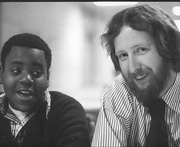
At 8am on Thanksgiving morning I met for coffee with a middle age man named Leo Hall. Leo lives in Nashville, TN, makes videos and is a substitute teacher. He has two great boys and a wonderful wife.
What made this event special?
I first met Leo almost 33 years ago when he was in 4th grade, attending an elementary school in the Cabrini-Green area of Chicago. I was a first year employee working in the Advertising Department of the Montgomery Ward corporate headquarters of Chicago. In the fall of 1973 I became a volunteer tutor with the Montgomery Ward Cabrini Green Tutoring Program in Chicago. I was assigned to work with Leo. We met every Tuesday night during that 1973-74 school year, and for the next several years.
In the years since then, I've attended every graduation of Leo's, including 8th grade, high school and college.
Leo sent me an email Tuesday, telling me he was coming to Chicago, and that he wanted to meet with me. He made special arrangements to be able to join me on Thursday morning, just as I did.
We have stayed in contact for 33 years, although we've not seen each other for about six years. Since he was coming to Chicago he wanted to make sure he saw me.
He wanted to say "thanks" for me being his mentor for all of these years.
While I accepted his "thanks" I also offered my own. I said "thanks" for him letting me be part of his life, and for all of the ways this involvement has become my life in the years since then.
When I write about tutoring/mentoring and the infrastructure needed to support such programs, I'm thinking about what it took for Leo and I to first meet in 1973, and to stay connected for all of these years. If some volunteers had not made the weekly commitment for the Wards program to operate, we never would have met. If donors had not provide enough dollars to operate every year, we would not have been able to stay connected. He could not have found me, or me him, if Cabrini Connections were not a home, that connects us, and many others, to each other.
As you do your holiday charitable giving, I encourage you to made a donation to a volunteer-based tutor/mentor program like Cabrini Connections so you can help us continue to make these connections between youth like Leo and adults like me.
If you view the Chicago Programs Links at the Tutor/Mentor Connection web site, you'll find web site links for Cabrini Connections and for many other Chicago organizations that offer various forms of tutoring and/or mentoring. You can use these to choose places where you might want to make a donation or become a volunteer in the coming year.
We all give thanks for the richness that mentoring has added to our lives. We hope that through your giving we'll be able to continue this work for many more years.
Thursday, November 16, 2006
$2 Million Award supports Chicago volunteer-based tutor/mentor programs!

Over the past two years I've posted many messages showing how the Tutor/Mentor Connection has been working to help volunteer-based tutor/mentor programs grow in Chicago and in other major cities. That has been a three part effort
a) building knowledge of who does this work, what works, who supports it, etc.
b) drawing programs together to learn from each other and collaborate on capacity building
c) working with business and professional groups to create strategies that distribute funds annually to tutor/mentor programs in every part of the city, instead of just to one or two favorite, or highly visible programs.
The best example of our success in getting businesses involved has been the work we've done since 1994 to help the Abraham Lincoln Marovitz Lend A Hand Program (http://www.lend-a-hand.net/ ) grow at the Chicago Bar Association. Since 1995 the LAH has been able to award $30,000 to $50,000 each year in small grants to 20-30 different programs. The photo above shows the Thomas A Demetrio Lend A Hand Award recognizing an outstanding example of a Chicago tutor/mentor program, being awarded during a Tutor/Mentor Conference.
While these were welcome, the size of the grant means the programs still had to find about 98% of the money needed to operate from other sources.
Yesterday the LAH received $2 million from the Chicago Sun Times as part of a legal settlement. These funds will increase the grant pool to as much as $300,000 per year over the next 3 to 5 years, and dramatically increase the size of grants awarded to tutor/mentor programs in the Chicago area.
This is the result of our efforts to connect those who can help with volunteer-based tutor/mentor programs who are helping inner city kids reach careers. It's also a result of many tutor/mentor programs participating in the May and November conference, and the August/September Volunteer Recruitment Campaigns, organized by the Tutor/Mentor Connection.
The goal of the T/MC is to have the Lend A Hand duplicated in every industry, so that tutor/mentor programs receive funds, and volunteers, from many sources, not just the legal community. The way we hope to achieve this is that more tutor/mentor leaders in Chicago will become active partners in this strategy, and that program leaders in other communities begin to work with the T/MC as collaborators so that the business and professional groups in their own community will adopt this strategy.
The best way to get more involved is to participate in the Nov. 30 Tutor/Mentor Conference being held at DePaul University, 1 E Jackson. Read about the conference at https://web.archive.org/web/20060810050733/http://www.tutormentorconference.bigstep.com/
This strategy can be duplicated in Rockford, Milwaukee, Detroit, Indianapolis, St. Louis, or any other major city. I encourage you to connect with the T/MC so we can help you take a T/MC type leadership in your neighborhood, or your city. To get involved, post a message in the Discussion Forum, or email me at tutormentor2@earthlink.net
Subscribe to:
Posts (Atom)


 Posts
Posts


