Saturday, September 28, 2019
Concept Map Library - new page
I've been creating concept maps to visualize ideas since 2005. These are embedded in dozens of blog articles which you can find if you scroll through this set of articles.
I have built so many that I created a page on my web site where I showed all that have been created. I've pointed to that link often.
Today, I built a new page, with a new link. It is
http://www.tutormentorexchange.net/conceptmaps
If you click on the earlier version you'll still see the maps, however, I'm not updating these and the images are not always showing properly.
If you're interested in the concept maps, bookmark the link above, so whenever you want to visit the library you go to the most current page.
By the way. I'm not really happy with how this looks, but I've stretched my page building and HTML knowledge as far as it goes. If someone wants to build a new page that I can put on the JOOMLA platform, please get in contact with me.
Thursday, September 26, 2019
Connecting with the world and the powerful - via Twitter
I've included versions of this graphic often in my blog articles to show my role in connecting people who can help, to information they can use to support decisions they make about who they will help and what type of help they will provide.
I've never had much (any) money for advertising so have used blogs, my web sites, email newsletters and social media to try to connect with others. Below are a few Tweets from the past few weeks that illustrate how I am doing this.
I posted this on Sept. 17 as I listened to a webinar hosted by the Forum for Youth Investment The archive of that event is here.
Then on Sept 19 I participated in this #MPCLuncheon, hosted by The Metropolitan Planning Council, with Tweets like this,
Here's another Tweet that I posted, using #MPCLuncheon hashtag.
At the same time I was watching the September 19 City Club of Chicago lunch speaker and posted the Tweet shown below. The City Club of Chicago hosts weekly lunches and livestreams them so people like myself can engage, just as I'm demonstrating.
Because I mentioned #NodeXL, a network analysis tool, in my #MPCLuncheon Tweet, they created a network analysis map showing who was connecting on September 19.
On Sept. 21 I shared this with Raymond Lopez, Chicago's 15th Ward Alderman
Then I posted this as I followed some Tweets from the Rockefeller Foundation who hosted a major gathering in New York City this week, to discuss ways to achieve the UN Global Goals by 2030. There are 17 Goals, so their event was organized into #17Rooms.
On Tuesday, Sept. 23, I responded to an email invitation from the Rockefeller Foundation to share #myglobalvision
Also on Tuesday I posted this Tweet, from The Green Living Room in the Woodlawn area of Chicago, just South of Hyde Park.
Today I shared this Tweet, pointing to an article written by the President of IFF (International Finance Fund?).
I've included hashtags and links in describing each of these Tweets, so you can go back and review each of these conversation threads. You can reTweet, LIKE, or even post your own comment, sharing information about your work the way I do.
You can also visit @tutormentorteam and scroll through Tweets I've posted over the past few weeks. What I've shared in this article are just a small sample of the wide range of people I've reached out to via multiple Tweets. I've been doing this for the past 10 years!
I received some ReTweets, some LIKES, and a few followers from these. Over the past few years I've developed some pretty strong relationships, and cultivated a few new contributors who help fund my work.
That's the goal. I want people to use the ideas I share, even if I never hear from them.
However a larger goal is that someone who reads my post and digs into my blog articles and web sites will step forward to put her name on the Tutor/Mentor Institute, LLC, with a major investment that brings it into a university, or some other structure, where it can be re-built, and reach a much larger network of people than what I've been able to reach.
These articles talk about "A New T/MC". Take some time to look through them.
It's a process. It takes time. It's an investment of time on my part.
If you want to make a difference, start reading these. Or start following me on Twitter, Linkedin and Facebook.
I've never had much (any) money for advertising so have used blogs, my web sites, email newsletters and social media to try to connect with others. Below are a few Tweets from the past few weeks that illustrate how I am doing this.
I posted this on Sept. 17 as I listened to a webinar hosted by the Forum for Youth Investment The archive of that event is here.
I'll be listening to the #readyyouth webinar for next hour. My focus for past 25 years has been to learn what youth #tutor #mentor & learning orgs were operating in different parts of #Chicago and to try to connect them with each other and with needed operating resources. https://t.co/kxIFEGalL7— Daniel Bassill (@tutormentorteam) September 17, 2019
Then on Sept 19 I participated in this #MPCLuncheon, hosted by The Metropolitan Planning Council, with Tweets like this,
Looking forward to Tweeting #MPCLuncheon #MakingPositiveChange w/ keynote from Raj Chetty today.— Daniel Bassill (@tutormentorteam) September 19, 2019
With so many in attendance at your event I'd hope to find 100 or more also Tweeting. Will you encourage that? A SNA map by @NodeXL could show participation.
Here's another Tweet that I posted, using #MPCLuncheon hashtag.
These #maps are great. How do we get dramatically more people to care about this enough to devote time, talent, dollars, taxes and votes to solutions that reach into all high poverty areas for many years? #MPCLuncheon https://t.co/mN0KvisUrp— Daniel Bassill (@tutormentorteam) September 19, 2019
At the same time I was watching the September 19 City Club of Chicago lunch speaker and posted the Tweet shown below. The City Club of Chicago hosts weekly lunches and livestreams them so people like myself can engage, just as I'm demonstrating.
In late 2000s we created a series of maps showing faith groups in Chicago as overlays on a maps showing poverty. Can @StIgnatius create a map showing where alumni are involved with youth orgs in the region? Might be a student project. @cityclubchicago https://t.co/WhZDdETG3p pic.twitter.com/c0lAAXIWqb— Daniel Bassill (@tutormentorteam) September 19, 2019
Because I mentioned #NodeXL, a network analysis tool, in my #MPCLuncheon Tweet, they created a network analysis map showing who was connecting on September 19.
My friends at @nodeXL saw this Tweet and created the map below which shows 25 people engaging around the #MPCLuncheon yesterday. I included it in this article on my #tutor #mentor blog. https://t.co/RQWk8WwtX8 pic.twitter.com/rXhhEXaU6z— Daniel Bassill (@tutormentorteam) September 20, 2019
On Sept. 21 I shared this with Raymond Lopez, Chicago's 15th Ward Alderman
I created this slide share following shootings in #Chicago a few years ago. It shows a use of #maps that could be adopted by community activists. Different layers of gov't are responsible for same places. Hold them all accountable for solutions. https://t.co/NQfeLX6ubd— Daniel Bassill (@tutormentorteam) September 21, 2019
Then I posted this as I followed some Tweets from the Rockefeller Foundation who hosted a major gathering in New York City this week, to discuss ways to achieve the UN Global Goals by 2030. There are 17 Goals, so their event was organized into #17Rooms.
Anyone can fill the blue box on this graphic, connecting people "who can help" to information such as shared via the #GlobalGoals, @RockefellerFdn , etc. websites, and to places shown on #maps where people, and organizations, need help. I do this at https://t.co/BA3aEUgLgB pic.twitter.com/7vl3GHgx7B— Daniel Bassill (@tutormentorteam) September 22, 2019
On Tuesday, Sept. 23, I responded to an email invitation from the Rockefeller Foundation to share #myglobalvision
This graphic shows #myglobalvision for 2030. Such #maps should be available in every city/country, w icons representing groups of people working toward achieving one or more of #GlobalGoals. All connected. All drawing from common base of information. pic.twitter.com/R9GXgCMFpV— Daniel Bassill (@tutormentorteam) September 23, 2019
Also on Tuesday I posted this Tweet, from The Green Living Room in the Woodlawn area of Chicago, just South of Hyde Park.
Enjoyed opportunity today to share work I have piloted since 1993 w owner of #TheGreenLivingRoom at 6432-335 Cottage Grove in Chicago. Anyone can apply these ideas in area as small as a few blocks, or as big as a city. Learn at https://t.co/85UGitcYDB pic.twitter.com/8lw5Sendwk— Daniel Bassill (@tutormentorteam) September 24, 2019
Today I shared this Tweet, pointing to an article written by the President of IFF (International Finance Fund?).
This article describes how Tutor/Mentor Connection datamaps were intended to be used, starting in 1993. "Using data to drive investment and impact" | IFF https://t.co/6YEtjZ22Cl— Daniel Bassill (@tutormentorteam) September 26, 2019
I've included hashtags and links in describing each of these Tweets, so you can go back and review each of these conversation threads. You can reTweet, LIKE, or even post your own comment, sharing information about your work the way I do.
You can also visit @tutormentorteam and scroll through Tweets I've posted over the past few weeks. What I've shared in this article are just a small sample of the wide range of people I've reached out to via multiple Tweets. I've been doing this for the past 10 years!
I received some ReTweets, some LIKES, and a few followers from these. Over the past few years I've developed some pretty strong relationships, and cultivated a few new contributors who help fund my work.
That's the goal. I want people to use the ideas I share, even if I never hear from them.
However a larger goal is that someone who reads my post and digs into my blog articles and web sites will step forward to put her name on the Tutor/Mentor Institute, LLC, with a major investment that brings it into a university, or some other structure, where it can be re-built, and reach a much larger network of people than what I've been able to reach.
These articles talk about "A New T/MC". Take some time to look through them.
It's a process. It takes time. It's an investment of time on my part.
If you want to make a difference, start reading these. Or start following me on Twitter, Linkedin and Facebook.
Thursday, September 19, 2019
Know the Network. Nudge the Network.
I started leading a volunteer-based tutor/mentor program in 1975 while starting an advertising career with the Montgomery Ward Corporation in Chicago. What I learned over the next 15 years was that leaders constantly need to be reaching out to people with different talents and networks to help them do the work needed to sustain and grow the organization.
As I was learning this by running a volunteer base program I was also learning this from how we used weekly national advertising to attract customers to our 400 retail stories located in 40 different states. The graphic above visualizes the idea that it takes teams of people with different talents to help youth tutor, mentor and learning programs thrive. In a big city like Chicago, it takes many of these programs to reach just a fraction of the 200,000 or so kids who could benefit.
At the right is a concept map that visualizes the talent needed to help an organization thrive. Each of these nodes should link to social media or Linkedin profiles of people who are providing that talent in support of the organization's mission.
In the blue box at the top of this cMap is a link pointing to a similar map, which shows networks, rather than skills. You need a mix of talent representing different networks.
Finding and recruiting people to fill these roles is an on-going challenge, that is especially difficult for smaller organizations who don't have major civic and/or business support.
I participated in two Twitter chats today which were in support of events held in Chicago which each attracted at least 200 civic and business leaders. One was hosted by the Metropolitan Planning Council, with the Raj Chetty (see my July article) as keynote speaker. I show one Tweet from that event, using #MPCLuncheon as the hashtag.
The second, held during the same time frame, was live streamed by the City Club of Chicago. Here's a Tweet that announced the event.
Today I posted a Tweet at the start of the event encouraging Metropolitan Planning Council organizers to do this.
Then later this afternoon I received a message from NodeXL with a map that they created showing participants in the #MPCLuncheon event. I show it below.
You can see this actual map, and view an interactive version, at this link.
I think there are 25 nodes (Twitter users) on this map. That's far short of the 150-200 who were at the actual lunch event, or the potential audience who could have been following on line. To make a comparison, visit the NodeXL gallery and view their collection of maps. Many with several hundred nodes.
Update: Here's an updated NodeXL map, from 9-20-2019 showing 43 users. click here
I've posted several articles in the past showing how network analysis can help community organizers build a better understanding of who is participating in their events, and thus, also a better understanding of who is missing.
Using this information I feel organizers can nudge the network to do learning, network building, donating, volunteering, voting, etc. and other things needed to build and sustain an effective organization.
They can also reach out to add new people based on what talents and networks are missing from their ecosystem. Furthermore, they can use these maps to demonstrate a growing (or shrinking) participation over months and years.
I'll share this article on social media with the goal that some of the people who see it will a) embrace the idea and build it into future activities; or b) show me blog posts that illustrate how they are already doing this type of work.
Maybe some will even add me as a consultant to their planning teams to help them think through network building and engagement strategies like this.
Thanks to Valdis Krebs for the "Know the network. Nudge the Network." phrase.
If you've found value in this article please consider a contribution to help fund the Tutor/Mentor Institute, LLC. Click here to learn more.
As I was learning this by running a volunteer base program I was also learning this from how we used weekly national advertising to attract customers to our 400 retail stories located in 40 different states. The graphic above visualizes the idea that it takes teams of people with different talents to help youth tutor, mentor and learning programs thrive. In a big city like Chicago, it takes many of these programs to reach just a fraction of the 200,000 or so kids who could benefit.
![]() |
| Talent needed - click here |
In the blue box at the top of this cMap is a link pointing to a similar map, which shows networks, rather than skills. You need a mix of talent representing different networks.
Finding and recruiting people to fill these roles is an on-going challenge, that is especially difficult for smaller organizations who don't have major civic and/or business support.
I participated in two Twitter chats today which were in support of events held in Chicago which each attracted at least 200 civic and business leaders. One was hosted by the Metropolitan Planning Council, with the Raj Chetty (see my July article) as keynote speaker. I show one Tweet from that event, using #MPCLuncheon as the hashtag.
Opportinity (defined as upward mobility) is distributed unevenly across the US. Lessons from Raj Chetty @OppInsights at #MPCLuncheon @Metroplanners pic.twitter.com/QiAjCbYp8b— Juan Sebastian Arias (@_jsarias) September 19, 2019
The second, held during the same time frame, was live streamed by the City Club of Chicago. Here's a Tweet that announced the event.
For several years I've been encouraging event organizers to be more active in encouraging participants to connect on Twitter using a common hashtag. At the same time I've also encouraged them to use network analysis tools like NodeXL to create a graphic showing who did participate and how they are connected to each other.Live at 12:20PM with our panelists @MaryAnnAhernNBC , Fr. Michael Caruso & Tony Harris on "A discussion of 150 years of @StIgnatius College Prep in Chicago" at https://t.co/7VWvNaDpx4 #watchnow pic.twitter.com/UD8GBztms2— City Club of Chicago (@CityClubChicago) September 19, 2019
Today I posted a Tweet at the start of the event encouraging Metropolitan Planning Council organizers to do this.
Looking forward to Tweeting #MPCLuncheon #MakingPositiveChange w/ keynote from Raj Chetty today.— Daniel Bassill (@tutormentorteam) September 19, 2019
With so many in attendance at your event I'd hope to find 100 or more also Tweeting. Will you encourage that? A SNA map by @NodeXL could show participation.
Then later this afternoon I received a message from NodeXL with a map that they created showing participants in the #MPCLuncheon event. I show it below.
You can see this actual map, and view an interactive version, at this link.
I think there are 25 nodes (Twitter users) on this map. That's far short of the 150-200 who were at the actual lunch event, or the potential audience who could have been following on line. To make a comparison, visit the NodeXL gallery and view their collection of maps. Many with several hundred nodes.
Update: Here's an updated NodeXL map, from 9-20-2019 showing 43 users. click here
I've posted several articles in the past showing how network analysis can help community organizers build a better understanding of who is participating in their events, and thus, also a better understanding of who is missing.
![]() |
| Connect those who can help with those who need help. |
They can also reach out to add new people based on what talents and networks are missing from their ecosystem. Furthermore, they can use these maps to demonstrate a growing (or shrinking) participation over months and years.
I'll share this article on social media with the goal that some of the people who see it will a) embrace the idea and build it into future activities; or b) show me blog posts that illustrate how they are already doing this type of work.
Maybe some will even add me as a consultant to their planning teams to help them think through network building and engagement strategies like this.
Thanks to Valdis Krebs for the "Know the network. Nudge the Network." phrase.
If you've found value in this article please consider a contribution to help fund the Tutor/Mentor Institute, LLC. Click here to learn more.
Saturday, September 14, 2019
Five Dot Challenge from #CLMOOC
| On Twitter - click here |
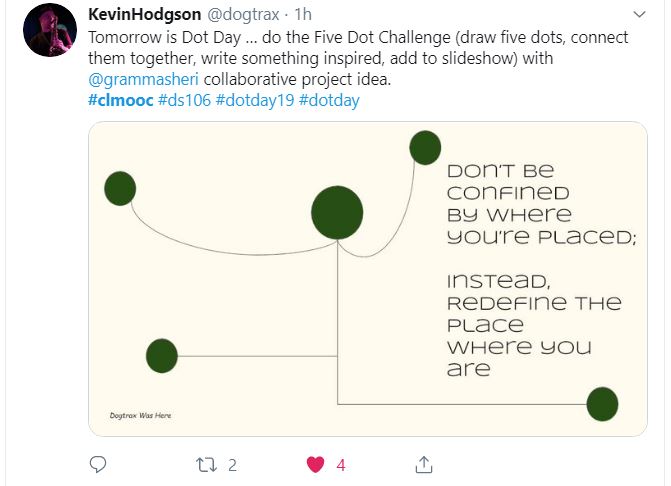
For the past week or so I've seen this invitation to participate in a five-dot challenge, which is illustrated by Kevin Hodgson in the Tweet at the left.
What you've also seen if you've read past articles is that I usually connect these activities to work I'm doing. So, my five-dot challenge graphic is shown below.
![]() |
| My five dots are shown on the 4-part strategy map. |
![]() |
| See intern visualizations |
I've never had enough support to do all that I've been trying to do, and have believed that youth in high school and colleges throughout the country could provide manpower and talent to lead Tutor/Mentor Connection-type strategies in their own communities. Below is another version of the four part strategy, which in this case, shows work youth could be doing.
![]() |
| Look deeply and see ways youth and others can help - click here |
While I've tried to inspire people to share what they find on my web sites, blogs and social media post, those who have been doing that are pretty scarce. Visit this cMap page and you can view blog articles that show how some people have been doing this.
| View here |
Thus, I've been really impressed by how Democratic Presidential Candidate Andrew Yang has inspired dozens (probably more) of people to create videos telling their #MyYangStory. The one shown at the left is just one that you will find if you search #yanggang on Twitter.
I've not made a commitment to vote for Andrew Yang. What I'm saying is that I'm really impressed at how he has inspired so many other people to help share his message.
Imagine if that many people were sharing the ideas of the Tutor/Mentor Connection/Institute, LLC.
Would that result in more people helping well-organized non-school tutor, mentor and learning programs reach k-12 youth in high poverty neighborhoods of the USA and the world?
Would it share ideas and generate resources so that in five or ten years we'd find stories on thousands of web sites showing kids and volunteers who have had their lives transformed as a result of being part of these programs?
That's the goal.
Thus, my five dot story is intended to inspire such actions. If you create a post, share it on Twitter with me at @tutormentorteam.
Labels:
CLMOOC,
four part strategy,
leadership,
vision,
visualization
Monday, September 09, 2019
Looking back 21 years - Webheads and Tutor/Mentor Connection
My wife complains that "I never throw anything away." She's right. I'm a collector. We sold our house this spring and had to down-size. It was terribly painful for me.
This habit is especially true when it comes to the information I've learned from leading a volunteer based tutor/mentor program in Chicago for 35 years and from trying to help fill city neighborhoods with well-organized programs for the past 25 years.
This graphic is one of the first that I created in the early 1990s to show the type of information I was gathering and sharing - initially via print newsletters. The challenge that I've always had (of many) is finding ways to help other people find and use the information I've been collecting.
It's not a challenge that is unique to myself.
Yesterday I joined in an on-line reunion, celebrating 21 years of a group called Webheads in Action.
Three original Writing for Webheads members, Vance Stevens, Michael Coghlan and Felix Zaniboni, convened in Zoom for a 21 year reunion. It started at 7:AM Chicago time, but late in the evening for the others. I joined in late.
Vance has been the prime mover in this group since it's beginning, so he created a blog article and posted it today, to recap the conversation. I show the heading below, but am not going to try to recap all of the detailed information that Vance put in the blog, which recapped what was shared in the on-line session.
| Read Vance Stevens' Learning2Gether blog from 9-8-19 |
![]() |
| Innovation, creativity - cMap |
At the right is a cMap showing one of four sections of the Tutor/Mentor Connection/Institute web library, which I started putting on-line in 1998. I'd been collecting some of this information as hard-copy publications since the 1970s.
Here's a screenshot of that section of the library.
| Collaboration, innovation, knowledge management, mapping - click here |
As I did this I shared some of the links on Twitter. Here's an example:
In the #tutor #mentor library I point to many sites which are also libraries hosting large amounts of information. This is one. It's a periodic table of visualization methods. Have fun with it. https://t.co/gYbV8uMFg3 pic.twitter.com/FWbeQdKBDO— Daniel Bassill (@tutormentorteam) September 9, 2019
If you search @tutormentorteam on Twitter and scroll through my past Tweets you'll find many examples. If you read Vance's blog, you'll see that he's doing the same thing in the way that he pointed at my Tweet about yesterday's event.
If you look at the graphic at the right, Vance, and myself, are the people in the middle, hosting information libraries and spending time on a regular basis helping other people find and use that information. I've been trying to teach others to take this role for many years.
Below is a cMap that illustrates some success. I created this a few years ago to point to places where other people were writing about work I'm doing, to help facilitate understanding among a larger network of people. Vance Stevens is one of the nodes on this map and I added a link to his blog. Many people who I've met via the #clmooc group are also included, as are interns who worked with me from 2006 to 2015.
![]() |
| Connecting with others - open links on each node |
Many of my blog articles are pointing to the past in an effort to share information people can use to shape a brighter future for kids and families. If you browse the list of articles in the cMap above (click here) you'll find many that talk about learning, network building, collaboration, etc. Most put the responsibility on the learner to do the walking and to create new content that does the sharing.
Want another example of what I'm talking about and asking you to do? Take a look at this Tweet.
Love it! A whole family joining the #YangGang family. https://t.co/rsYl2IhAw5— Steve Marchand (@marchandsteve) September 8, 2019
For the past month or so I've watched a growing number of people take turns sharing the ideas of Andrew Yang on Twitter, using #YangGang as one of their hashtags. He and his campaign team have created content which they share via books and on his web site, and a growing number of others are creating new content to share these ideas.
Imagine being able to get kids and volunteers from multiple youth programs connected to each other in long-term communities like Webheads. Then imagine them sharing their stories and talking about what it takes to build and sustain a long-term tutor/mentor program, using the same enthusiasm and frequency that #YangGang members are doing.
Would that result in more well-organized, long-term programs reaching k-16 youth in high poverty areas all over the country - or the world?
That's the goal. If you've read this, write about it. Share it. Create a video.
And, if you're able, send me a contribution, click here, to help me fund this work.
Labels:
CLMOOC,
collaboration,
knowledge,
learning,
library
Saturday, August 31, 2019
Building Systems of Support for Urban Youth - What's It Look Like?
Last Sunday the Chicago Tribune called attention to our inability to solve the violence and poverty that plagues some parts of Chicago more than others by telling the story of Yummy Sandifer, from 1994. I wrote about this on Monday.
I shared my post on social media but received no responses. Yesterday I saw a post on Twitter, following up on this story. You can see it below:
Peter Nickeas, the writer, talks about systems that touch violence. As I read this and tried to frame a response, I was frustrated because I have more thoughts than could be communicated in one Tweet.
Since the mid 1990s I've been using visual tools to try to show "systems" of support that need to be available in every high poverty neighborhood, using graphics like the one at the right. I've embedded these in print newsletters, web sites and my blog articles, as well as in my own posts on social media.
I create many of these using PowerPoint, which I then convert to JPGs. A few months ago I embedded one of my PPTs on Slideshare, to enable people to view a collection of graphics in one place. I show it below:
While there are more than 30 graphics in this PPT, that's really just a small sample of the graphics I've created. Here are places you can find more:
1) Pinterest.com/tutormentor - I've created several collections on Pinterest. With each graphic I've included a link to where the graphic was used
2) Google search - view images - if you search 'tutor/mentor connection' on Google then look at the images, you'll find dozens of my graphics. Each has a link to where it was used. Do the same search on Bing.com
3) Concept maps can be used to visualize systems of support, showing all that is needed, to help young people move safely through school and into adult lives. I show a collection of my cMaps at this link.
The Mentoring-Kids-to-Careers cMap is at this link.
Every time a story appears in the news that causes you to ask "Why is that happening?" or "What can I do to change that" I encourage you to view some of my graphics and draw others together to discuss what they mean to you.
That's what I was trying to communicate in this graphic (which was created by an intern from South Korea, using the graphic shown below). We talk about the "village" that needs to be involved in raising kids. I show that the "village" consists of many groups. Each needs to be looking at these graphics, and maps of their city, and asking "What can we do?" and "Where can we help?"
The graphic below shows this in two earlier visualizations. The top one shows the network of support that helps kids grow from birth to adult lives. Where you are born determines the range of support and opportunities your network makes available to you. Kids born in high poverty don't have as diverse a network modeling hope and opportunity. I believe organized tutor/mentor programs can provide such support. They need to be available in every high poverty zip code. Here's my list of programs that I'm aware of
The second graphic shows how any person can invite people she knows into a discussion using the graphics and articles I've been sharing. Many need to be doing this.
I mentioned that an intern from South Korea created the first graphic, using the second as inspiration. Youth from schools across the world could be looking at my graphics and then creating their own interpretations and sharing them via social media, YouTube, Instagram, etc. with the same goals as I have. If you're doing that, let me know!
While last Sunday's Chicago Tribune focused on one killing, there have really been hundreds in the years since then. At the left is a story from 1997 with a map we created at that time. We did not have the Internet then to communicate these. Now we do.
I'd be happy to talk with any group and explain the meaning of my graphics or show how they could be creating and sharing their own.
I'm on Twitter, Facebook and Linkedin. If you want to help me do this, visit this page and send me a contribution.
I shared my post on social media but received no responses. Yesterday I saw a post on Twitter, following up on this story. You can see it below:
Every, *every* system in this city that touches violence has to triage because there's more demand than there is capacity for service. And things like this will keep happening. That's why we're 25 years on and kids are still doing shootings and murders and getting killed.— Peter Nickeas (@PeterNickeas) August 30, 2019
Peter Nickeas, the writer, talks about systems that touch violence. As I read this and tried to frame a response, I was frustrated because I have more thoughts than could be communicated in one Tweet.
Since the mid 1990s I've been using visual tools to try to show "systems" of support that need to be available in every high poverty neighborhood, using graphics like the one at the right. I've embedded these in print newsletters, web sites and my blog articles, as well as in my own posts on social media.
I create many of these using PowerPoint, which I then convert to JPGs. A few months ago I embedded one of my PPTs on Slideshare, to enable people to view a collection of graphics in one place. I show it below:
While there are more than 30 graphics in this PPT, that's really just a small sample of the graphics I've created. Here are places you can find more:
1) Pinterest.com/tutormentor - I've created several collections on Pinterest. With each graphic I've included a link to where the graphic was used
2) Google search - view images - if you search 'tutor/mentor connection' on Google then look at the images, you'll find dozens of my graphics. Each has a link to where it was used. Do the same search on Bing.com
![]() |
| See map here |
The Mentoring-Kids-to-Careers cMap is at this link.
Every time a story appears in the news that causes you to ask "Why is that happening?" or "What can I do to change that" I encourage you to view some of my graphics and draw others together to discuss what they mean to you.
That's what I was trying to communicate in this graphic (which was created by an intern from South Korea, using the graphic shown below). We talk about the "village" that needs to be involved in raising kids. I show that the "village" consists of many groups. Each needs to be looking at these graphics, and maps of their city, and asking "What can we do?" and "Where can we help?"
The graphic below shows this in two earlier visualizations. The top one shows the network of support that helps kids grow from birth to adult lives. Where you are born determines the range of support and opportunities your network makes available to you. Kids born in high poverty don't have as diverse a network modeling hope and opportunity. I believe organized tutor/mentor programs can provide such support. They need to be available in every high poverty zip code. Here's my list of programs that I'm aware of
The second graphic shows how any person can invite people she knows into a discussion using the graphics and articles I've been sharing. Many need to be doing this.
I mentioned that an intern from South Korea created the first graphic, using the second as inspiration. Youth from schools across the world could be looking at my graphics and then creating their own interpretations and sharing them via social media, YouTube, Instagram, etc. with the same goals as I have. If you're doing that, let me know!
![]() |
| Chicago SunTimes 4-7-1997 |
I'd be happy to talk with any group and explain the meaning of my graphics or show how they could be creating and sharing their own.
I'm on Twitter, Facebook and Linkedin. If you want to help me do this, visit this page and send me a contribution.
Monday, August 26, 2019
Yummy's Story. New for You? Not for me.
Did you see this editorial in yesterday's Chicago Tribune? I created the graphic at the left so I could talk about it in this article. I shared it on Twitter with this Tweet (open to view).
It's the story of an 11-year-old Chicago boy murdered 25 years ago in August 1994. While the story might be new to you, it is not new to me.
I've been collecting news clips of stories like this for nearly 30 years in an effort to mobilize more consistent attention and resources to help prevent kids from becoming victims of poverty and inequality.
So I looked in my files to see what I had. Below are just a few of a series of 1994 stories.
This was the front page of the Chicago SunTimes on September 2, 1994 as media started to try to build an understanding of why this happened.
This is the front page of the Chicago Tribune on August 25, 1994. The image from this story was used in yesterday's editorial.
67 kids were slain in Chicago in 1994 according to a Chicago Tribune story from January 1, 1995. I put that story into the graphic below to highlight where Yummy Sandifer was on the list and where in Chicago his killing took place....in the Roseland area on the far South Side of Chicago.
I had created the Tutor/Mentor Connection in 1993 and our goal was to help draw volunteers, donors and ideas to non-school tutor/mentor programs in Chicago, using a four-part strategy that you can see on this page. Step 1 was an information collection strategy, which included building a list of non-school tutor/mentor programs in Chicago. In 1994 we started trying to use maps to show this information and map-stories to try to draw attention to different areas following media stories.
Below is a map created in August 1994 to highlight the Roseland area where this shooting took place. Over the next 25 years our maps became more sophisticated yet the purpose remained the same.
If you look at the January 1, 1995 Chicago Tribune story shown above, you'll see at the right that they point to places where people could volunteer. Unfortunately they did not point to the Tutor/Mentor Connection and the Directory that we had first published in May 1994 or the conference that we held that May. (They did do a story in May 1994 about the conference, but did not tie these together).
If you view this list you can see a long list of articles where local media did try to tell what the Tutor/Mentor Connection was trying to do. Unfortunately these were far fewer after 2001. We tried to overcome that with a growing use of the Internet.
While yesterday's Chicago Tribune editorial focused on the Yummy Sandifer story the Chicago SunTimes did a story showing changes of demographics in Chicago, caused by a growing number of college graduates moving into the city. Below are the maps featured in this story, along with maps from a WBEZ story that I used in a "Don't Drive By Poverty. Get Involved." story.
As you look at graphics like this, where I show maps and the "mentoring kids to careers" graphic, also look at concept maps like the one below.
For any number of reasons I've not had the magic formula for drawing leaders to this information and motivating them to use it. Nor have I been able to attract consistent funding, or a significant benefactor who would champion the Tutor/Mentor Connection.
What I started 25 years ago has left many footprints that others could follow, but as we enter 2020 I don't have any resources to go beyond maintaining an information base and posting articles like this to build on stories I see in the media and try to stimulate more strategic thinking by more people.
In the graphic above where I show the SunTimes maps I also put a small graphic of a bridge. If you look at the maps you see colors representing rich and poor sections of Chicago. Volunteer-based tutor, mentor and learning programs can be islands of hope and opportunity that serve as bridges that connect people from both backgrounds in mutually beneficial ways.
Such programs need to be identified, supported and multiplied so they are in every high poverty neighborhood.
If you want to help me keep writing these articles visit this page and make a contribution.
Or, better yet, reach out and start a conversation. Hire me to be a consultant to share these ideas with you and your planning team.
Or help create a Tutor/Mentor Connection at one of Chicago's colleges, so student researchers can dig into my files and pull out more stories that might motivate people to do what has not been done in the past 30 years:
Build a system of school and community support that really does reach kids and families in every poverty neighborhood.
I'm on Twitter, Facebook and Linkedin. Connect with me there or leave a comment.
It's the story of an 11-year-old Chicago boy murdered 25 years ago in August 1994. While the story might be new to you, it is not new to me.
I've been collecting news clips of stories like this for nearly 30 years in an effort to mobilize more consistent attention and resources to help prevent kids from becoming victims of poverty and inequality.
So I looked in my files to see what I had. Below are just a few of a series of 1994 stories.
This was the front page of the Chicago SunTimes on September 2, 1994 as media started to try to build an understanding of why this happened.
This is the front page of the Chicago Tribune on August 25, 1994. The image from this story was used in yesterday's editorial.
67 kids were slain in Chicago in 1994 according to a Chicago Tribune story from January 1, 1995. I put that story into the graphic below to highlight where Yummy Sandifer was on the list and where in Chicago his killing took place....in the Roseland area on the far South Side of Chicago.
I had created the Tutor/Mentor Connection in 1993 and our goal was to help draw volunteers, donors and ideas to non-school tutor/mentor programs in Chicago, using a four-part strategy that you can see on this page. Step 1 was an information collection strategy, which included building a list of non-school tutor/mentor programs in Chicago. In 1994 we started trying to use maps to show this information and map-stories to try to draw attention to different areas following media stories.
Below is a map created in August 1994 to highlight the Roseland area where this shooting took place. Over the next 25 years our maps became more sophisticated yet the purpose remained the same.
If you look at the January 1, 1995 Chicago Tribune story shown above, you'll see at the right that they point to places where people could volunteer. Unfortunately they did not point to the Tutor/Mentor Connection and the Directory that we had first published in May 1994 or the conference that we held that May. (They did do a story in May 1994 about the conference, but did not tie these together).
If you view this list you can see a long list of articles where local media did try to tell what the Tutor/Mentor Connection was trying to do. Unfortunately these were far fewer after 2001. We tried to overcome that with a growing use of the Internet.
While yesterday's Chicago Tribune editorial focused on the Yummy Sandifer story the Chicago SunTimes did a story showing changes of demographics in Chicago, caused by a growing number of college graduates moving into the city. Below are the maps featured in this story, along with maps from a WBEZ story that I used in a "Don't Drive By Poverty. Get Involved." story.
I've been using maps in stories for 25 years, in my print newsletters, on my web sites, email newsletters and blog articles. If you read the stories about kids in poor schools, kids in gangs, kids in poverty and kids killing each other, and look at maps showing where these are taking place, you begin to understand that there is a need for solutions in many parts of the city.
Here's another map-story that has driven my efforts. This is from 1994, showing more than 240,000 kids in poverty. If you look at the shaded areas they are pretty much the same areas as we're looking at in 2019. Yet, there are changes, too.
What a map is intended to provoke are questions of "How do we reach all of these kids with great programs?" How do we help these programs stay connected to kids from the years they start school till they are adults with jobs able to raise their own kids free of poverty? How do we change the funding systems that make long-term programs so difficult to operate?"
Below is just one of many graphics I've included in blog articles and newsletters. How can we do this better? How do we bring leaders from every sector into this conversation and keep them involved for many years. How do we build birth to work programs reaching kids in every poverty area? How do we collect and report data that shows what programs are operating, where they are and what they do, so we can know that we really are reaching kids in all places where they are needed.
![]() |
| This "how to do it better" conversation needs to be taking place in many sectors. |
| Kids in every neighborhood need ALL of these supports - view map |
For any number of reasons I've not had the magic formula for drawing leaders to this information and motivating them to use it. Nor have I been able to attract consistent funding, or a significant benefactor who would champion the Tutor/Mentor Connection.
What I started 25 years ago has left many footprints that others could follow, but as we enter 2020 I don't have any resources to go beyond maintaining an information base and posting articles like this to build on stories I see in the media and try to stimulate more strategic thinking by more people.
In the graphic above where I show the SunTimes maps I also put a small graphic of a bridge. If you look at the maps you see colors representing rich and poor sections of Chicago. Volunteer-based tutor, mentor and learning programs can be islands of hope and opportunity that serve as bridges that connect people from both backgrounds in mutually beneficial ways.
Such programs need to be identified, supported and multiplied so they are in every high poverty neighborhood.
If you want to help me keep writing these articles visit this page and make a contribution.
Or, better yet, reach out and start a conversation. Hire me to be a consultant to share these ideas with you and your planning team.
Or help create a Tutor/Mentor Connection at one of Chicago's colleges, so student researchers can dig into my files and pull out more stories that might motivate people to do what has not been done in the past 30 years:
Build a system of school and community support that really does reach kids and families in every poverty neighborhood.
I'm on Twitter, Facebook and Linkedin. Connect with me there or leave a comment.
Wednesday, August 21, 2019
Looking Back - 2006 Skoll Foundation "Profit for a Purpose"
I'm in the process of updating the web library that I host on the Tutor/Mentor Connection web site and I just opened a link to this 2006 conversation hosted on the Skoll Social Edge Forum (now an archive).
The topic was Profit for a Purpose.
I scrolled through the conversation and found that I'd posted some thoughts. They are still relevant today, so I've re-posted them below.
----------------------------
Thinking of Social Enterprise in three dimensions, not two:
Sutia,
You had many inspiring ideas in your message. One that made me chuckle in agreement was "The private sector uses the term “going concern” which implies an active, dynamic, tap-dancing state also known as survival."
I’ve led a donor-funded(non profit) organization in Chicago for 14 years and when donors ask for a report on accomplishments I always say my first accomplishment is that I’m still in business and able to continue the process of growing from good to great in the coming year. I rely on a wide range of volunteers to supplement an inconsistent flow of dollars.
When I read about the various social enterprise leaders and activities, I see innovative people finding ways to support their own vision for saving the world. The funds they raise from their enterprise support one or a few organizations that do the work they are interested in. The more successful they are, the greater their ability becomes to host forums like this, bringing others together to share ideas.
While this is good, what about the others in the world who do similar work, maybe in different places, and who have not found a way to create a revenue producing enterprise to sustain their vision? What would it take to expand the support generated by one entrepreneur for a single charity, to multiple charities doing the same work, or to multiple charities needed to solve the same problem?
Here’s my example. I maintain a database listing 200-300 organizations in the Chicago region that offer various forms of volunteer-based tutoring and/or mentoring. Each is constantly seeking dollars. Mentoring is a long term process, so each needs to find ways to keep kids and volunteers connected for many years.
Most are not running food pantries to pay the bills, and few parents have the funds to pay for services. Thus, most operate in a level of relative poverty, struggling to do good work, and still be in business at the end of each year (survival).
By providing my list of organizations via the Program Locator at at http://tutormentorprogramlocator.net/Prgloc.aspx, I make it possible for any business, college, law association, etc. who wants to make the world better by helping inner city kids connect with mentors, and move to jobs, to create a social enterprise that draws dollars, volunteers and other resources to all tutor/mentor programs throughout Chicago on a consistent basis, or to fund just one or a few programs in a single zip code, if they choose. (The Lend A Hand Program at the Chicago Bar Association is an early adopter of this strategy – https://www.lawyerslendahand.org/ )
If a few people from every industry who have been successful in making profit, point their profit and their employees and customers, to tutor/mentor programs throughout the city, there will be a better distribution of resources to all programs doing this work, and more programs will have the ability to constantly get better at what they do.
Since tutoring/mentoring alone will not solve the problems facing kids in poverty, I suggest a "blueprint" be created that shows all of the services that are needed at any time in order for a youth to reach adulthood. All of these need to be funded, just as all sub contractors on a building blueprint need to be funded. If that does not happen, the program is not successful. By only funding a few of the needed services in a neighborhood, city or country, we only address part of a complex problem, and may not really solve the problem at all. Thus funding, or social enterprise, needs to focus at multiple service providers, not just one or a few.
This is a three dimensional approach, where a) for profits choose a cause to support, and stick with it for decades; b) social entrepreneurs who have succeeded in creating a money flow point their resources at multiple organizations, not just their own non profit; and c) where non profits are able to attract and retain a higher quality of leadership who use the resources more effectively for social benefit, while also learn to collaborate with others, and market there efforts more successfully to compete for resources for the entire community, not just their own agency.
The result would be that more places where tutoring/mentoring is needed would begin to have good programs that not only survive from year to year, but begin to accelerate the rate of youth finishing school with a network of adults helping them to the next level in their lives. While my example focuses on tutoring/mentoring, I feel it could apply to any other social endeavor.
In the past couple of years I’ve sent invitations to the Said Business School, and to others in the US, encouraging teams of graduate students to adopt this approach, creating an international competition of business school teams who compete with each other to see which can raise the most money, visibility and volunteers, for tutor/mentor programs in their community. If such a competition repeated from year to year, its visibility, and impact would grow and young people would learn lessons they could apply the rest of their lives. You can read about this idea on this wiki page.
If some of you reading this would like to take a role of making this idea a reality, I hope you’ll contact me.
-----------------------------
A couple of things are obvious in what I wrote in 2006.
1) I could really have benefited from a spell check for my post. I've found that too often to be the case when I write and type stream of conscious posts. I'm sure that has hurt my credibility over the past 25 years.
2) The problem I was describing has not changed in 13 years since I wrote this.
3) I'm still trying to find a lead university and business sponsor to get the Business School Connection idea off the ground.
Below is a presentation describing the need for a "blueprint" and showing work that I was trying to do in past years and still seek to do as we head into 2020.
Much has changed for me personally and professionally. Since 2011 I have not led the Cabrini Connections direct service program. And since 2011 I've led the Tutor/Mentor Connection through the Tutor/Mentor Institute, LLC, which is no longer a 501-c-3 but now one of those social enterprises seeking investors.
Because of my age, I'm 72, I no longer seek to re-build the Tutor/Mentor Connection around me. Instead I seek a partner, at a university, or a business, or of a new group of younger leaders, who will use all that I've created and re-build it, making it much stronger and more influential in the next decade.
The Business School Connection idea is just one of many that are on the drawing board waiting for investors to help bring it to life.
I want to help make that happen while I still am able.
I'm on Twitter, Facebook and Linkedin. Connect with me in one of those spaces or introduce yourself with a comment on this blog.
The topic was Profit for a Purpose.
I scrolled through the conversation and found that I'd posted some thoughts. They are still relevant today, so I've re-posted them below.
----------------------------
Thinking of Social Enterprise in three dimensions, not two:
Sutia,
You had many inspiring ideas in your message. One that made me chuckle in agreement was "The private sector uses the term “going concern” which implies an active, dynamic, tap-dancing state also known as survival."
I’ve led a donor-funded(non profit) organization in Chicago for 14 years and when donors ask for a report on accomplishments I always say my first accomplishment is that I’m still in business and able to continue the process of growing from good to great in the coming year. I rely on a wide range of volunteers to supplement an inconsistent flow of dollars.
When I read about the various social enterprise leaders and activities, I see innovative people finding ways to support their own vision for saving the world. The funds they raise from their enterprise support one or a few organizations that do the work they are interested in. The more successful they are, the greater their ability becomes to host forums like this, bringing others together to share ideas.
While this is good, what about the others in the world who do similar work, maybe in different places, and who have not found a way to create a revenue producing enterprise to sustain their vision? What would it take to expand the support generated by one entrepreneur for a single charity, to multiple charities doing the same work, or to multiple charities needed to solve the same problem?
Here’s my example. I maintain a database listing 200-300 organizations in the Chicago region that offer various forms of volunteer-based tutoring and/or mentoring. Each is constantly seeking dollars. Mentoring is a long term process, so each needs to find ways to keep kids and volunteers connected for many years.
Most are not running food pantries to pay the bills, and few parents have the funds to pay for services. Thus, most operate in a level of relative poverty, struggling to do good work, and still be in business at the end of each year (survival).
By providing my list of organizations via the Program Locator at at http://tutormentorprogramlocator.net/Prgloc.aspx, I make it possible for any business, college, law association, etc. who wants to make the world better by helping inner city kids connect with mentors, and move to jobs, to create a social enterprise that draws dollars, volunteers and other resources to all tutor/mentor programs throughout Chicago on a consistent basis, or to fund just one or a few programs in a single zip code, if they choose. (The Lend A Hand Program at the Chicago Bar Association is an early adopter of this strategy – https://www.lawyerslendahand.org/ )
If a few people from every industry who have been successful in making profit, point their profit and their employees and customers, to tutor/mentor programs throughout the city, there will be a better distribution of resources to all programs doing this work, and more programs will have the ability to constantly get better at what they do.
Since tutoring/mentoring alone will not solve the problems facing kids in poverty, I suggest a "blueprint" be created that shows all of the services that are needed at any time in order for a youth to reach adulthood. All of these need to be funded, just as all sub contractors on a building blueprint need to be funded. If that does not happen, the program is not successful. By only funding a few of the needed services in a neighborhood, city or country, we only address part of a complex problem, and may not really solve the problem at all. Thus funding, or social enterprise, needs to focus at multiple service providers, not just one or a few.
This is a three dimensional approach, where a) for profits choose a cause to support, and stick with it for decades; b) social entrepreneurs who have succeeded in creating a money flow point their resources at multiple organizations, not just their own non profit; and c) where non profits are able to attract and retain a higher quality of leadership who use the resources more effectively for social benefit, while also learn to collaborate with others, and market there efforts more successfully to compete for resources for the entire community, not just their own agency.
The result would be that more places where tutoring/mentoring is needed would begin to have good programs that not only survive from year to year, but begin to accelerate the rate of youth finishing school with a network of adults helping them to the next level in their lives. While my example focuses on tutoring/mentoring, I feel it could apply to any other social endeavor.
In the past couple of years I’ve sent invitations to the Said Business School, and to others in the US, encouraging teams of graduate students to adopt this approach, creating an international competition of business school teams who compete with each other to see which can raise the most money, visibility and volunteers, for tutor/mentor programs in their community. If such a competition repeated from year to year, its visibility, and impact would grow and young people would learn lessons they could apply the rest of their lives. You can read about this idea on this wiki page.
If some of you reading this would like to take a role of making this idea a reality, I hope you’ll contact me.
-----------------------------
A couple of things are obvious in what I wrote in 2006.
1) I could really have benefited from a spell check for my post. I've found that too often to be the case when I write and type stream of conscious posts. I'm sure that has hurt my credibility over the past 25 years.
2) The problem I was describing has not changed in 13 years since I wrote this.
3) I'm still trying to find a lead university and business sponsor to get the Business School Connection idea off the ground.
Below is a presentation describing the need for a "blueprint" and showing work that I was trying to do in past years and still seek to do as we head into 2020.
Much has changed for me personally and professionally. Since 2011 I have not led the Cabrini Connections direct service program. And since 2011 I've led the Tutor/Mentor Connection through the Tutor/Mentor Institute, LLC, which is no longer a 501-c-3 but now one of those social enterprises seeking investors.
Because of my age, I'm 72, I no longer seek to re-build the Tutor/Mentor Connection around me. Instead I seek a partner, at a university, or a business, or of a new group of younger leaders, who will use all that I've created and re-build it, making it much stronger and more influential in the next decade.
The Business School Connection idea is just one of many that are on the drawing board waiting for investors to help bring it to life.
I want to help make that happen while I still am able.
I'm on Twitter, Facebook and Linkedin. Connect with me in one of those spaces or introduce yourself with a comment on this blog.
Thursday, August 15, 2019
Connecting Leaders of Youth Tutor / Mentor Programs
For the past 25 years I've made efforts to identify volunteer-based youth tutor, mentor and learning programs operating in different parts of the Chicago region. At this link you can find my list and a map that shows locations of nearly 200 organizations.
The graphic below is an example of how I share that information and how I've been trying to encourage on-line engagement and collaboration, based on the Connected Learning (CLMOOC) group that I interact with on Twitter, Facebook and formerly on the Google+ platform. .
I hosted Tutor/Mentor Leadership and Networking Conferences every six months from 1994 to 2015 in an on-going effort to draw stakeholders from different programs together to share ideas, identify challenges, and help each program constantly improve.
While I've tried to draw people to event's I've attended, I've also made an effort to be part of events hosted by others. Below is a 2005 Tech Soup on-line event that I co-hosted.
I was really pleased to be able to do a Google search for "Tech Soup Bassill" and find conversations held in 2005. I had summarized these on this blog, with April 2005 articles that you can find here. If you scroll back from that article you'll find four posts from the week of April 18, 2005 in which I talk about what was taking place on the Tech Soup Forum.
When I wrote this article the link to the 2005 Tech Soup forum was still available. Alas, it's no longer on-line, even in the Internet archive.
I'm still writing about the same issues today as I was then.
I used the graphic at the right in this December 2016 article. The dark red areas of the map are high poverty areas where mentor-rich programs are most needed. The oil wells represent programs that connect with youth when they are in elementary or middle school, then stay connected all the way through high school and beyond. There are too few of such programs operating in Chicago.
This graphic represents the teams of people who need to be working to help each individual programs grow, while it also represents teams who need to be working to fill every high poverty community area with well-organized, and well-funded, programs.
Such teams are also needed at the city level.
I can't find them. At least I can't find them on Twitter, Linkedin, or Facebook.
Or, I can't find any that are using concept maps like the one below to show all the things that need to be considered in building and sustaining needed youth supports in multiple areas.
I started joining on-line conversations in the late 1990s and by 2004 I was committed to trying to build an on-line conference to parallel the Chicago conferences we were hosting. Below is a screen shot of a page on the Tutor/Mentor Institute, LLC site that shows on-line learning goals.
Here are the eLearning goals that I outlined in 2004 and have updated since then:
a) convergence - tutoring, mentoring, education-to-careers, youth development, etc. mean different things to different people, depending on the economic and social isolation of the people being served. Social workers, businesses, educators, prevention, etc. each look at solutions differently, or fund different programs. Yet they are all part of the actions needed to help individual kids move from poverty to careers. Our goal is to draw people from different strands of service into collaborations that deliver multiple services from central sites in neighborhoods where such services are needed. A power point that illustrates this concept can be found at Creating a Learning & Collaboration Network
b) out of the box learning - while many efforts are aimed at improving what happens at schools during the school day, our efforts focus on increasing the variety of tutoring, mentoring and learning opportunities that are available in every poverty area and near every poorly performing school during non-school hours, on weekends and in the summer. Links in the Tutor/Mentor library demonstrate the many different types of learning and mentoring opportunities that are working in some parts of the world which could be working in many other places. Links in the T/MC web library can help you learn more about the types of innovation and collaboration we seek to encourage.
c) eLearning and Collaboration - The T/MC believes that the Internet offers the only hope of gathering millions of people in on-going learning, networking and collaboration that is essential to make more and better tutoring/mentoring and learning opportunities available in all places where they are needed. The Internet can be used to distribute knowledge, build collaboration, and help youth and leaders find resources to help them achieve any goal. The following power point illustrates this goal: eLearning and Collaboration
d) Leadership Development - our goal is to help develop leaders for volunteer-based tutor/mentor programs all over the world. By connecting people who operate such programs with researchers, educators and business leaders, we seek to connect knowledge and partners in a process that leads to a formal education program at one or more universities in the world. Such a program will teach people to use the Internet effectively to learn from each other, to learn to collaborate, and to learn ways to build and sustain effective, volunteer-based tutoring and mentoring-to-career programs where ever they are needed. The goal is to train leaders who will be volunteers, as well as leaders who become the staff and directors of programs. If we can grow a network of business, foundation and public leaders who use their visibility and resources to support the growth of tutor/mentor programs, we can dramatically improve the availability and impact of these programs.
- Read Role of Leaders.
- Read this Tipping Point blog article.
- Read articles inviting universities to build on-campus Tutor/Mentor Connection strategies.
e) Sustainability - The first four goals lead to this fifth goal. The discussion focuses on innovating ways to distribute needed resources (volunteers, dollars, technology, leaders, etc.) on a continuous and flexible basis to all places where kids need extra help that tutor/mentor programs can provide. The Tutor/Mentor library aggregates links to innovative sustainability strategies from one part of the country with the goal that others will share this information with people in other parts of the country. Read about T/MC Use of GIS Maps to Create a Better Distribution of Resources throughout a large City
Summary: If we can build a growing network of people and organizations who will communicate and share ideas on a regular basis, we can focus a more consistent attention on all parts of the world where help is needed, and hopefully, stabilize the flow of resources, so that programs in multiple locations can grow from good to great, and then stay great for many years. In this type of vision there are funds for on-going operations of needed social benefit organizations, and their are emergency funds to provide relief when a tragedy hits some place in the world and where massive amounts of support are needed. This concept map shows how Tutor/Mentor Institute, LLC is trying to build this growing network and where help is needed.
The fund raising challenges of 2000-2011 and since then have limited my ability to build this type of on-line learning community. Social media has made it easier to connect, but has also led to greater fragmentation, meaning getting hundreds of stakeholders into one on-going conversation, is almost impossible---especially if you're without the financial resources or celebrity visibility that might attract more people.
Yet I keep sharing these ideas with the goal that someone will do the Google search needed to find this blog and my web sites and will begin to read and understand the ideas. Below is a Tweet posted yesterday by Terry Elliott of the #clmooc group.
If enough people do this I'm hoping someone with greater resources will reach out and offer to help.
If you've read this far, maybe you'll consider a contribution to help me fund this work. Click here to learn more.
The graphic below is an example of how I share that information and how I've been trying to encourage on-line engagement and collaboration, based on the Connected Learning (CLMOOC) group that I interact with on Twitter, Facebook and formerly on the Google+ platform. .
I hosted Tutor/Mentor Leadership and Networking Conferences every six months from 1994 to 2015 in an on-going effort to draw stakeholders from different programs together to share ideas, identify challenges, and help each program constantly improve.
While I've tried to draw people to event's I've attended, I've also made an effort to be part of events hosted by others. Below is a 2005 Tech Soup on-line event that I co-hosted.
| This conversation is no longer available! Here's a sample of what I posted. |
I was really pleased to be able to do a Google search for "Tech Soup Bassill" and find conversations held in 2005. I had summarized these on this blog, with April 2005 articles that you can find here. If you scroll back from that article you'll find four posts from the week of April 18, 2005 in which I talk about what was taking place on the Tech Soup Forum.
When I wrote this article the link to the 2005 Tech Soup forum was still available. Alas, it's no longer on-line, even in the Internet archive.
I'm still writing about the same issues today as I was then.
I used the graphic at the right in this December 2016 article. The dark red areas of the map are high poverty areas where mentor-rich programs are most needed. The oil wells represent programs that connect with youth when they are in elementary or middle school, then stay connected all the way through high school and beyond. There are too few of such programs operating in Chicago.
![]() |
| click to enlarge |
Such teams are also needed at the city level.
I can't find them. At least I can't find them on Twitter, Linkedin, or Facebook.
Or, I can't find any that are using concept maps like the one below to show all the things that need to be considered in building and sustaining needed youth supports in multiple areas.
![]() |
| Open map - click here |
I started joining on-line conversations in the late 1990s and by 2004 I was committed to trying to build an on-line conference to parallel the Chicago conferences we were hosting. Below is a screen shot of a page on the Tutor/Mentor Institute, LLC site that shows on-line learning goals.
| Visit this page - click here |
a) convergence - tutoring, mentoring, education-to-careers, youth development, etc. mean different things to different people, depending on the economic and social isolation of the people being served. Social workers, businesses, educators, prevention, etc. each look at solutions differently, or fund different programs. Yet they are all part of the actions needed to help individual kids move from poverty to careers. Our goal is to draw people from different strands of service into collaborations that deliver multiple services from central sites in neighborhoods where such services are needed. A power point that illustrates this concept can be found at Creating a Learning & Collaboration Network
b) out of the box learning - while many efforts are aimed at improving what happens at schools during the school day, our efforts focus on increasing the variety of tutoring, mentoring and learning opportunities that are available in every poverty area and near every poorly performing school during non-school hours, on weekends and in the summer. Links in the Tutor/Mentor library demonstrate the many different types of learning and mentoring opportunities that are working in some parts of the world which could be working in many other places. Links in the T/MC web library can help you learn more about the types of innovation and collaboration we seek to encourage.
c) eLearning and Collaboration - The T/MC believes that the Internet offers the only hope of gathering millions of people in on-going learning, networking and collaboration that is essential to make more and better tutoring/mentoring and learning opportunities available in all places where they are needed. The Internet can be used to distribute knowledge, build collaboration, and help youth and leaders find resources to help them achieve any goal. The following power point illustrates this goal: eLearning and Collaboration
d) Leadership Development - our goal is to help develop leaders for volunteer-based tutor/mentor programs all over the world. By connecting people who operate such programs with researchers, educators and business leaders, we seek to connect knowledge and partners in a process that leads to a formal education program at one or more universities in the world. Such a program will teach people to use the Internet effectively to learn from each other, to learn to collaborate, and to learn ways to build and sustain effective, volunteer-based tutoring and mentoring-to-career programs where ever they are needed. The goal is to train leaders who will be volunteers, as well as leaders who become the staff and directors of programs. If we can grow a network of business, foundation and public leaders who use their visibility and resources to support the growth of tutor/mentor programs, we can dramatically improve the availability and impact of these programs.
- Read Role of Leaders.
- Read this Tipping Point blog article.
- Read articles inviting universities to build on-campus Tutor/Mentor Connection strategies.
e) Sustainability - The first four goals lead to this fifth goal. The discussion focuses on innovating ways to distribute needed resources (volunteers, dollars, technology, leaders, etc.) on a continuous and flexible basis to all places where kids need extra help that tutor/mentor programs can provide. The Tutor/Mentor library aggregates links to innovative sustainability strategies from one part of the country with the goal that others will share this information with people in other parts of the country. Read about T/MC Use of GIS Maps to Create a Better Distribution of Resources throughout a large City
Summary: If we can build a growing network of people and organizations who will communicate and share ideas on a regular basis, we can focus a more consistent attention on all parts of the world where help is needed, and hopefully, stabilize the flow of resources, so that programs in multiple locations can grow from good to great, and then stay great for many years. In this type of vision there are funds for on-going operations of needed social benefit organizations, and their are emergency funds to provide relief when a tragedy hits some place in the world and where massive amounts of support are needed. This concept map shows how Tutor/Mentor Institute, LLC is trying to build this growing network and where help is needed.
The fund raising challenges of 2000-2011 and since then have limited my ability to build this type of on-line learning community. Social media has made it easier to connect, but has also led to greater fragmentation, meaning getting hundreds of stakeholders into one on-going conversation, is almost impossible---especially if you're without the financial resources or celebrity visibility that might attract more people.
Yet I keep sharing these ideas with the goal that someone will do the Google search needed to find this blog and my web sites and will begin to read and understand the ideas. Below is a Tweet posted yesterday by Terry Elliott of the #clmooc group.
C'mon peoples, give Daniel Bassill a read and look at his grand maps like this one. Go slow, read close, and apply to your own situation. I guarantee good results. I plan on using this infographic on my first day of classes. https://t.co/xQsvdIoWUk— Terry Elliott (@telliowkuwp) August 14, 2019
If enough people do this I'm hoping someone with greater resources will reach out and offer to help.
If you've read this far, maybe you'll consider a contribution to help me fund this work. Click here to learn more.
Labels:
CLMOOC,
conference,
learning,
strategy,
vision
Subscribe to:
Posts (Atom)