Since 1993 I've been collecting information that anyone in Chicago or the world could use to support their own efforts to “create a better world”. I've been using GIS maps to show where programs supporting youth and families are needed and concept maps to show strategy, steps to achieve goals, network needed, etc.
I started using power point to create visualizations showing ideas and information available in my library back in the 1990s. I started putting this info on line in 1998. If you do a Google search for the words “tutor mentor” then click on images, you can see dozens of images that I've embedded in blog articles, web sites and other posts over the past 15 years. If you visit www.pinterest.com/tutormentor you can see a library of some of these. Browse the various sections of http://www.tutormentorexchange.net and the http://tutormentor.blogspot.com blog and you can see more.
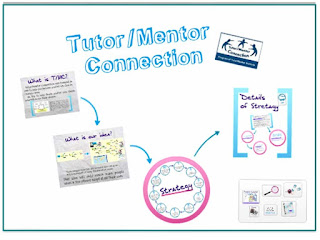
I launched this strategy map on line in 2005. Each node on this map expands to open a new page in the strategy map. Interns have created animated versions of this and other maps, helping expand understanding of the ideas.
The blue box at the top of the graphic represents the commitment of myself, or any other leader, to on-going actions that help youth born in poverty move through school and into jobs and careers, with the support of volunteers and staff in well-organized, long-term, tutor/mentor type programs.
In 2011 David Price of Debategraph encouraged me to embed this information on his platform. The graphic below can be accessed at http://debategraph.org/mentoring_kids_to_careers Click on any node and the map reforms with information related to that node.
This map has layers showing information in the Tutor/Mentor library. It's intended to support a conversation about ways people from every sector can “help youth move from living in poverty to jobs” as a result of long-term mentoring and a age appropriate learning supports. It's intended to support a conversation based on “what are all the things we need to be doing” that leads a growing number of people to take actions based on what they are learning.
As more information was added, the map became more complex, and thus fewer and fewer people were willing to view the map and, thus, use the information.
In other articles on this blog I've focused on network building and network mapping. Who are the people who should be looking at the information I've collected and who are the people who should be helping tutor/mentor programs grow in more places? How do we know who is involved? How do we expand involvement from year to year and sustain it over many years? This “village” map is one graphic intended to communicate this idea.
Recently I've connected with Gene Bellinger and a variety of other visualization innovators in groups on Linked in. I've shared my enthusiasm for systems thinking and idea mapping in articles like this one.
Through this I learned about another mapping platform called KUMU. I showed my interest in this in another article shown here
Yesterday I viewed a new video where Gene and Jeff talk about using KUMU which you can see below.
I hope you'll view this, and look at my own efforts to map networks, ideas and relationships. I really think this has huge potential and want to create some KUMU maps that would show the information in the Tutor/Mentor Institute, LLC library, as well as the information on the Debategraph map.
What appeals to me in this video is the ability to map networks of people and organizations, as well as the ability to sequence and relate ideas in ways others might follow along. If we can use these tools to identify who “is already involved” and to build “roadmaps” of actions that lead to more and better programs in the right places, helping youth through school and into jobs, this information can support millions of users, and provide a template for solving other social, environmental, health issues around the world.
I've worked under the “if you build it, they will come” mentality for 20 years since I never was able to find long-term partners and/or funders for the Tutor/Mentor Connection when I was first trying to build support in 1992 and 1993. I've had help from hundreds of people, but none have provided time, talent and dollars for the long term. Some who did give support were forced to stop due to business conditions, or changes in their own focus.
I just read an article in Fortune magazine about the property developers responsible for Silicon Valley. When they stated they had a few thousand dollars but the vision of what farmland could become if they put buildings on the property and found tenants. They are now billionaires. I'm energized to see that “if you build it, they will come” has actually worked for some people.
While I've attracted many positive comments, many interested parties, and more than 1 million visitors (and 15 million hits) to my web sites, this has been an effort to “find a needle in a world size haystack”. I know there are other people who share the same passion. We've just not connected.
I've created dozens of concept maps like the ones above that I feel could be converted to KUMU and communicated the same way Gene is sharing ideas in his videos. I think people could discuss the meaning of the maps, add new information, and form collaborations to apply the thinking in support of youth and families in their own communities, not just in Chicago.
I could convert the Debategraph by myself but I'm trying to resist this. I want to find partners in one or more universities, networks, companies, etc. who will not only provide the manpower, talent and dollars to do this work, but will take active roles in sharing this with the goal of putting the ideas to work over the next 20 years.
If you're at a university, part of a service learning project, or a company or foundation that supports this thinking please reach out and help me do this work.
Note: 7/7/2017 update - here's an article that applies systems thinking, concept mapping and theory of change ideas, using Kumu.io as the mapping tool. I've added this link to a section of the Tutor/Mentor web library, while also posting it here.
Wednesday, July 16, 2014
Tuesday, July 15, 2014
Expanding number of people involved in Chicago youth development
This graphic was created by an intern from South Korea as an update of an earlier project done in 2005 by an intern from Hong Kong. You can view it here.
This second graphic was created by a volunteer from the University of Michigan as part of a one week winter break project. You can view it here.
Both projects show that volunteers who become part of well-organized tutor/mentor programs grow in their understanding of poverty and the challenges faced by youth, families, and the tutor/mentor programs who support these connections. As some volunteers grow over a period of two to three or more years of involvement, some become recruiters and resource builders who do more to help the program, and some become deeply involved in the lives of the youth, and do more to help the youth move through school.
Using maps, leaders can build a marketing and program support effort, modeled after how corporate offices support multiple stores in different locations, to make more mentor rich programs available throughout a city like Chicago. At some point, the number of programs who are growing new leaders would lead to a constant expansion of the people and resources needed to grow the number of programs, and grow the impact of these programs.
This does not happen if a few leaders don't step forward to support this process.
See more ideas like this on the Tutor/Mentor Institute, LLC site and library.
This second graphic was created by a volunteer from the University of Michigan as part of a one week winter break project. You can view it here.
Both projects show that volunteers who become part of well-organized tutor/mentor programs grow in their understanding of poverty and the challenges faced by youth, families, and the tutor/mentor programs who support these connections. As some volunteers grow over a period of two to three or more years of involvement, some become recruiters and resource builders who do more to help the program, and some become deeply involved in the lives of the youth, and do more to help the youth move through school.
Using maps, leaders can build a marketing and program support effort, modeled after how corporate offices support multiple stores in different locations, to make more mentor rich programs available throughout a city like Chicago. At some point, the number of programs who are growing new leaders would lead to a constant expansion of the people and resources needed to grow the number of programs, and grow the impact of these programs.
This does not happen if a few leaders don't step forward to support this process.
See more ideas like this on the Tutor/Mentor Institute, LLC site and library.
Labels:
leadership,
planning,
strategy,
volunteer
Thursday, July 10, 2014
Problem Solving, Systems Thinking, Hacking: Violence, Education, Jobs
I’ve been working on this article for a week. The way I create articles is to draw from graphics and articles I’ve created in the past, and to point to articles, videos and graphics created by others who communicate an idea more effectively than I do.
Earlier this week I received the newsletter from the Making Learning Connected MOOC, #CLMOOC, which I’ve been following. This week’s assignment encourages participants to “hack their writing”.
In the newsletter these suggestions were offered:
In Make Cycle #4 we invite you to “Hack Your Writing.” Maybe you do not think you’re a “hacker” and associate the term exclusively with the most skillful and renegade of computer programmers. But this week we are encouraging a broader use of this term and a more open sense of its possibilities.
We imagine there are multiple entry points for this week’s make cycle. One option might be to revisit something you wrote before and “dress it up” anew. If you have a notebook or journal that you’ve scribbled in, if you have jotted down a fleeting poem, or if perhaps you have penned an essay or article, this week’s make cycle might involve revisiting an old writing moment and breathing new life into a former work. Perhaps you might want to take several different pieces of writing and put them together to create a collage or compilation? Go for it!
As I read this, I said, “That’s what I’ve been doing since I started writing this blog in 2005. It’s what interns have been doing when they create new versions of articles I’ve posted here.” So as you read this article, think of the different ways I’ve “hacked” and think of how you might duplicate what I’m posting to add your own voice to this movement.
The front page of both major newspapers featured “Violence in Chicago” this week. It's been an ongoing theme for a few years. In fact, This problem has been in the news off and on for over 20 years.
However, not much has changed. Perhaps if there were a “systems thinking” approach applied to this, more people might become informed, and involved in solutions. We might find ways to keep people involved for many years.
This is a long article. Please read on.
Here’s a graphic that I’ve borrowed from a video created by Gene Bellinger, who leads a Systems Thinking discussion group on Linkedin.
As I view Gene’s videos, my wish is that someone were doing exactly the same presentation, but focused on bringing people together to solve some of the problems we face in Chicago, which are deeply rooted in poverty, income inequality, political power, etc.
I've hacked Gene's video to copy this graphic, then to create views of each element.
I'm using them to communicate an idea that I launched over six years ago in a blog post focused on comparing the thinking and planning process that General's use to fight wars to what we need to be doing in Chicago to fight poverty and violence by providing stronger, on-going birth-to-work support systems for youth living in high poverty areas. You can find this graphic with an explanation here.
In the systems thinking video, this graphic is used to describe a “situation”, something that motivates people to gather to find ways to change the situation. In this and many articles I've posted on this blog the “situation” is poverty, violence, workforce development, poorly performing schools, and an ineffective funding stream to support organizations working to solve the problem.
In this graphic, Gene is focusing on how groups need to gather and review information that helps them understand the situation, as well as potential solutions.
In my own graphic, I show this as the analysis stage. I've created a huge library of information that people can use to understand how where you live influences what your future is. This library includes maps, that show all of the areas of Chicago where poverty is concentrated, so that planners provide support services in all of those areas, not just in high profile areas.
I've used concept maps to outline sections of the library. This shows sub sections. Thus in understanding violence you'd need to look at articles on poverty, drop out issues, social capital, workforce development, crime, etc. You can find this map at http://tinyurl.com/TMI-Library-Research
Based on shared understanding a group will propose solutions, and build strategies to implement those solutions. This is the Strategy stage Gene describes. I use this Strategy Map to focus attention on a goal that can be shared by just about everyone, which is to help kids grow up and be starting jobs and careers by their mid-20s. People in different places, and with different resources, will develop different strategies to reach this goal. If they are well supported, and given time, many can be effective.
Steps 2 through 6 of my graphic represent stages of putting a strategy into operation. This includes generating the revenue needed to fund the entire operation, not just parts of it. In the military, the troops in combat are supported by a huge supply chain. We don't have such a system supporting all of the organizations working with youth in Chicago. This is the adoption stage of Gene's video.
As the plan rolls out in its first year data is collected showing what happened, and new information is collected showing how others have been trying to solve the same problem in different places. An analysis of this information leads to improvement in the strategy so it works better the second year.
This graphic illustrates this process of constant improvement as “The Problem Solving Loop”. The “Reality” in this process is that complex problems, such as ending poverty, require many years of effort.
One of the articles from my web library is titled, “The cyclical process of action research – The contribution of Gilles Deleuze” This article is part of a web library hosted by Geno Bertini.
One complete sub section of the Tutor/Mentor web library focuses on process improvement, collaboration, knowledge management, visualization, etc. That map is shown below.
In action research, a situation is identified and a group of people gather to build understanding and propose solutions. An action plan is developed and the ideas are put in to action. When the initial problem is solved, such as getting a business to donate land for a park, a new situation is created, which is “what do we do with the land”. This requires new people, with new expertise.
In numerous reports mentoring is mentioned as a solution. The situation that needs to be addressed is “how do we connect youth and adults and keep them connected long enough for the mentoring to influence the habits and behaviors of the mentee?”
Organized tutor/mentor programs are a solution, but then the “situation” becomes “how do we make these programs available in all of the places where they are needed”.
A variety of mapping platforms are available to support this stage of planning. Maps can include overlays showing indicators, like poverty, violence, poorly performing schools. They can show locations of existing programs. They can even show assets in different parts of the city who should be supporting program growth in different areas. You can find many examples for using maps at http://mappingforjustice.blogspot.com
At this stage of the problem solving there are many different “situations” which need to be addressed concurrently. Every organization working to reduce poverty by helping young people move through school and into jobs, or in helping parents earn a wage that enables them to provide more support to their own kids, has the same needs. They all need volunteers, public visibility (advertising), operating dollars, technology, etc.
I've created graphics like this to illustrate the 12 years it takes for a youth to go from first grade through high school. Building funding commitments that sustain this journey in every neighborhood is one of the challenges we need to overcome. One of the PDF essays I've written it titled “tipping points”. It lists some actions that might lead to more and better youth serving organizations in places where they are most needed.
Step 7 of my graphic is one that we struggle with as a country. We fail to keep the issue in front of the public long enough to reach all the people who need to be involved in solving the problem, and we fail to keep them involved for all of the years it takes for great programs to grow in all the places where they are needed, then to grow their impact on youth as they move from first grade to first job, which is a 20 year journey for every youth.
Thus this is another “situation” that requires the involvement of people from many different backgrounds, who innovate ways to communicate ideas and create on-going social purpose advertising, without the same resources that for-profit businesses use to attract customers. Dan Pallotta's TED talk calls attention to this “situation”. Here's a blog article inviting you to be part of that problem solving community.
This is another graphic from my blog. Note how it includes elements from several other graphics that were created earlier. The intent is to show that if we want to solve complex problems we need to influence what resource providers do, not just what social service and education providers do.
As I mentioned above, a major challenge is finding ways to reach more people with these ideas, and doing so with few, or no, advertising dollars. One solution is to engage young people in communicating these ideas.
At this link you can see how an intern from South Korea “hacked” my blog article to create a new video interpretation of the first graphic in this article. Here's a page where you can see a video created by a different intern providing an interpretation of the above graphic.
My hope is that many will do this.
Read the articles about learning and network building on this blog. Every person who shares these ideas helps expand the network of people who get involved and stay involved in providing solutions to poverty in one or more places. As one person learns to hack these ideas in their own efforts, they become a leader who then mobilizes others, rather than a bystander who hoping others “will solve the problem” or who thinks they can build a wall that keeps them and their family safe and not affected.
I do my best with what talent I have to communicate these ideas. I know others can do better. That's why I include links in my articles to other web sites.
Here is the Systems Thinking video which I “hacked” to build this article.
This is one of a series of videos that I hope you'll take time to look at and share with others. Gene does a great job of showing tools to use to create understanding, while also helping us understand how to look at problem solving from a systems thinking perspective.
Here's a section of my web library with links to many other people with great ideas for collaboration, innovation, knowledge management, etc.
Here are more articles with strategy ideas that you can use to build your understanding of the situation and potential strategies to solve the problem.
There are thousands of consultants, writers, educators, etc. who provide tools and ideas that people can use to solve problems. Most of these are “generic”. It's like getting a liberal arts degree but needing to learn what to do when you get a job.
I think students in high schools and colleges could hack work done by people like Gene, and build versions that apply those tools and ideas to solving specific problems.
If you're already doing this, please share. Perhaps future MOOCS will be showcasing such work, and will be helping more people become involved.
Earlier this week I received the newsletter from the Making Learning Connected MOOC, #CLMOOC, which I’ve been following. This week’s assignment encourages participants to “hack their writing”.
In the newsletter these suggestions were offered:
In Make Cycle #4 we invite you to “Hack Your Writing.” Maybe you do not think you’re a “hacker” and associate the term exclusively with the most skillful and renegade of computer programmers. But this week we are encouraging a broader use of this term and a more open sense of its possibilities.
We imagine there are multiple entry points for this week’s make cycle. One option might be to revisit something you wrote before and “dress it up” anew. If you have a notebook or journal that you’ve scribbled in, if you have jotted down a fleeting poem, or if perhaps you have penned an essay or article, this week’s make cycle might involve revisiting an old writing moment and breathing new life into a former work. Perhaps you might want to take several different pieces of writing and put them together to create a collage or compilation? Go for it!
As I read this, I said, “That’s what I’ve been doing since I started writing this blog in 2005. It’s what interns have been doing when they create new versions of articles I’ve posted here.” So as you read this article, think of the different ways I’ve “hacked” and think of how you might duplicate what I’m posting to add your own voice to this movement.
The front page of both major newspapers featured “Violence in Chicago” this week. It's been an ongoing theme for a few years. In fact, This problem has been in the news off and on for over 20 years.
However, not much has changed. Perhaps if there were a “systems thinking” approach applied to this, more people might become informed, and involved in solutions. We might find ways to keep people involved for many years.
This is a long article. Please read on.
Here’s a graphic that I’ve borrowed from a video created by Gene Bellinger, who leads a Systems Thinking discussion group on Linkedin.
As I view Gene’s videos, my wish is that someone were doing exactly the same presentation, but focused on bringing people together to solve some of the problems we face in Chicago, which are deeply rooted in poverty, income inequality, political power, etc.
I've hacked Gene's video to copy this graphic, then to create views of each element.
I'm using them to communicate an idea that I launched over six years ago in a blog post focused on comparing the thinking and planning process that General's use to fight wars to what we need to be doing in Chicago to fight poverty and violence by providing stronger, on-going birth-to-work support systems for youth living in high poverty areas. You can find this graphic with an explanation here.
In the systems thinking video, this graphic is used to describe a “situation”, something that motivates people to gather to find ways to change the situation. In this and many articles I've posted on this blog the “situation” is poverty, violence, workforce development, poorly performing schools, and an ineffective funding stream to support organizations working to solve the problem.
In this graphic, Gene is focusing on how groups need to gather and review information that helps them understand the situation, as well as potential solutions.
In my own graphic, I show this as the analysis stage. I've created a huge library of information that people can use to understand how where you live influences what your future is. This library includes maps, that show all of the areas of Chicago where poverty is concentrated, so that planners provide support services in all of those areas, not just in high profile areas.
I've used concept maps to outline sections of the library. This shows sub sections. Thus in understanding violence you'd need to look at articles on poverty, drop out issues, social capital, workforce development, crime, etc. You can find this map at http://tinyurl.com/TMI-Library-Research
Based on shared understanding a group will propose solutions, and build strategies to implement those solutions. This is the Strategy stage Gene describes. I use this Strategy Map to focus attention on a goal that can be shared by just about everyone, which is to help kids grow up and be starting jobs and careers by their mid-20s. People in different places, and with different resources, will develop different strategies to reach this goal. If they are well supported, and given time, many can be effective.
Steps 2 through 6 of my graphic represent stages of putting a strategy into operation. This includes generating the revenue needed to fund the entire operation, not just parts of it. In the military, the troops in combat are supported by a huge supply chain. We don't have such a system supporting all of the organizations working with youth in Chicago. This is the adoption stage of Gene's video.
As the plan rolls out in its first year data is collected showing what happened, and new information is collected showing how others have been trying to solve the same problem in different places. An analysis of this information leads to improvement in the strategy so it works better the second year.
This graphic illustrates this process of constant improvement as “The Problem Solving Loop”. The “Reality” in this process is that complex problems, such as ending poverty, require many years of effort.
One of the articles from my web library is titled, “The cyclical process of action research – The contribution of Gilles Deleuze” This article is part of a web library hosted by Geno Bertini.
One complete sub section of the Tutor/Mentor web library focuses on process improvement, collaboration, knowledge management, visualization, etc. That map is shown below.
![]() |
| Process Improvement, Innovation, Knowledge Management, Visualization, etc. Open Map |
In numerous reports mentoring is mentioned as a solution. The situation that needs to be addressed is “how do we connect youth and adults and keep them connected long enough for the mentoring to influence the habits and behaviors of the mentee?”
Organized tutor/mentor programs are a solution, but then the “situation” becomes “how do we make these programs available in all of the places where they are needed”.
A variety of mapping platforms are available to support this stage of planning. Maps can include overlays showing indicators, like poverty, violence, poorly performing schools. They can show locations of existing programs. They can even show assets in different parts of the city who should be supporting program growth in different areas. You can find many examples for using maps at http://mappingforjustice.blogspot.com
At this stage of the problem solving there are many different “situations” which need to be addressed concurrently. Every organization working to reduce poverty by helping young people move through school and into jobs, or in helping parents earn a wage that enables them to provide more support to their own kids, has the same needs. They all need volunteers, public visibility (advertising), operating dollars, technology, etc.
I've created graphics like this to illustrate the 12 years it takes for a youth to go from first grade through high school. Building funding commitments that sustain this journey in every neighborhood is one of the challenges we need to overcome. One of the PDF essays I've written it titled “tipping points”. It lists some actions that might lead to more and better youth serving organizations in places where they are most needed.
Step 7 of my graphic is one that we struggle with as a country. We fail to keep the issue in front of the public long enough to reach all the people who need to be involved in solving the problem, and we fail to keep them involved for all of the years it takes for great programs to grow in all the places where they are needed, then to grow their impact on youth as they move from first grade to first job, which is a 20 year journey for every youth.
Thus this is another “situation” that requires the involvement of people from many different backgrounds, who innovate ways to communicate ideas and create on-going social purpose advertising, without the same resources that for-profit businesses use to attract customers. Dan Pallotta's TED talk calls attention to this “situation”. Here's a blog article inviting you to be part of that problem solving community.
This is another graphic from my blog. Note how it includes elements from several other graphics that were created earlier. The intent is to show that if we want to solve complex problems we need to influence what resource providers do, not just what social service and education providers do.
As I mentioned above, a major challenge is finding ways to reach more people with these ideas, and doing so with few, or no, advertising dollars. One solution is to engage young people in communicating these ideas.
At this link you can see how an intern from South Korea “hacked” my blog article to create a new video interpretation of the first graphic in this article. Here's a page where you can see a video created by a different intern providing an interpretation of the above graphic.
My hope is that many will do this.
Read the articles about learning and network building on this blog. Every person who shares these ideas helps expand the network of people who get involved and stay involved in providing solutions to poverty in one or more places. As one person learns to hack these ideas in their own efforts, they become a leader who then mobilizes others, rather than a bystander who hoping others “will solve the problem” or who thinks they can build a wall that keeps them and their family safe and not affected.
I do my best with what talent I have to communicate these ideas. I know others can do better. That's why I include links in my articles to other web sites.
Here is the Systems Thinking video which I “hacked” to build this article.
This is one of a series of videos that I hope you'll take time to look at and share with others. Gene does a great job of showing tools to use to create understanding, while also helping us understand how to look at problem solving from a systems thinking perspective.
Here's a section of my web library with links to many other people with great ideas for collaboration, innovation, knowledge management, etc.
Here are more articles with strategy ideas that you can use to build your understanding of the situation and potential strategies to solve the problem.
There are thousands of consultants, writers, educators, etc. who provide tools and ideas that people can use to solve problems. Most of these are “generic”. It's like getting a liberal arts degree but needing to learn what to do when you get a job.
I think students in high schools and colleges could hack work done by people like Gene, and build versions that apply those tools and ideas to solving specific problems.
If you're already doing this, please share. Perhaps future MOOCS will be showcasing such work, and will be helping more people become involved.
Labels:
collaboration,
MOOC,
planning,
strategy,
systems thinking
Tuesday, July 08, 2014
82 shot and 14 killed. The war zone that is Chicago.
This is a guest article, submitted by Dan Cotter, who is Chairman of the Board of the Lawyers Lend A Hand to Youth organization, and 2014-15 President of the Chicago Bar Association. This is his opinion, and not an official statement from either of the organizations where he serves.
We must find a way to stem this violence and to create safe places and alternatives. One way to address the violence is through strong mentoring programs in our disadvantaged communities. Working as a board member of Lawyers Lend-A-Hand over the last decade, I have witnessed the impact that mentoring has on our youth.
A recent example of how powerful mentoring can be occurred at the Lawyers Lend-A-Hand to Youth Spring Awards Dinner on April 30. At the dinner, George, a young man mentored through the Urban Life Skills Program of New Life Centers, spoke of how before joining the program he cared little for anyone else. He literally described himself as a "psychopath." After working with his mentor, he has become a whole new person that "wants to give back."
George is just one example. At an awards presentation by Jeffrey Leving to Passages, we met a number of young men who anxiously await the arrival daily of its executive director. They spoke of how important the mentoring program was to them and described it as a sanctuary from the streets and violence around them.
A dozen years ago, with two young children at home, I wanted to pay it forward for the huge impact mentoring had on my life. From my first mentor, my dad, to my 8th grade teacher, Cheryl Porter, to my high school coach, John Urban, to my college coaches, Tiny Devore and Kelly Kane, to my first boss in law, Mark Wilcox, and first corporate mentor, Paul Hourihan, to my wife, Ann, I have been blessed. So many provided advice, tutoring, and friendship to me. I was beginning to competitively powerlift. I joined the two and came up with Lifting to Lend-A-Hand. In 2002, I raised $2,600. I took 2003 off due to injury but then discovered I was a line item for revenue in the LLAH budget.
The next 9 years, the amount increased each year until we raised $45,000 in 2012. Taking a year off to "allow the organization to find other fundraising avenues," I decided to give it one final push this year as I became CBA President.
Thinking of George and the wonderful work grantees of LLAH perform to provide our future with strong mentoring opportunities, I decided the goal this year would be one year's grants - $100,000. Nothing ventured, nothing gained. And think of the number of George's we can help with that amount.
It literally takes not just a village but a city, a state and beyond. You can partner with me. No amount is too small - if 5,000 people gave $20 each, we would hit it; 2,000 people at $50 each, 10,000 @ $10, 1,000 @ $100, etc. With just under two weeks to go, we are about to surpass $50,000 with less than 200 donors. Think of the alternatives if we hit $100,000. A city with less violence and more future. Please I to lawyerslendahand.org, hit donate and give what you can. $1, $5, $10. Etc. Dig deep and be part of the collective you that raises $100,000 for mentoring. Thank the mentors who have you their time, talent and treasures. Pay it forward. Yours in mentoring, grateful and thankful for the power of mentoring, The Lifting Lawyer. @lifting2014xi. Liftingtolendahand@hotmail.com.
Thank you Dan. We need more leaders duplicating your efforts.
In the editorial page of the July 14, 2014 Chicago Tribune, the final call to action says "If Chicago is to conquer this plague of violence in Chicago, the solutions have to come from all of us." The image at the left is from the October 15, 1992 Chicago Sun Times, where virtually the same call to responsibility was issued.
I've been trying to build business and political support for volunteer-based tutor/mentor programs for nearly 25 year. This image is from 1990 when Mayor Richard Daley and the CEOs of the Montgomery Ward Corporation and Quaker Oats Corporation visited the tutor/mentor program I led in Chicago. If you view past newsletters, media stories, and blog articles, you'll see a consistent call for leadership that would help mentor-rich programs grow in high poverty areas of Chicago and its suburbs.
This "it takes a village" map is one I've shared for many years, indicating that leaders from every sector need to support the growth of mentor rich programs that help youth through school and into jobs.
Had these ideas been embraced in the early 1990s, perhaps there would be fewer youth out on the streets shooting at each other.
Unless these strategies are embraced in 2014, I fear what the stories will be in 2034.
We need more people like Dan Cotter, doing heavy lifting to raise funds to support tutor/mentor programs, and using his own social media to help me spread this message.
We must find a way to stem this violence and to create safe places and alternatives. One way to address the violence is through strong mentoring programs in our disadvantaged communities. Working as a board member of Lawyers Lend-A-Hand over the last decade, I have witnessed the impact that mentoring has on our youth.
A recent example of how powerful mentoring can be occurred at the Lawyers Lend-A-Hand to Youth Spring Awards Dinner on April 30. At the dinner, George, a young man mentored through the Urban Life Skills Program of New Life Centers, spoke of how before joining the program he cared little for anyone else. He literally described himself as a "psychopath." After working with his mentor, he has become a whole new person that "wants to give back."
George is just one example. At an awards presentation by Jeffrey Leving to Passages, we met a number of young men who anxiously await the arrival daily of its executive director. They spoke of how important the mentoring program was to them and described it as a sanctuary from the streets and violence around them.
A dozen years ago, with two young children at home, I wanted to pay it forward for the huge impact mentoring had on my life. From my first mentor, my dad, to my 8th grade teacher, Cheryl Porter, to my high school coach, John Urban, to my college coaches, Tiny Devore and Kelly Kane, to my first boss in law, Mark Wilcox, and first corporate mentor, Paul Hourihan, to my wife, Ann, I have been blessed. So many provided advice, tutoring, and friendship to me. I was beginning to competitively powerlift. I joined the two and came up with Lifting to Lend-A-Hand. In 2002, I raised $2,600. I took 2003 off due to injury but then discovered I was a line item for revenue in the LLAH budget.
The next 9 years, the amount increased each year until we raised $45,000 in 2012. Taking a year off to "allow the organization to find other fundraising avenues," I decided to give it one final push this year as I became CBA President.
Thinking of George and the wonderful work grantees of LLAH perform to provide our future with strong mentoring opportunities, I decided the goal this year would be one year's grants - $100,000. Nothing ventured, nothing gained. And think of the number of George's we can help with that amount.
It literally takes not just a village but a city, a state and beyond. You can partner with me. No amount is too small - if 5,000 people gave $20 each, we would hit it; 2,000 people at $50 each, 10,000 @ $10, 1,000 @ $100, etc. With just under two weeks to go, we are about to surpass $50,000 with less than 200 donors. Think of the alternatives if we hit $100,000. A city with less violence and more future. Please I to lawyerslendahand.org, hit donate and give what you can. $1, $5, $10. Etc. Dig deep and be part of the collective you that raises $100,000 for mentoring. Thank the mentors who have you their time, talent and treasures. Pay it forward. Yours in mentoring, grateful and thankful for the power of mentoring, The Lifting Lawyer. @lifting2014xi. Liftingtolendahand@hotmail.com.
Thank you Dan. We need more leaders duplicating your efforts.
In the editorial page of the July 14, 2014 Chicago Tribune, the final call to action says "If Chicago is to conquer this plague of violence in Chicago, the solutions have to come from all of us." The image at the left is from the October 15, 1992 Chicago Sun Times, where virtually the same call to responsibility was issued.
I've been trying to build business and political support for volunteer-based tutor/mentor programs for nearly 25 year. This image is from 1990 when Mayor Richard Daley and the CEOs of the Montgomery Ward Corporation and Quaker Oats Corporation visited the tutor/mentor program I led in Chicago. If you view past newsletters, media stories, and blog articles, you'll see a consistent call for leadership that would help mentor-rich programs grow in high poverty areas of Chicago and its suburbs.
This "it takes a village" map is one I've shared for many years, indicating that leaders from every sector need to support the growth of mentor rich programs that help youth through school and into jobs.
Had these ideas been embraced in the early 1990s, perhaps there would be fewer youth out on the streets shooting at each other.
Unless these strategies are embraced in 2014, I fear what the stories will be in 2034.
We need more people like Dan Cotter, doing heavy lifting to raise funds to support tutor/mentor programs, and using his own social media to help me spread this message.
Tuesday, July 01, 2014
Create a University Tutor/Mentor Connection
Since forming the Tutor/Mentor Connection in 1993 a major goal has been that others adopt the strategy and use their own resources to help volunteer-based tutor/mentor programs grow and impact the lives of youth and volunteers in different parts of the Chicago region.
Colleges and universities are an ideal host for Tutor/Mentor Connection teams, especially since they are located geographically in different parts of the Chicago region. If you browse this section of articles you can see many that have been written with this goal in mind.
Many universities have vast resources that could be supporting the long-term mission of the Tutor/Mentor Connection and Tutor/Mentor Institute, LLC, but in most cases, there is no central coordination drawing these resources into collaboration. Instead there are "silos" and "competition for resources" that reduce the long-term impact.
Here's an article illustrating this potential, written by an alumni from Northwestern University, who served a one year fellowship with the Tutor/Mentor Connection. This includes a map of the different departments at Northwestern University who could be working individually with Tutor/Mentor Connection, or collectively, through a University Tutor/Mentor Connection partnership, to help more kids from poor neighborhoods go from first grade to first job, with college a step along the way.
Many universities, such as Loyola University Chicago, have launched Centers for Experiential Learning to support the engagement of students, faculty, and possibly even alumni. At the University of Wisconsin-Parkside, this is called the Center for Community Partnerships.
At University of Wisconsin-Parkside the Center has taken the lead in helping a Mentor Kenosha Racine strategy develop.
It's been the goal of the Tutor/Mentor Connection, and the Tutor/Mentor Institute, to work with universities all over the world, and connecting them to each other via web forums and knowledge sharing. All it takes to get started is for one faculty member, or student, to join us on our Tutor/Mentor Connection ning site, and begin learning what we do, and sharing this with others.
Here's a progression of questions that might be asked:
a) What is the Tutor/Mentor Connection? What is the Tutor/Mentor Institute?
b) What are the questions we're asking and that we need help in answering?
c) What are the questions we're not yet asking, that you might begin to ask, based on your growing involvement with the T/MC?
d) What are the opportunities?
e) How can involvement with T/MC benefit the university, its students, its alumni, its donors, and the general community and society?
There's already a model for this type of student investigation. The presentation below was created by an intern from Illinois Institute of Technology, as part of a six week internship.
Colleges and universities are an ideal host for Tutor/Mentor Connection teams, especially since they are located geographically in different parts of the Chicago region. If you browse this section of articles you can see many that have been written with this goal in mind.
Many universities have vast resources that could be supporting the long-term mission of the Tutor/Mentor Connection and Tutor/Mentor Institute, LLC, but in most cases, there is no central coordination drawing these resources into collaboration. Instead there are "silos" and "competition for resources" that reduce the long-term impact.
Here's an article illustrating this potential, written by an alumni from Northwestern University, who served a one year fellowship with the Tutor/Mentor Connection. This includes a map of the different departments at Northwestern University who could be working individually with Tutor/Mentor Connection, or collectively, through a University Tutor/Mentor Connection partnership, to help more kids from poor neighborhoods go from first grade to first job, with college a step along the way.
Many universities, such as Loyola University Chicago, have launched Centers for Experiential Learning to support the engagement of students, faculty, and possibly even alumni. At the University of Wisconsin-Parkside, this is called the Center for Community Partnerships.
At University of Wisconsin-Parkside the Center has taken the lead in helping a Mentor Kenosha Racine strategy develop.
It's been the goal of the Tutor/Mentor Connection, and the Tutor/Mentor Institute, to work with universities all over the world, and connecting them to each other via web forums and knowledge sharing. All it takes to get started is for one faculty member, or student, to join us on our Tutor/Mentor Connection ning site, and begin learning what we do, and sharing this with others.
Here's a progression of questions that might be asked:
a) What is the Tutor/Mentor Connection? What is the Tutor/Mentor Institute?
b) What are the questions we're asking and that we need help in answering?
c) What are the questions we're not yet asking, that you might begin to ask, based on your growing involvement with the T/MC?
d) What are the opportunities?
e) How can involvement with T/MC benefit the university, its students, its alumni, its donors, and the general community and society?
There's already a model for this type of student investigation. The presentation below was created by an intern from Illinois Institute of Technology, as part of a six week internship.
At this page you can find many visualizations done by interns and on this page, many articles written by interns.
In most cases, the people teaching at a university don't know much about the Tutor/Mentor Connection, and have not given much thought as to ways students could have a meaningful role with us. I'd like to create a learning process that leads to a better understanding of the Tutor/Mentor Connection and strategies that have been developed over the past 20 years, which could be lead by teams from any university.
Finally, this should be thought of as an on-going project. We both learn from the experiences of the first students, and use that to improve the design of the University engagement, so that each successive student benefits more, and contributes more to the success of local volunteer based tutor/mentor programs around the university, in Chicago and in other cities, through support given by intermediary organizations like T/MC.
In the early 2000s a team of graduate students at DePaul University developed a presentation, intended to serve as strategic planning for a University seeking to form a Tutor/Mentor Connection. I've updated that several times and now it is available on Scribd.com.
If you'd like to meet with me to discuss this idea, let's connect on-line or suggest a time when we might meet here in the Chicago region.
If you're interested in this idea, email me at tutormentor2 at earthlink.net or connect on Twitter @tutormentorteam
In most cases, the people teaching at a university don't know much about the Tutor/Mentor Connection, and have not given much thought as to ways students could have a meaningful role with us. I'd like to create a learning process that leads to a better understanding of the Tutor/Mentor Connection and strategies that have been developed over the past 20 years, which could be lead by teams from any university.
Finally, this should be thought of as an on-going project. We both learn from the experiences of the first students, and use that to improve the design of the University engagement, so that each successive student benefits more, and contributes more to the success of local volunteer based tutor/mentor programs around the university, in Chicago and in other cities, through support given by intermediary organizations like T/MC.
In the early 2000s a team of graduate students at DePaul University developed a presentation, intended to serve as strategic planning for a University seeking to form a Tutor/Mentor Connection. I've updated that several times and now it is available on Scribd.com.
If you'd like to meet with me to discuss this idea, let's connect on-line or suggest a time when we might meet here in the Chicago region.
If you're interested in this idea, email me at tutormentor2 at earthlink.net or connect on Twitter @tutormentorteam
Monday, June 30, 2014
Connecting network. Building Relationships.
The video below is from a Google hangout this morning, with Terry Elliott, who I met last year when I began following the Making Learning Connected MOOC. That is repeating again this year and following a comment I posted a week ago, Terry invited me to connect this morning in a Hangout. I hope you'll take a look.
I've been reaching out to share ideas and learn from others via on-line communities since I started using the Internet in 1998. This is part of a process of learning and network building that I feel is essential to expand my own effectiveness, and expand the range of non-school, volunteer-based tutor/mentor programs reaching youth in high poverty areas of Chicago and other cities.
This relationship-building is a process. In the final part of today's interview, Terry said that when I first started posting on the CLMOOC he and other organizers were not sure if I wasn't just a spammer. Over time Terry began to dig deeper to see how what I was posting was related to the goals of the group, and that led to today's interview.
I started participating in discussions on the Skoll Foundation's Social Edge platform in 2005, and over the years have built strong relationships with a few people. Here's a discussion led by Charles Cameron, who I started connecting with in 2005. As a result Charles was a speaker at the 2010 Tutor/Mentor Conference I host in Chicago.
I first connected with the Webheads group in 2004, and in recent years that has resulted in on-line sessions like the one today. Here's a link to a discussion with Vance Stephens in 2012. This link points to an archive of many interviews and videos I've been part of.
I've participated in MOOCs for the past few years and believe that MOOCS are one strategy for building a deeper understanding of all the ideas I share on the Tutor/Mentor Institute, LLC web site, as well as a larger network of people who help share that information and apply the ideas in more places.
I post links to these MOOCs, and to articles about "how to create a MOOC" with the goal that others will step forward to organize MOOCs and communities of practice aimed at helping mentor-rich youth programs grow in more places, using the ideas I and others share from our own experiences.
Thanks Terry for taking time to get to know what I was offering the community and for inviting me to share my ideas in today's hangout.
I've been reaching out to share ideas and learn from others via on-line communities since I started using the Internet in 1998. This is part of a process of learning and network building that I feel is essential to expand my own effectiveness, and expand the range of non-school, volunteer-based tutor/mentor programs reaching youth in high poverty areas of Chicago and other cities.
This relationship-building is a process. In the final part of today's interview, Terry said that when I first started posting on the CLMOOC he and other organizers were not sure if I wasn't just a spammer. Over time Terry began to dig deeper to see how what I was posting was related to the goals of the group, and that led to today's interview.
I started participating in discussions on the Skoll Foundation's Social Edge platform in 2005, and over the years have built strong relationships with a few people. Here's a discussion led by Charles Cameron, who I started connecting with in 2005. As a result Charles was a speaker at the 2010 Tutor/Mentor Conference I host in Chicago.
I first connected with the Webheads group in 2004, and in recent years that has resulted in on-line sessions like the one today. Here's a link to a discussion with Vance Stephens in 2012. This link points to an archive of many interviews and videos I've been part of.
I've participated in MOOCs for the past few years and believe that MOOCS are one strategy for building a deeper understanding of all the ideas I share on the Tutor/Mentor Institute, LLC web site, as well as a larger network of people who help share that information and apply the ideas in more places.
I post links to these MOOCs, and to articles about "how to create a MOOC" with the goal that others will step forward to organize MOOCs and communities of practice aimed at helping mentor-rich youth programs grow in more places, using the ideas I and others share from our own experiences.
Thanks Terry for taking time to get to know what I was offering the community and for inviting me to share my ideas in today's hangout.
Labels:
CLMOOC,
interview,
MOOC,
network building
Thursday, June 19, 2014
Deeper Thinking about Strategic Philanthropy - Join in
There's been an interesting conversation about 'strategic philanthropy' taking place on Stanford Social Innovation Review, the Center for Effective Philanthropy and other places.
On Monday, June 16 I received a White Paper from the Donors Forum of Chicago, titled: "A Commitment to Full Cost Funding" which includes solid recommendations to funders that I hope readers will share.
I posted some ideas about how philanthropy can better support non profits here, and I've built a library showing challenges to non profits at this link.
If you believe in the value of volunteer-based tutor/mentor programs and understand that long-term connections have the most impact, what keeps you from helping mobilize resources to support the on-going operations of programs in every part of the Chicago region? That's what Dan Cotter is doing with his weight lifting. He's been raising money to support tutor/mentor programs in Chicago for more than 10 years. He's not asking for metrics and outcome statements. He knows that without the operating funds, good programs cannot be available, and good programs cannot stay good.
For great programs to reach youth in more places, people in every sector need to be learning more about ways to help, and talking to other people about ways they can help.
See how Mark Carter is using his blog to engage his followers in this discussion. See how Betsey Merkel of I-Open in Ohio is using her blog to expand this discussion. If you do the same, you can help expand the network of people looking at this information, and acting consistently to help youth tutor/mentor programs grow in places where they are most needed.
If hundreds, or thousands, of resource providers reach out consistently to support constantly improving youth tutoring, mentoring and learning programs, they will reach youth in more places, and grow their impact, on youth, and the volunteers who get involved.
On Monday, June 16 I received a White Paper from the Donors Forum of Chicago, titled: "A Commitment to Full Cost Funding" which includes solid recommendations to funders that I hope readers will share.
I posted some ideas about how philanthropy can better support non profits here, and I've built a library showing challenges to non profits at this link.
If you believe in the value of volunteer-based tutor/mentor programs and understand that long-term connections have the most impact, what keeps you from helping mobilize resources to support the on-going operations of programs in every part of the Chicago region? That's what Dan Cotter is doing with his weight lifting. He's been raising money to support tutor/mentor programs in Chicago for more than 10 years. He's not asking for metrics and outcome statements. He knows that without the operating funds, good programs cannot be available, and good programs cannot stay good.
For great programs to reach youth in more places, people in every sector need to be learning more about ways to help, and talking to other people about ways they can help.
See how Mark Carter is using his blog to engage his followers in this discussion. See how Betsey Merkel of I-Open in Ohio is using her blog to expand this discussion. If you do the same, you can help expand the network of people looking at this information, and acting consistently to help youth tutor/mentor programs grow in places where they are most needed.
If hundreds, or thousands, of resource providers reach out consistently to support constantly improving youth tutoring, mentoring and learning programs, they will reach youth in more places, and grow their impact, on youth, and the volunteers who get involved.
Saturday, June 14, 2014
Can World Cup draw attention to poverty, not just to sports?
So now another mega sports event is capturing the attention of millions of people, not just in the USA, but around the world. In some of the coverage of the World Cup, I've seen stories about the poverty in Brazil. But these stories are fragmented. They fight for attention.
I've been creating map stories for nearly 20 years in an attempt to draw people into a discussion of solutions.
What can we do to create a "World Cup" like focus on forums where people build a better understanding of poverty and environmental issues, and of potential solutions that could be implemented in more places if resource providers were doing as much to support poverty fighting teams as they do to support sports teams?
I attended a Veteran's event in Chicago last week, where the issue was employment of vets. As I took notes, I scribbled an idea, which I converted into this graphic:
When I describe mentoring, I'm talking about organizations that bring together a wide range of volunteers with youth who live in neighborhoods dominated by poverty, which means the range of adults modeling a variety of college and career options is limited. The graphic I created at the Veteran's event suggest that if young people became part of an extended network of adults BEFORE they entered the military, they would have the support of that network AFTER they left (and while they are there).
Here's an article I posted showing how veterans might become staff and volunteers in a citywide network of mentor-rich programs, creating jobs for vets and networks of support for future vets.
This type of structure exists naturally in more affluent and diverse communities. It's a structure that needs to be created and sustained in high poverty areas. While a few people might see this on my blog, or when I post it on Twitter, that's not the type of viewer mass that is needed. It's no where close to how many are following golf, basketball, soccer and baseball this weekend.
Which leads to the question, and the challenge, of engaging resource providers as on-going partners and supporters of mentor-rich programs in more places.
There's been an interesting conversation about 'strategic philanthropy' taking place on Stanford Social Innovation Review, the Center for Effective Philanthropy and other places.
UPDATE: On Monday, June 16 I received a White Paper from the Donors Forum of Chicago, titled: "A Commitment to Full Cost Funding" which includes solid recommendations to funders that I hope readers will share.
I posted some ideas about how philanthropy can better support non profits here, and I've built a library showing challenges to non profits at this link.
So how do we attract just a fraction of the attention devoted to sports, entertainment and other time-consuming activities so that more people are spending time looking at this information? How do we increase the number who are talking about these ideas over water coolers and on social media, like they talk about yesterday, or tomorrow's, sports event? How do we bring team owners, investors, philanthropic leaders into the same discussion space?
I'm participating in a Making Learning Connected MOOC (#clmooc) , which started on June 5. Online events like this are a step toward bringing more people together. Some of the ideas shared focus on engaging youth, and making learning a game. If more people are looking at these ideas, more will begin to innovate ways to bring people together to solve problems.
However, until we have sports celebrities helping draw people to these forums, we'll have too little attention, and too few participating. I share some ideas on this on past articles.
I've been creating map stories for nearly 20 years in an attempt to draw people into a discussion of solutions.
What can we do to create a "World Cup" like focus on forums where people build a better understanding of poverty and environmental issues, and of potential solutions that could be implemented in more places if resource providers were doing as much to support poverty fighting teams as they do to support sports teams?
I attended a Veteran's event in Chicago last week, where the issue was employment of vets. As I took notes, I scribbled an idea, which I converted into this graphic:
When I describe mentoring, I'm talking about organizations that bring together a wide range of volunteers with youth who live in neighborhoods dominated by poverty, which means the range of adults modeling a variety of college and career options is limited. The graphic I created at the Veteran's event suggest that if young people became part of an extended network of adults BEFORE they entered the military, they would have the support of that network AFTER they left (and while they are there).
Here's an article I posted showing how veterans might become staff and volunteers in a citywide network of mentor-rich programs, creating jobs for vets and networks of support for future vets.
This type of structure exists naturally in more affluent and diverse communities. It's a structure that needs to be created and sustained in high poverty areas. While a few people might see this on my blog, or when I post it on Twitter, that's not the type of viewer mass that is needed. It's no where close to how many are following golf, basketball, soccer and baseball this weekend.
Which leads to the question, and the challenge, of engaging resource providers as on-going partners and supporters of mentor-rich programs in more places.
There's been an interesting conversation about 'strategic philanthropy' taking place on Stanford Social Innovation Review, the Center for Effective Philanthropy and other places.
UPDATE: On Monday, June 16 I received a White Paper from the Donors Forum of Chicago, titled: "A Commitment to Full Cost Funding" which includes solid recommendations to funders that I hope readers will share.
I posted some ideas about how philanthropy can better support non profits here, and I've built a library showing challenges to non profits at this link.
So how do we attract just a fraction of the attention devoted to sports, entertainment and other time-consuming activities so that more people are spending time looking at this information? How do we increase the number who are talking about these ideas over water coolers and on social media, like they talk about yesterday, or tomorrow's, sports event? How do we bring team owners, investors, philanthropic leaders into the same discussion space?
I'm participating in a Making Learning Connected MOOC (#clmooc) , which started on June 5. Online events like this are a step toward bringing more people together. Some of the ideas shared focus on engaging youth, and making learning a game. If more people are looking at these ideas, more will begin to innovate ways to bring people together to solve problems.
However, until we have sports celebrities helping draw people to these forums, we'll have too little attention, and too few participating. I share some ideas on this on past articles.
Labels:
cause marketing,
collective action,
events,
leadership,
MOOC,
sports
Wednesday, June 11, 2014
Mapping strategies. Building Shared Understanding
Over the past few months I've been building an understanding of a new concept mapping software (KUMU), by following its use in the Systems Thinking World. I viewed this video today:
In the video is a graphic of an iceberg. After viewing that I searched for a post I'd made in the past, using an iceberg graphic that had been created to show the infrastructure needed to support youth and volunteer connections in organized, non-school tutor/mentor programs. I've included the text of that blog article, written in 2012, below.
I've been using concept maps to show strategy, and in 2011 created this Debategraph outline, to show everything we should be thinking about in efforts to help kids living in high poverty areas get the extra support needed to move through school and into jobs.
I've so much information on my web library that most people have a hard time understanding what's there. I created this concept map to show a "learning path" that people might use to go through the information.
Once you view the video above, the one below, and the iceberg graphics, I hope some of you will help me find some volunteers and/or college study groups who might want to help me build a Kumu version of this learning path, and videos that describe each step of the map.
Here's the article from 2012
This video is one I've discovered as a result of connecting with a Systems Thinking World group on Linked in.
In the video is a graphic that looks like an Iceberg along with a graphic showing a problem solving process. I've used this graphic to show the range of skills/actions that need to be embedded into a tutor/mentor program in order for it to have a growing impact on the lives of kids, volunteers and communities.
This graphic includes a map, illustrating that great tutor/mentor programs are needed in many parts of Chicago. It also includes an inverted pyramid which illustrates steps communities need to go through to build enough support and u understanding to generate the resources that enable each program to have the skills/talents shown in the above graphic. And it shows a need to connect people from beyond poverty with the information being shared and with programs in different high poverty neighborhoods.
I'd like to find volunteers, interns, researchers, Phd students and partners who can convert my maps and charts and essays into systems thinking diagrams and videos so that we might gain grater understanding and support for the ideas.
Want to help?
12-28-18 update - Systems Thinking Model: The Iceberg - related reading for the ideas posted in this article. click here
In the video is a graphic of an iceberg. After viewing that I searched for a post I'd made in the past, using an iceberg graphic that had been created to show the infrastructure needed to support youth and volunteer connections in organized, non-school tutor/mentor programs. I've included the text of that blog article, written in 2012, below.
I've been using concept maps to show strategy, and in 2011 created this Debategraph outline, to show everything we should be thinking about in efforts to help kids living in high poverty areas get the extra support needed to move through school and into jobs.
I've so much information on my web library that most people have a hard time understanding what's there. I created this concept map to show a "learning path" that people might use to go through the information.
Once you view the video above, the one below, and the iceberg graphics, I hope some of you will help me find some volunteers and/or college study groups who might want to help me build a Kumu version of this learning path, and videos that describe each step of the map.
Here's the article from 2012
This video is one I've discovered as a result of connecting with a Systems Thinking World group on Linked in.
In the video is a graphic that looks like an Iceberg along with a graphic showing a problem solving process. I've used this graphic to show the range of skills/actions that need to be embedded into a tutor/mentor program in order for it to have a growing impact on the lives of kids, volunteers and communities.

This graphic includes a map, illustrating that great tutor/mentor programs are needed in many parts of Chicago. It also includes an inverted pyramid which illustrates steps communities need to go through to build enough support and u understanding to generate the resources that enable each program to have the skills/talents shown in the above graphic. And it shows a need to connect people from beyond poverty with the information being shared and with programs in different high poverty neighborhoods.

I'd like to find volunteers, interns, researchers, Phd students and partners who can convert my maps and charts and essays into systems thinking diagrams and videos so that we might gain grater understanding and support for the ideas.
Want to help?
12-28-18 update - Systems Thinking Model: The Iceberg - related reading for the ideas posted in this article. click here
Friday, June 06, 2014
D-Day and Planning
As you read about D-Day and the sacrifices soldiers made seventy years ago, I encourage you to think of the planning that enabled the landing, and the massive buildup of supplies needed to support the landing and the push into Europe in 1944 and 1945.
Then, spend a few moments viewing this video, created for the Tutor/Mentor Institute, LLC by Kyungryul Kim, an intern from South Korea. His video provided a new interpretation of the ideas presented originally in this PDF essay, which shows strategies needed to build and sustain a wide range of youth serving organizations reaching k-12 kids in high poverty areas of Chicago and other cities.
Yesterday morning I attended a symposium in Chicago, focused on employment of veterans. In the evening I attended a reception hosted by the Civic Consulting Alliance which "takes on projects with the potential to make a big difference in our (Chicago) region."
I met several people in each event who have talents, skills and networks that could adopt the ideas in the video above into their own efforts, and who could communicate them more effectively, and with greater influence, than I can. Together we could build a better information base to support social/economic problem solving. We could create more frequent communications, serving as advertising to draw needed resources to all of the organizations working in Chicago to solve the same problems, but in different places. We could generate thousands of small group discussions, like those that take places in faith groups each week, where people dig into the information and learn ways to become part of a solution distribution system, which looks very much like the distribution of supplies needed to support troops who landed on Normandy 70 years ago.
Our social sector needs this type of support. It does not exist.
I hope some will take a few moments to view my blog and ideas and will want to find ways to connect.
In this blog article I introduced people I met a few weeks ago, showing how they had the talent to create visualizations and communicate ideas more effectively than I do. I felt the same way as I passed out business cards yesterday.
Here's an example of how Betsey Merkel, who leads the I-Open network in Ohio, has used her blog to communicate my ideas. Here's an article on Kelly Fair's blog, sharing my ideas.
The video above is just one of many presentations created by interns working with me since 2005 and the two blogs I pointed to are just a few examples of how others are amplifying the ideas by communicating them in their own networks.
As you view more on this page I invite you to consider how you might communicate these ideas and support the planning and infrastructure needed to help solve, complex, long-term problems created by high concentrations of poverty and great gaps in wealth and opportunity.
Connect with me on Twitter @tutormentor team, or on my Facebook page. Or connect with me on Linkedin.
Then, spend a few moments viewing this video, created for the Tutor/Mentor Institute, LLC by Kyungryul Kim, an intern from South Korea. His video provided a new interpretation of the ideas presented originally in this PDF essay, which shows strategies needed to build and sustain a wide range of youth serving organizations reaching k-12 kids in high poverty areas of Chicago and other cities.
Yesterday morning I attended a symposium in Chicago, focused on employment of veterans. In the evening I attended a reception hosted by the Civic Consulting Alliance which "takes on projects with the potential to make a big difference in our (Chicago) region."
I met several people in each event who have talents, skills and networks that could adopt the ideas in the video above into their own efforts, and who could communicate them more effectively, and with greater influence, than I can. Together we could build a better information base to support social/economic problem solving. We could create more frequent communications, serving as advertising to draw needed resources to all of the organizations working in Chicago to solve the same problems, but in different places. We could generate thousands of small group discussions, like those that take places in faith groups each week, where people dig into the information and learn ways to become part of a solution distribution system, which looks very much like the distribution of supplies needed to support troops who landed on Normandy 70 years ago.
Our social sector needs this type of support. It does not exist.
I hope some will take a few moments to view my blog and ideas and will want to find ways to connect.
In this blog article I introduced people I met a few weeks ago, showing how they had the talent to create visualizations and communicate ideas more effectively than I do. I felt the same way as I passed out business cards yesterday.
Here's an example of how Betsey Merkel, who leads the I-Open network in Ohio, has used her blog to communicate my ideas. Here's an article on Kelly Fair's blog, sharing my ideas.
The video above is just one of many presentations created by interns working with me since 2005 and the two blogs I pointed to are just a few examples of how others are amplifying the ideas by communicating them in their own networks.
As you view more on this page I invite you to consider how you might communicate these ideas and support the planning and infrastructure needed to help solve, complex, long-term problems created by high concentrations of poverty and great gaps in wealth and opportunity.
Connect with me on Twitter @tutormentor team, or on my Facebook page. Or connect with me on Linkedin.
Monday, June 02, 2014
More Heavy Lifters Needed
This photo shows Daniel Cotter, the incoming president of the Chicago Bar Association, doing some “heavy lifting” to raise money to support volunteer based tutor/mentor programs in Chicago.
Dan sent me information about this year’s lifting event over the weekend and I invited him to write an article that I could share on my blog, and that others can share via social media and their own email networks.
Dan wrote:
"Approximately 15 years ago, I started to compete in powerlifting. My good friend from college suggested I consider it so that my training had a focus and I had specific goals in the gym. I played football in college and the 10 years since I had graduated were not exactly kind to my body. At my 10th reunion, some of my teammates suggested I get back in the gym. I did so the following Monday.
Competing did give me a focus and a mission. Early meets were not great in terms of the weights lifted. But I had a plan. In 2002, I was a Vice Chair of the Young Lawyers Section of the Chicago Bar Association. The YLS had a mentoring program with Working in the Schools. The program required that the participants be available one day a week for several hours to tutor and mentor a Chicago student. I wanted to do it, but had a five year old and a two year old at home. I could not directly participate in the mentoring program.
I was competing in meets. I thought that the idea of raising money like a walkathon or marathon while competing in a meet would help mentoring even if I could not directly mentor. I made the proposal and “Lifting to Lend-A-Hand” was born. The idea was simple – I would solicit people I knew for donations and then lift. The first year, in 2002, I raised $2,600. That was a good raise. Since then, the raise has gone up each year and in 2012, the last time I did the event, I raised $45,000.
Every penny that I raise goes to the Sun-Times Judge Marovitz Lawyers Lend-A-Hand to Youth, which promotes best practice mentoring programs in disadvantaged communities. Since its founding in 1994 by former CBA President Thomas A. Demetrio, Lawyers Lend-A-Hand to Youth has awarded over $1.5 million in grants and positively affected the lives of tens of thousands of youth.
This year will be my 11th and final year of Lifting to Lend-A-Hand. I first publicly announced my goal at the Lawyers Lend-A-Hand to Youth Spring Awards Dinner on April 30. At the dinner, George, a young man mentored through the Urban Life Skills Program of New Life Centers, spoke of how before joining the program he cared little for anyone else. He literally described himself as a “psychopath.” After working with his mentor, he has become a whole new person that “wants to give back.”
With a donation from you, think about how many more young people like George can be guided towards a different path in life.
How does this all work? On July 19, I will compete in a powerlifting meet. The best lift in each of the squat, the bench, and the deadlift will go towards my total “Lift.” You can make a specific pledge, or you can pledge by the pound. Specific pledges can be fulfilled anytime by donating online or by sending in a check with the attached donation form. I expect to lift between 1400 and 1500 pounds total. If you pledge $.10 per pound, and I lift 1500 pounds, you would owe $150. I will notify everyone of the results of my July 19 lifting the following week.”
The question raised to me by Dan Bassill is, “Why do you do this?” The main reason is I have been blessed in my life with the most incredible mentors. My dad was my original mentor and idol. He supported and encouraged me and kept me focused on my education and football, as well as showing what it meant to make sacrifices for family. He and my mom also instilled in me the need to give back. We did not always have a great amount of excess at home, but my parents always made sure to contribute to the betterment of society and support causes.
Other mentors includes teachers, coaches and bosses, as well as people such as Dan Bassill. Dan has a passion for tutoring and mentoring that is seldom matched.
I want to “pay it forward” and give back to the community. Mentoring is a foundation of our nation’s successful future and we need to help ensure the vitality of mentoring programs in Chicago and beyond."
Thank you Dan. We need more people to be like you!
My history with Dan Cotter and the Lawyers Lend A Hand Program goes back to 1994 when I formed a partnership with the Lend A Hand Program, which was then hosted at the Chicago Bar Foundation. This partnership formed with a goal of raising "large amounts" of money from Chicago's legal community to support the on-going operating expenses of volunteer-based tutor/mentor programs in Chicago.
In 1994 we created a November “Tutor/Mentor Week” to build visibility for programs in the six weeks leading into the year end gift giving period. This proclamation was issued by Mayor Richard M. Daley.
Since then more than $2.5 million has been raised to support the operations of tutor/mentor programs in Chicago. The money Dan has raised has contributed to this total.
In 1994 I started publishing a map-based directory showing where tutor/mentor programs are needed, and where existing programs are located. All of the outreach I’ve done since then has intended to recruit leaders like Dan Cotter, who would use their own talents and network to raise money needed by each of these programs to sustain, and constantly improve, the work they are doing to help youth in Chicago area neighborhoods.
This is one of many graphics I’ve created to show that support for tutor/mentor programs needs to come from every industry, business and faith sector, and on an on-going basis so programs can stay connected to youth for multiple years.
I hope you’ll help Dan Cotter reach his goal of raising $100,000 this July. And I hope some of you will make a commitment to duplicate Dan’s effort, or even exceed it.
Here’s a list of Chicago area youth serving organizations. Some are better than others, but most are in areas where kids need help. You can reach out to one or more programs directly, or through your personal or corporate foundation, or in partnership with the Lend A Hand Program.
Dan sent me information about this year’s lifting event over the weekend and I invited him to write an article that I could share on my blog, and that others can share via social media and their own email networks.
Dan wrote:
"Approximately 15 years ago, I started to compete in powerlifting. My good friend from college suggested I consider it so that my training had a focus and I had specific goals in the gym. I played football in college and the 10 years since I had graduated were not exactly kind to my body. At my 10th reunion, some of my teammates suggested I get back in the gym. I did so the following Monday.
Competing did give me a focus and a mission. Early meets were not great in terms of the weights lifted. But I had a plan. In 2002, I was a Vice Chair of the Young Lawyers Section of the Chicago Bar Association. The YLS had a mentoring program with Working in the Schools. The program required that the participants be available one day a week for several hours to tutor and mentor a Chicago student. I wanted to do it, but had a five year old and a two year old at home. I could not directly participate in the mentoring program.
I was competing in meets. I thought that the idea of raising money like a walkathon or marathon while competing in a meet would help mentoring even if I could not directly mentor. I made the proposal and “Lifting to Lend-A-Hand” was born. The idea was simple – I would solicit people I knew for donations and then lift. The first year, in 2002, I raised $2,600. That was a good raise. Since then, the raise has gone up each year and in 2012, the last time I did the event, I raised $45,000.
Every penny that I raise goes to the Sun-Times Judge Marovitz Lawyers Lend-A-Hand to Youth, which promotes best practice mentoring programs in disadvantaged communities. Since its founding in 1994 by former CBA President Thomas A. Demetrio, Lawyers Lend-A-Hand to Youth has awarded over $1.5 million in grants and positively affected the lives of tens of thousands of youth.
This year will be my 11th and final year of Lifting to Lend-A-Hand. I first publicly announced my goal at the Lawyers Lend-A-Hand to Youth Spring Awards Dinner on April 30. At the dinner, George, a young man mentored through the Urban Life Skills Program of New Life Centers, spoke of how before joining the program he cared little for anyone else. He literally described himself as a “psychopath.” After working with his mentor, he has become a whole new person that “wants to give back.”
With a donation from you, think about how many more young people like George can be guided towards a different path in life.
How does this all work? On July 19, I will compete in a powerlifting meet. The best lift in each of the squat, the bench, and the deadlift will go towards my total “Lift.” You can make a specific pledge, or you can pledge by the pound. Specific pledges can be fulfilled anytime by donating online or by sending in a check with the attached donation form. I expect to lift between 1400 and 1500 pounds total. If you pledge $.10 per pound, and I lift 1500 pounds, you would owe $150. I will notify everyone of the results of my July 19 lifting the following week.”
The question raised to me by Dan Bassill is, “Why do you do this?” The main reason is I have been blessed in my life with the most incredible mentors. My dad was my original mentor and idol. He supported and encouraged me and kept me focused on my education and football, as well as showing what it meant to make sacrifices for family. He and my mom also instilled in me the need to give back. We did not always have a great amount of excess at home, but my parents always made sure to contribute to the betterment of society and support causes.
Other mentors includes teachers, coaches and bosses, as well as people such as Dan Bassill. Dan has a passion for tutoring and mentoring that is seldom matched.
I want to “pay it forward” and give back to the community. Mentoring is a foundation of our nation’s successful future and we need to help ensure the vitality of mentoring programs in Chicago and beyond."
Thank you Dan. We need more people to be like you!
My history with Dan Cotter and the Lawyers Lend A Hand Program goes back to 1994 when I formed a partnership with the Lend A Hand Program, which was then hosted at the Chicago Bar Foundation. This partnership formed with a goal of raising "large amounts" of money from Chicago's legal community to support the on-going operating expenses of volunteer-based tutor/mentor programs in Chicago.
In 1994 we created a November “Tutor/Mentor Week” to build visibility for programs in the six weeks leading into the year end gift giving period. This proclamation was issued by Mayor Richard M. Daley.
Since then more than $2.5 million has been raised to support the operations of tutor/mentor programs in Chicago. The money Dan has raised has contributed to this total.
In 1994 I started publishing a map-based directory showing where tutor/mentor programs are needed, and where existing programs are located. All of the outreach I’ve done since then has intended to recruit leaders like Dan Cotter, who would use their own talents and network to raise money needed by each of these programs to sustain, and constantly improve, the work they are doing to help youth in Chicago area neighborhoods.
This is one of many graphics I’ve created to show that support for tutor/mentor programs needs to come from every industry, business and faith sector, and on an on-going basis so programs can stay connected to youth for multiple years.
I hope you’ll help Dan Cotter reach his goal of raising $100,000 this July. And I hope some of you will make a commitment to duplicate Dan’s effort, or even exceed it.
Here’s a list of Chicago area youth serving organizations. Some are better than others, but most are in areas where kids need help. You can reach out to one or more programs directly, or through your personal or corporate foundation, or in partnership with the Lend A Hand Program.
Labels:
leadership,
Lend-A-Hand,
volunteer donate
Subscribe to:
Posts (Atom)


