In the July 27th Chicago SunTimes a feature article is titled, "Has Scottsdale reached the Tipping Point? After recent violence residents from different backgrounds are wondering if the neighborhood will change forever", writes Mark Konkol of the SunTimes.
Scottsdale is a neighborhood on the far Southwest side of Chicago that is beginning to feel the affect of the migration of lower income minority residents from inner city neighborhoods impacted by gentrification. In January 2007 I wrote about a report released by the Chapin Hall for Children at the University of Chicago highlighted this movement in the city and suburbs.
In Friday's article residents talked about the racial tension that the integration of this previously mostly-white neighborhood has caused, and the potential of "White-flight" similar to that of the 1960's which left many Chicago neighborhoods mostly segregated.
I did a search of the Tutor/Mentor Program Locator to see if there were any volunteer-based tutor/mentor programs in the 60652 zip code. While there are three park district sites in the area, there are no comprehensive, volunteer-based tutor/mentor programs listed in our database.
In the SunTimes article, one person was quoted as saying "If we continue to have gang problems up here and property damage and drugs, people will move."
Why wait to let that happen? Why not create a community/business task force and develop a variety of volunteer-based tutor/mentor programs to provide non-school learning, mentoring and engagement opportunities for the youth in the neighborhood? Such programs can connect youth and adults from diverse backgrounds and head off further racial divisions.
You don't need to start from scratch. Look at the web sites of tutor/mentor programs operating in the Central part of Chicago. Borrow ideas from them? Invite them to duplicate their programs in Scottsdale.
I did a search on Google to get a map of the Scottsdale neighborhood. The Google map shows a list of local businesses who could provide financial support and leadership for comprehensive tutor/mentor programs. They're in the neighborhood. An investment in prevention and workforce development would benefit these businesses.
If the alderman, or a business leader, or faith leader would take the lead, a community group could form and build programs that support the integration of this neighborhood and make it a great place for people of all different backgrounds to live and raise families.
The story of this neighborhood is repeating all over the Chicago region. Many communities are experiencing a growth of low-income residents but have few or no social services in place to help those new residents climb the social economic ladder. Thus their kids become isolated and are willing recruits for gangs who feed on this isolation.
Do something about it. Act now. Change the script. Don't let the 60's repeat.
Friday, July 27, 2007


Thursday, July 26, 2007
Act Now. Help Tutor/Mentor Programs connect with volunteers and donors

School starts in a few weeks and volunteer-based organizations all over the country are beginning to look for people who will share time, talent and dollars to help them connect with at-risk kids.
I've been blogging with Suzanne Morse, of the Pew Partnership for Civic Change, and today the title of her blog is New Wiki Articles on Dropout Projects, Mentoring, and Youth Engagement. I encourage you to visit the Act Now section of the Best Practices wiki and look for ways that you can incorporate these ideas into company communications, your United Way campaign, or in sermons and media reports.
Once you begin to write about tutor/mentor programs, your next step is to point to links that help people shop for where they get involved. I encourage you to use the Program Locator and Program Links sections of the T/MC web site, as well as national volunteer search engines, to find programs near where you work or live.
If there are no programs near you, or if they don't serve a youth at the right age group, then use the information in the Tutor/Mentor Resource Library to begin the steps to start a new program to fill this void.
What we do now to help volunteers connect with kids, can help prevent drop outs, gang violence, and make a lifetime of difference for kids who have too few adult supports and learning activities in their own personal network.
Monday, July 23, 2007
Cabrini Connections teens create videos that tell story
What's the difference between tutoring, mentoring and a tutor/mentor program? At one you may get homework help, and even sophisticated academic support (if you can afford it). At the other you may make a friend for life.
At a well organized, volunteer-based tutor/mentor program you might get both of these (but not a high priced professional tutors). You'll also get to participate in a variety of learning and enrichment activities.
At Cabrini Connections youth participate in writing, video, technology and college and career activities. Some of the videos our teens have created are now on-line. Some of our interns and volunteers are now creating blogs that tell the stories of our different learning activities. At the Cabrini Blog you can find links to some of these.
In the Tutor/Mentor Institute, one of our interns has converted some of our PDF essays into a flash presentation, showing more of our ideas. This is another example of how young people can use their talent to help non profits reach out for business and foundation support. These presentations are intended to help you understand our concept of a tutor/mentor program, and our vision of a support strategy that would make programs like Cabrini Connections available in many neighborhoods, not just a few.
I encourage you to visit these sites and view the videos and blogs. A picture will begin to emerge of a tutor/mentor program as an enriched learning community, only available to high poverty kids through programs like Cabrini Connections.
If you value these types of programs, please help us raise the money needed to operate them. If you'd like to apply these ideas in your own program, or in your own community, please show then to others who might support you, and help you.
School is starting in a few weeks. Get involved with your time, talent and dollars to help these programs grow.
At a well organized, volunteer-based tutor/mentor program you might get both of these (but not a high priced professional tutors). You'll also get to participate in a variety of learning and enrichment activities.
 |
| These are some of the learning activities offered by Cabrini Connections between 1993 and 2011 |
At Cabrini Connections youth participate in writing, video, technology and college and career activities. Some of the videos our teens have created are now on-line. Some of our interns and volunteers are now creating blogs that tell the stories of our different learning activities. At the Cabrini Blog you can find links to some of these.
In the Tutor/Mentor Institute, one of our interns has converted some of our PDF essays into a flash presentation, showing more of our ideas. This is another example of how young people can use their talent to help non profits reach out for business and foundation support. These presentations are intended to help you understand our concept of a tutor/mentor program, and our vision of a support strategy that would make programs like Cabrini Connections available in many neighborhoods, not just a few.
I encourage you to visit these sites and view the videos and blogs. A picture will begin to emerge of a tutor/mentor program as an enriched learning community, only available to high poverty kids through programs like Cabrini Connections.
If you value these types of programs, please help us raise the money needed to operate them. If you'd like to apply these ideas in your own program, or in your own community, please show then to others who might support you, and help you.
School is starting in a few weeks. Get involved with your time, talent and dollars to help these programs grow.
Saturday, July 21, 2007
Students as journalists
For several years I've recognized the challenge leaders of small non profits have in telling their stories on a regular basis. One solution has been to try to enlist college and high school students as journalists. Ultimately, our goal is that we're teaching our own teens to write about what happens every week in a tutor/mentor program.
This week, Nicole White, who is with Cabrini Connections, Tutor/Mentor Connection through a Northwestern Public Interest Program Fellowship, wrote about two activities involving Cabrini Connections students and volunteers.
Here's another example. A group of volunteers and teens at Cabrini Connections are meeting weekly, and using a blog to share their experiences.
This illustrates what's possible. If you teach journalism, or English, or lead a service-learning program, why not engage your students as writers who tell the story of tutor/mentor programs in Chicago or in your own community.
If you share your blog address with us, we'll post it to our web site.
This week, Nicole White, who is with Cabrini Connections, Tutor/Mentor Connection through a Northwestern Public Interest Program Fellowship, wrote about two activities involving Cabrini Connections students and volunteers.
Here's another example. A group of volunteers and teens at Cabrini Connections are meeting weekly, and using a blog to share their experiences.
This illustrates what's possible. If you teach journalism, or English, or lead a service-learning program, why not engage your students as writers who tell the story of tutor/mentor programs in Chicago or in your own community.
If you share your blog address with us, we'll post it to our web site.
Saturday, July 14, 2007
Connecting College, Careers, Inner City Teens and Golf

On Monday, July 16, 20 to 30 graduate students from Edgewood College in Madison, Wisconsin, will come to Chicago for a three day Chicago experience, where they will host a summer learning workshop for our Cabrini Connections teens. You can read about this on the Cabrini Blog. This connection is intended to help Edgewood students learn about working with inner city kids, while helping our teens build aspirations and habits that help them succeed in school, then move to college, and then careers.

We cannot host this connection, or keep Cabrini Connections in business each year, without donations from many different people and organizations. That's why the Jimmy Biggs Memorial Cabrini Connections Golf Benefit is so important. Jimmy was a 4th grader when he joined the tutoring program hosted by Montgomery Ward back in the late 1980s. He stayed with us through high school and then became part of the Cabrini Connections staff. His vision was that he could recruit 100 business leaders to be supporters of Cabrini Connections and the Tutor/Mentor Connection. He died in 2000, before he could make that vision a reality. Since Jimmy helped organize the 1995 to 2000 golf benefits, we've named this event in his honor, and to keep his vision alive.
Without the money raised through events like this there is no tutor/mentor program, and kids like Jimmy and the students from Edgewood, along with our many volunteers, would never connect.
If you can help support us with a donation, or by playing in the golf benefit on July 19, you're helping many lives be changed. Learn more at http://www.cabrinitmcgolf.org.
Tuesday, July 10, 2007
Students as Leaders; Learning to Lead
In the messages I've posted previously on this blog, and in the information you will find in the http://www.tutormentorconnection.org web site, I illustrate the use of knowledge to expand the ideas people have for solving problems.
The problem I focus on is helping kids born in inner-city neighborhoods with high concentrations of poverty stay in school, graduate, and be starting jobs and careers by age 25.
This is a complex problem because it take 25 years for each youth to take this journey. It requires many different kinds of age-appropriate support in many neighborhood of many cities. This requires a leadership and revenue system that supports the operations of many contributors, just like the funding plan for building a skyscraper provides funding for each of the sub contractors and workers who will be involved in building this structure.
Thus, we not only need to visualize a multi dimension blueprint of the type of operating system that would support this mentoring-to-career process in many places, but we also need to create a learning network that enables people from many places to understand the obstacles and to innovate solutions that overcome these barriers.
While a web site enables us to collect and share information, it does little good if only a few people look at the information and try to understand it, then act on what they learn.
Thus, my role as leader of the Tutor/Mentor Connection is to teach other people to take on this leadership, or network weaving, role. One way I do this is to work with interns from various colleges, teaching them to create blogs and discussion forums where they share what they are learning from me, in an effort to help others learn from them.
We have two interns with us this summer. One is Paul Wei, who is from Hong Kong Baptist University. Paul is the second intern I've had from HKBU. Michael Tam was our first intern, during the summer of 2006. At http://michaelcnt.blogspot.com/ you can read the blog that Michael created and which Paul is now contributing to.
While Paul will only be with us for two months, Nicole White will be with us for an entire year. Nicole is a 2007 graduate of Northwestern University and is just beginning a one year term of service at Cabrini Connections, Tutor/Mentor Connection, as part of the Northwestern Public Interest Program Fellowship. You can meet Nicole at http://nicolecabrini.blogspot.com/
While Michael and Nicole are working directly at my offices in Chicago, there are many other people and organizations around the world who are using the Tutor/Mentor Connection as learning resource, with me serving as a coach and mentor whenever they ask questions. In the discussion forums of the T/MC Ning site you can meet some of these people and add yourself to this network. If you search Google for "tutormentor" you can find many other places where a network and share this information.
The challenges non profits face in building organizations that constantly improve, and maintain long-term contact between youth and adults are daunting. Unless we find ways to work together to overcome those challenges, few of us will stay in business long enough to succeed, and too few kids will reach their full potential for 21st century jobs and careers.
Nicole and Paul are both college age students. Imagine if students in high schools and colleges all over the world were using web sites to learn about problems and to meet with others to innovate solutions. This could be happening, leading to hundreds of blogs like those of Nicole and Paul, with thousands of youth learning to take on leadership roles that use knowledge to innovate solutions to complex problems.
If you're a service learning leader, or teaching a college marketing or journalism or problem solving class, consider this as an opportunity for serice, teaching and learning.
I hope you'll join us and that you and your students will take on a role similar to Nicole and Paul.
The problem I focus on is helping kids born in inner-city neighborhoods with high concentrations of poverty stay in school, graduate, and be starting jobs and careers by age 25.
This is a complex problem because it take 25 years for each youth to take this journey. It requires many different kinds of age-appropriate support in many neighborhood of many cities. This requires a leadership and revenue system that supports the operations of many contributors, just like the funding plan for building a skyscraper provides funding for each of the sub contractors and workers who will be involved in building this structure.
Thus, we not only need to visualize a multi dimension blueprint of the type of operating system that would support this mentoring-to-career process in many places, but we also need to create a learning network that enables people from many places to understand the obstacles and to innovate solutions that overcome these barriers.
While a web site enables us to collect and share information, it does little good if only a few people look at the information and try to understand it, then act on what they learn.
Thus, my role as leader of the Tutor/Mentor Connection is to teach other people to take on this leadership, or network weaving, role. One way I do this is to work with interns from various colleges, teaching them to create blogs and discussion forums where they share what they are learning from me, in an effort to help others learn from them.
We have two interns with us this summer. One is Paul Wei, who is from Hong Kong Baptist University. Paul is the second intern I've had from HKBU. Michael Tam was our first intern, during the summer of 2006. At http://michaelcnt.blogspot.com/ you can read the blog that Michael created and which Paul is now contributing to.
While Paul will only be with us for two months, Nicole White will be with us for an entire year. Nicole is a 2007 graduate of Northwestern University and is just beginning a one year term of service at Cabrini Connections, Tutor/Mentor Connection, as part of the Northwestern Public Interest Program Fellowship. You can meet Nicole at http://nicolecabrini.blogspot.com/
While Michael and Nicole are working directly at my offices in Chicago, there are many other people and organizations around the world who are using the Tutor/Mentor Connection as learning resource, with me serving as a coach and mentor whenever they ask questions. In the discussion forums of the T/MC Ning site you can meet some of these people and add yourself to this network. If you search Google for "tutormentor" you can find many other places where a network and share this information.
The challenges non profits face in building organizations that constantly improve, and maintain long-term contact between youth and adults are daunting. Unless we find ways to work together to overcome those challenges, few of us will stay in business long enough to succeed, and too few kids will reach their full potential for 21st century jobs and careers.
Nicole and Paul are both college age students. Imagine if students in high schools and colleges all over the world were using web sites to learn about problems and to meet with others to innovate solutions. This could be happening, leading to hundreds of blogs like those of Nicole and Paul, with thousands of youth learning to take on leadership roles that use knowledge to innovate solutions to complex problems.
If you're a service learning leader, or teaching a college marketing or journalism or problem solving class, consider this as an opportunity for serice, teaching and learning.
I hope you'll join us and that you and your students will take on a role similar to Nicole and Paul.
Sunday, July 08, 2007
Leadership: A Shared Responsibility
I'd like to point you to three places where there are significant discussions going on.
First is a post on the Chronicle of Philanthropy Blog.
This article points to another article written on the Grand Rapids (MI) Community Foundation Blog
These articles question the blurred role of philanthropy and government in providing resources for community benefit organizations.
After you read these, listen to this interview on the roles young people can take in leadership and problem solving: http://nlcommunities.com/podcasts/1798/blc06/entry127299.aspx
I feel the Internet changes the paradigm. Someone can post and idea, or describe a social benefit, using a web site. Anyone else in the world who is interested can visit that web site and use its ideas in their own actions and network building. Anyone can take on a leadership role to invite more people to look at this information, and anyone can take on a leadership role to help solve the problem that is being described on the host web site.
Thus, it's not a question of "is government or philanthropy doing too much" but a question of "how do we train people to be leaders in using more of their time, talent and resources to solve community or world problems."
If we can recruit more leaders who support the potential of volunteer based tutor/mentor programs like Cabrini Connections , we can have more programs like this available in all high poverty neighborhoods of Chicago and other big cities.
First is a post on the Chronicle of Philanthropy Blog.
This article points to another article written on the Grand Rapids (MI) Community Foundation Blog
These articles question the blurred role of philanthropy and government in providing resources for community benefit organizations.
After you read these, listen to this interview on the roles young people can take in leadership and problem solving: http://nlcommunities.com/podcasts/1798/blc06/entry127299.aspx
I feel the Internet changes the paradigm. Someone can post and idea, or describe a social benefit, using a web site. Anyone else in the world who is interested can visit that web site and use its ideas in their own actions and network building. Anyone can take on a leadership role to invite more people to look at this information, and anyone can take on a leadership role to help solve the problem that is being described on the host web site.
Thus, it's not a question of "is government or philanthropy doing too much" but a question of "how do we train people to be leaders in using more of their time, talent and resources to solve community or world problems."
If we can recruit more leaders who support the potential of volunteer based tutor/mentor programs like Cabrini Connections , we can have more programs like this available in all high poverty neighborhoods of Chicago and other big cities.
Monday, July 02, 2007
International Connections - To England and Back in 72 hours

"Have message. Will travel."
Over the past 15 years my network has expanded to include peers from around the world. Through this process I've expanded my own tool box of ideas that can help me lead the Cabrini Connections and Tutor/Mentor Connection. I've also shared ideas that I hope will help others help young people in many other places.
Last Wednesday evening I flew to England to be a speaker at CWDC’S Integrated Working Conference 2007 for Learning Development Support Services (LDSS) Strategic Managers, hosted by Learning Mentors, which is primarily a school-based support service for at-risk students. I left on Wednesday evening from Chicago and arrived at London seven hours later. I transfered to a flight taking me to Manchester, where a taxi was waiting to whisk me to the conference site about 30 minutes away.
I arrived just in time to participate in a workshop on mentoring around the world. One of the highlights was a video created by Claire Kime, who had visited America in 2004 as part of a Winston Churchill Fellowship. I was one of the people she met when she came to Chicago and that was what led to my invitation to the Learning Mentors conference.
While I participated in workshops on Thursday and Friday, I also delivered a keynote presentation on Friday morning. I've posted it on the T/MC site so that Learning Mentors participants can draw on it for further deliberations, and so that others in different countries can also draw from this.
I flew back to Chicago on Saturday, so my trip lasted a total of less than 72 hours.
While this trip lasted such a short time, my hope is that the results last a lifetime. There was a genuine enthusiasm for collaboration and shared learning among the people I met at this conference. While I hope this means some of the ideas from the Tutor/Mentor Connection are used in their own efforts, I also hope it means that some UK leaders take on the same networking role we do, with a goal of enlisting British universities and multi-national corporations as strategic leaders in comprehensive, long-term mentoring programs that expand adult networks and lead more young people to jobs and careers.
In the past two days I've introduced the Learning Mentors network to several others who I have met in Internet forums, such as Classroom 2.0. Today, I read a message posted by Christine Gray, CEO of The School Volunteer Program Inc., based in Australia. I sent an e-mail to Christine and told her of the Learning Mentors, because many of the concepts that Christine is applying in Australia could also be applied by Learning Mentors in England.
In this role I'm a "network weaver" connecting people and organizations from different places with each other. As others take this role I feel we create a greater public and private sector understanding of the various forms of mentoring and tutoring that lead kids to jobs and careers.
If this happens, we can recruit higher visibility leaders who use their positions of influence to draw more volunteers, leaders and financial supporters to tutor/mentor programs in Chicago, and in other cities throughout the world.
This can help us do more to help the teens and volunteers at Cabrini Connections. It can help others like me do more to help the kids they work with.
I've invited some of the new friends I met in England to introduce themselves via my blog, or the T/MC discussion forum.
If you'd like to join this networking, please add your own introduction.
Wednesday, June 27, 2007
ENOUGH is ENOUGH. How many times do we need to repeat this?

Today's SunTimes features another tragic shooting. We can't fix this problem over night but we'll never fix this until the media end stories of negative news by pointing to places where potential volunteers, philanthropists, business partners, faith leaders and others can learn more about the problem, and find places where they can get involved to help solve it.
I wrote about this a few weeks ago after the last shooting. Please read this and encourage your friends and co-workers to get involved.
Form a learning group at your church, company, civic group. As you learn more about the problem, your involvement will contribute more consistently to a solution. It's not up to the Mayor or Arne Duncan. It's up to each citizen to look in the mirror and say "If it is to be, it is up to me."
Tuesday, June 26, 2007
Expanding the network - Blog Exchange #11
I'm participating in another round of the Non-Profit Blog Exchange. These have been organized since November 2005. I've found them to be a valuable way to meet new people.
For instance, I'm now sharing information in a Wiki hosted by the Pew Partnership for Civic Change. I was first introduced to by exchanging blogs with Suzanne Morse who writes the Smart Communities Blog.
In May of 2007 I launched a Tutor/Mentor Blog Exchange and as a result, connected with Vermont Mentoring and Thierry Koehrlen and Clément Devaux at NosVies.com, who created a cartoon that I used at the Tutor/Mentor Leadership Conference.
My goal of this networking is to bring together leaders from non profits, business, philanthropy, universities, churches, etc. who are already involved in volunteer-based tutoring/mentoring, and who understand the need to work together to solve some of the challenges facing this field.
Because the internet connects us, my partners and friends can be in any part of the world. For instance, I'll be in England on Thursday and Friday, speaking at CWDC’S Integrated Working Conference 2007 for Learning Development Support Services (LDSS) Strategic Managers, hosted by Learning Mentors
In this round of the Non Profit Blog Exchange, I'm exchanging blog reviews with Patricia Perkins who writes the World Touch blog.
I must admit that when I first visited this blog I was a bit put off. The first article I read was a review of the World's Worst Web site. As I read it I was thinking about my own sites and how difficult it has been for me over the past 10 years to find volunteers and donors to provide the resources for me to operate the Tutor/Mentor Connection, and to share what I was learning effectively with others via the Internet. I'm sure a few people have told me how bad my web sites have been. I can also tell you that many people have told me they have spent hours on my web sites, and even created entire new tutor/mentor organizations based on the information they learned.
One of the reasons I participate in Blog Exchanges, and other on-line forums, is that it is a form of recruiting people with the ideas and talent that can help me and others build more effective ways of communicating their messages to the public. Thus, my hope is that when we're critical we're also offering help.
That's why I was pleased as I read further on this blog I found a list of Tools that technologists could use. This is helpful.
I also learned that Patricia will be providing technology services for a new organization called West End Ministries. It will be interesting to watch how this organization communicates its mission and mobilizes resources using the technology talent that someone like Particia can supply.
I hope that as this happens we're able to connect our missions because as I've learned in leading a small non profit for many years, it's not easy. You need many friends. Unless we work together to educate donors on the importance of our work, and the importance of a consistent flow of operating dollars, we'll all be competing with each other for customer attention and an inadequate pool of resources.
I'll be visiting all of the blogs in this blog exchange, and I'm planning to organize another Tutor/Mentor Blog Exchange in August, with a focus on sharing ideas for recruiting volunteers. My goal is that this discussion builds public awareness and draws more volunteers directly to tutor/mentor programs in Chicago and other cities. If you'd like to participate, just introduce yourself here, or in the forums at http://www.tutormentorconnection.org .
For instance, I'm now sharing information in a Wiki hosted by the Pew Partnership for Civic Change. I was first introduced to by exchanging blogs with Suzanne Morse who writes the Smart Communities Blog.
In May of 2007 I launched a Tutor/Mentor Blog Exchange and as a result, connected with Vermont Mentoring and Thierry Koehrlen and Clément Devaux at NosVies.com, who created a cartoon that I used at the Tutor/Mentor Leadership Conference.
My goal of this networking is to bring together leaders from non profits, business, philanthropy, universities, churches, etc. who are already involved in volunteer-based tutoring/mentoring, and who understand the need to work together to solve some of the challenges facing this field.
Because the internet connects us, my partners and friends can be in any part of the world. For instance, I'll be in England on Thursday and Friday, speaking at CWDC’S Integrated Working Conference 2007 for Learning Development Support Services (LDSS) Strategic Managers, hosted by Learning Mentors
In this round of the Non Profit Blog Exchange, I'm exchanging blog reviews with Patricia Perkins who writes the World Touch blog.
I must admit that when I first visited this blog I was a bit put off. The first article I read was a review of the World's Worst Web site. As I read it I was thinking about my own sites and how difficult it has been for me over the past 10 years to find volunteers and donors to provide the resources for me to operate the Tutor/Mentor Connection, and to share what I was learning effectively with others via the Internet. I'm sure a few people have told me how bad my web sites have been. I can also tell you that many people have told me they have spent hours on my web sites, and even created entire new tutor/mentor organizations based on the information they learned.
One of the reasons I participate in Blog Exchanges, and other on-line forums, is that it is a form of recruiting people with the ideas and talent that can help me and others build more effective ways of communicating their messages to the public. Thus, my hope is that when we're critical we're also offering help.
That's why I was pleased as I read further on this blog I found a list of Tools that technologists could use. This is helpful.
I also learned that Patricia will be providing technology services for a new organization called West End Ministries. It will be interesting to watch how this organization communicates its mission and mobilizes resources using the technology talent that someone like Particia can supply.
I hope that as this happens we're able to connect our missions because as I've learned in leading a small non profit for many years, it's not easy. You need many friends. Unless we work together to educate donors on the importance of our work, and the importance of a consistent flow of operating dollars, we'll all be competing with each other for customer attention and an inadequate pool of resources.
I'll be visiting all of the blogs in this blog exchange, and I'm planning to organize another Tutor/Mentor Blog Exchange in August, with a focus on sharing ideas for recruiting volunteers. My goal is that this discussion builds public awareness and draws more volunteers directly to tutor/mentor programs in Chicago and other cities. If you'd like to participate, just introduce yourself here, or in the forums at http://www.tutormentorconnection.org .
Wednesday, June 20, 2007
Cabrini Connections celebrates 15 years

On June 8, 2007 the Cabrini Connections, Tutor/Mentor Connection celebrated its 15th year with its annual year end dinner. Above are three youth who have been part of this program for six years each, along with one of our volunteers, who has been a mentor for the past 4 years.
While the newspapers are able to write stories about a few tutor/mentor programs, those of us who lead these programs need to find ways to tell our stories via blogs and web sites. We need to find ways that our volunteers, students and parents are evangelizing this work in their own personal, work and social networks. This has to lead to more consistent funding or even programs like Cabrini Connections won't be able to sustain these long-term connections with kids and volunteers.
If you'd like to make a donation, or lend your time and talent to help tutor/mentor programs grow in all poverty areas of cities like Chicago, email tutormentor2@earthlink.net and introduce yourself.
Sunday, June 17, 2007
Tutoring, Mentoring in Media
I'm not sure what has caused this, but the SunTimes and Tribune have been writing stories about tutor/mentor programs recently. I listed a few of these in a discussion I started in the T/MC forum.
While these stories focus on single programs, I feel that Chicago and other cities need to talk about how to make programs like these available in more of the neighborhoods where they are needed, based on high poverty, poorly performing schools, or incidents of youth-on-youth violence.
I think that there's another conversation that these stories can stimulate, which is a comparison of No Child Left Behind Supplemental Tutoring, and long-term tutoring/mentoring offered by programs such as those which have been featured in the media. If you view the links in the Chicago Programs Links section of the T/MC web site, you'll see additonal programs that offer comprehensive, mentor-rich services.
You'll also see that there are very few of these comprehensive programs in the South part of Chicago, and in the South and West and North Suburbs. In reality, there are too few comprehensive, long-term programs in most high poverty areas of Chicago, and probably any other major city.
That's why we need to stimulate a discussion in which teams of leaders from business, colleges, hospitals, churches, and civic and social organizations, are looking at the same information we're looking at, and doing the same type of brainstorming and innovation, with the same goal of making more and better tutor/mentor programs available to more kids who need this help.
If you are part of such a team, I encourage you to use the resources at http://www.tutormentorconnection.org for your deliberations and invite leaders of tutor/mentor programs to be part of your team.
The work we do in June and July can lead to more and better tutor/mentor programs reaching kids as school starts in September.
While these stories focus on single programs, I feel that Chicago and other cities need to talk about how to make programs like these available in more of the neighborhoods where they are needed, based on high poverty, poorly performing schools, or incidents of youth-on-youth violence.
I think that there's another conversation that these stories can stimulate, which is a comparison of No Child Left Behind Supplemental Tutoring, and long-term tutoring/mentoring offered by programs such as those which have been featured in the media. If you view the links in the Chicago Programs Links section of the T/MC web site, you'll see additonal programs that offer comprehensive, mentor-rich services.
You'll also see that there are very few of these comprehensive programs in the South part of Chicago, and in the South and West and North Suburbs. In reality, there are too few comprehensive, long-term programs in most high poverty areas of Chicago, and probably any other major city.
That's why we need to stimulate a discussion in which teams of leaders from business, colleges, hospitals, churches, and civic and social organizations, are looking at the same information we're looking at, and doing the same type of brainstorming and innovation, with the same goal of making more and better tutor/mentor programs available to more kids who need this help.
If you are part of such a team, I encourage you to use the resources at http://www.tutormentorconnection.org for your deliberations and invite leaders of tutor/mentor programs to be part of your team.
The work we do in June and July can lead to more and better tutor/mentor programs reaching kids as school starts in September.
Thursday, June 07, 2007
Turn Bad News into Good News - Rest of the Story
 In Thursday, June 7th's Chicago SunTimes, a few stories caught my attention. One was about a 29 year old man accused of killing a bank teller in a recent bank robbery. In describing the man's background the story said "he had a lot of time without parental oversight".
Another story was headlined with "College Bound Sisters". This one was a good news story about how two sisters overcame obstacles and are headed for college. One of the reasons was they were supported by the Mike Trout and the Young Men's Educational Network.

Almost every day, one, or more, media stories highlight a serious social problem caused by poverty in Chicago (Rev. Jesse Jackson lables the recent string of shootings a "State of Emergency in Chicago"). Some of these reach a point of public outrage that they are followed by editorials, and/or a series of articles by featured columnist.
While reports of bad news are given more space and featured more often, occasionally, the newspapers will tell stories of students overcoming the challenges of poverty, such as the story about two sisters graduating from high school. Out of a full page only the last few paragraphs showed the help these girls received for at least six consecutive years from the YMEN program.
This is the type of program I have in mind when I say "long-term tutor/mentor program".
However, there doesn't seem to be any consistent strategy from the media (or from public leaders) to connect the bad news stories, the good news stories and editorial commentary, in a daily effort to reduce poverty by mobilizing community resources.
While media might highlight a single act of kindness, like YMEN, they don't use their maps and charts and web sites to point to all of the places in Chiago where there is poverty and poorly performing schools, and where programs like YMEN are needed to help kids avoid gangs and negative behaviors.
Why is this important? Non profits who provide these services, don't have the advertising dollars needed to advertise their products and services every day like fast food or credit card companies do. Thus, they struggle to find donors who provide the flexible operating dollars needed every year to keep these programs available to kids in high poverty neighborhoods.
Only business, media and faith institutions have the ability to communicate this message daily. We need some leaders to step forward to take this role consistently, like lawyers are doing at the Abraham Lincoln Marovitz Lend A Hand Program.
If you use the Tutor/Mentor Program Locator to search the zip codes of neighborhoods where there is high poverty, or where the bad news took place, you'll see if there are any tutor/mentor programs like YMEN in those areas. If you scan the program links section of the T/MC web site you can begin to discern the differences between programs like YMEN, Midtown, East Village Youth Program, Chicago Youth Programs, Inc, and Cabrini Connections and programs that exist in these areas.
When you look at this information, we want you to say "ENOUGH." We hope you'll take the advise of another story I saw in a recent SunTimes. It said "You don't have to be Oprah to help kids."
Tonight, June 8th, Cabrini Connections will celebrate its 15th anniversary year end dinner. In other parts of Chicago similar programs will be celebrating another year of tutoring/mentoring. Unfortunately too many neighborhoods don't have programs.
I encourage our media, business leaders and candidates for public office to integrate this "REST Of The Story" message into their own strategies. Every time you talk about bad news, or the need for better schools, end your message by pointing to web sites with resources like the Program Locator and Chicago Program Links, so that your actions are helping people who want to end violence and poverty find places to shop and choose where, and how, they will use their time, talent and treasure to help tutor/mentor programs stay part of the lives of inner city kids in Chicago and other cities.
Tuesday, June 05, 2007
Follow Up to May Tutor/Mentor Leadership Conference

The measure of a successful Tutor/Mentor Conference is how much people work together after the conference to help build more and better tutor/mentor programs in Chicago and other cities. Ellen Ingram, Director of Institutional Relations, University of Toledo (left in photo) and Anastasia Mirzoyants, MA, PhD candidate, (right in photo), were two of our speakers. They showed the planning process that they are leading from the University of Toledo which intends to support the growth of volunteer-based tutor/mentor programs in the city of Toledo.
I'm the one in the middle. Anastasia and I began talking last November via the Internet, as she was doing research for their project. After several idea exchanges over a few months, the Tutor/Mentor Connection now is an active contributor to this planning. That's our goal. While we can help the University build more tutor/mentor programs in Toledo, we also want to help one or more universities set up leadership development programs that prepare students and alumni to be leaders of volunteer-based tutor/mentor programs in every city, including Chicago. In such training, we're aiming for alumni who will lead businesses and philanthropy, not just those who will operate tutor/mentor programs.
The work we're doing with the University of Toledo is just one example of how we share the T/MC knowledge with others. We're also participating in a Learning to Finish wiki hosted by the Pew Partnership for Civic Change. In addition, we're mapping our strategy and sharing it on the T/MC web site.
Our aim is to engage students, faculty and alumni of universities from all parts of the world, who each will take a role in creating a better support system for volunteer-based tutor/mentor programs, aimed at helping these programs have a greater impact on youth moving through school and into jobs and careers. In another wiki, you can see how we're reaching out to MBA students attending business schools throughout the country.
If you join this discussion, you can help us engage more universities, businesses and others who need to be involved in helping recruit volunteers and donors this fall, as kids living in poverty are starting the 2007-08 school year.
Saturday, June 02, 2007
Oprah's call to action for 1,000,000 new mentors
Organizations that connect youth with mentors can all take a moment to say "thanks" to Oprah Winfrey, Essence Cares and its partners (including the National Urban League, 100 Black Men of America, Inc., and YWCA), and MENTOR/National Mentoring Partnership for Oprah's call to action for 1,000,000 new mentors yesterday, May 31, 2007, as part of the Essence Cares National Mentoring Movement. (Click here to see a clip of the show)
Now I don't want to pour cold water on such a gesture, but I want to point out how a few years ago we sent over 100,000 troops into war in Iraq and many of them did not have proper armor, proper training, and were led by leaders who had a poorly designed plan to fight this war.
In 1997 I was a Chicago Delegate to President's Summit for America's Future, which was held in Philadelphia. Every living US President was represented and pledges were made to mobilize volunteers to help the 13 million US kids living in poverty.
Not much has resulted because of the same lack of planning and support as we're seeing in Iraq. What will make this million volunteer mobilization any more effective than these other failed mobilizations?
If we're going to mobilize volunteers to work in this war against poverty, we need to think of the infrastructure needed to make good tutor/mentor programs available in all of the high poverty neighborhoods where they are needed. We need to overcome the funding challenges facing non profits.
It also means we need to learn to use maps, the way Generals use maps to distribute troops to all of the places where they are needed. We need to be able to point volunteers to specific zip codes, and to programs working with specific age groups, such as the Chicago Tutor/Mentor Program Locator is doing.
This means we need to be mobilizing donors who will provide consistent, flexible and on-going operating dollars to agencies in those areas who are the connecting points between kids, volunteers and a wide range of learning experiences.
This means we need to be setting up programs at universities to train people to lead such programs, who can work with youth and work with adult volunteers (who some times act like youth), as well as with donors and others who don't understand what it takes to motivate a youth and an adult volunteer to spend a few hours together each week, month after month, and year after year, so that the end result is that the youth is an adult who can take care of himself and his family, and has the skills and motivation to succeed in a 21st century Internet based world.
I've written more about this on other pages of my blog and you can review a strategy that leaders might adoptby visiting the T/MC web site.
Now I don't want to pour cold water on such a gesture, but I want to point out how a few years ago we sent over 100,000 troops into war in Iraq and many of them did not have proper armor, proper training, and were led by leaders who had a poorly designed plan to fight this war.
In 1997 I was a Chicago Delegate to President's Summit for America's Future, which was held in Philadelphia. Every living US President was represented and pledges were made to mobilize volunteers to help the 13 million US kids living in poverty.
Not much has resulted because of the same lack of planning and support as we're seeing in Iraq. What will make this million volunteer mobilization any more effective than these other failed mobilizations?
If we're going to mobilize volunteers to work in this war against poverty, we need to think of the infrastructure needed to make good tutor/mentor programs available in all of the high poverty neighborhoods where they are needed. We need to overcome the funding challenges facing non profits.
It also means we need to learn to use maps, the way Generals use maps to distribute troops to all of the places where they are needed. We need to be able to point volunteers to specific zip codes, and to programs working with specific age groups, such as the Chicago Tutor/Mentor Program Locator is doing.
This means we need to be mobilizing donors who will provide consistent, flexible and on-going operating dollars to agencies in those areas who are the connecting points between kids, volunteers and a wide range of learning experiences.
This means we need to be setting up programs at universities to train people to lead such programs, who can work with youth and work with adult volunteers (who some times act like youth), as well as with donors and others who don't understand what it takes to motivate a youth and an adult volunteer to spend a few hours together each week, month after month, and year after year, so that the end result is that the youth is an adult who can take care of himself and his family, and has the skills and motivation to succeed in a 21st century Internet based world.
I've written more about this on other pages of my blog and you can review a strategy that leaders might adoptby visiting the T/MC web site.
Thursday, May 31, 2007
Mapping the Tutor/Mentor Connection Strategy
For several years I've been trying to find ways to more clearly illustrate the actions and strategies of the Tutor/Mentor Connection. Over the past two years, with the help of volunteers from Indiana University Purdue University Indianapolis IUPUI, and our own eLearning and Technology Coordinator, Ariane Lee, and many volunteers, we've greatly improved the way our Cabrini Connections, Conference, and Tutor/Mentor Connection web sites communicate our goals.


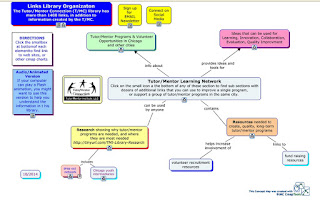
Program Locator (archive since 2019) and Find a Tutor/Mentor Program cMap
We're still working on these and will continue to update them as we learn new strategies or add new information to the web site. However, we hope you find these useful and that they help guide you in your own thinking. There's lots that needs to be done if more inner city youth are to be connected to tutors/mentors in comprehensive, long-term programs that mentor these kids to jobs and careers. Creating a blueprint to guild actions is an important step.
2022 update - many concept maps were created since 2007. This page shows the entire collection.
This week we've added another layer of information, which I believe will help more people understand what we're trying to do, and find the information they are looking for when they visit our sites.
I encourage you to take some time to receive these concept maps, and consider using them to fuel your own leadership of a tutor/mentor strategy from your business or church, or in your community.
Here are a few sections to look at:


Program Locator (archive since 2019) and Find a Tutor/Mentor Program cMap
We're still working on these and will continue to update them as we learn new strategies or add new information to the web site. However, we hope you find these useful and that they help guide you in your own thinking. There's lots that needs to be done if more inner city youth are to be connected to tutors/mentors in comprehensive, long-term programs that mentor these kids to jobs and careers. Creating a blueprint to guild actions is an important step.
2022 update - many concept maps were created since 2007. This page shows the entire collection.
Friday, May 25, 2007
Memorial Day - Keeping Commitments
 |
| See Animation of graphic |
I've also written that there are too few such programs, and too few leaders with a comprehensive strategy to change the availability of programs.
As you browse the internet over the weekend, I encourage you to reflect on the Tutor/Mentor Connection Strategy which I've begun to outline, using a concept mapping tool.
At the same time, consider the actions outlined below:
If we want to stop this violence, we have to act now, and keep acting to solve this problem for many years. We have to think spatially, that is, look at the entire city and suburban problem, not just one neighborhood. At the same time, we need to act locally, because none of us has the time, or the resources to help each of the kids in the entire Chicago region who live in neighborhoods where poverty is the root cause of the violence.
Here are some ways to remind yourself. Think of ENOUGH, is ENOUGH
E – educate yourself – most of us do not live in high poverty neighborhoods, so we only understand the root causes of senseless shootings from what we read in newspapers. We also only read negative news in the media, so we’re not really well informed on where these events are taking place most frequently. Finally, while there is a perception that there are plenty of youth programs, we really don’t have a good understanding of the distribution of different types of youth programs, to different age groups, in different zip codes. The only way this will change is if each of us pledges to spend one hour a week reading books, articles and web reports, that illustrate the root causes of these shootings, or of poor performance in schools. Through our learning we can draw ideas that we use in our own actions. We can also begin to contribute information that other people use to support their own decision making.
N – engage your network – find ways to draw others who you know into this shared understanding. Recognize people who volunteer time and talent, or who help kids through the programs they operate. If you are a business leader, or a church leader, engage your corporation or your congregation. You can use your web site, advertising, point of purchase materials, etc. to point to web sites that show all of the agencies in the city who do tutoring/mentoring, such as www.tutormentorconnection.org. If you do this weekly, year after year, your friends, coworkers and customers will become involved in solving this problem with you.
O – offer help, don’t wait to be asked. As you build your understanding of where poverty is most concentrated, and what social services are in those areas, choose a neighborhood, and reach out with offers of time, as a volunteer, talent, help build a web site, do the accounting, or offer Public relations services, and dollars, if the web site of an organization shows they do good work, you don’t need to ask for a proposal of h ow they would spend your donation, you need to send them a donation so they can keep doing that good work
U – build a shared understanding. Form groups of peers to share reading and learning assignments, just as you meet every Sunday to read passages of scripture and build the group’s understanding of the Word of God. Use the many different resources of the http://www.tutormentorconnection.org library as the starting point for your search for wisdom, and understanding.
G – give until it feels good – people who generously donate time and dollars to causes they believe in feel good about their giving. If we’re going surround kids living in poverty dominated neighborhoods with extra learning and adult mentoring networks, donors will need to give more than random contributions of time, dollars and talent. On the Bolder Giving web site (http://www.boldergiving.org/) donors are inspired to give to their full potential and those giving 50% or more are given recognition. Can we inspire donors who support youth services to give at this level?
H – form habits of learning, and pass these on to your kids. Imagine how much more successful teachers were if youth came to school every day asking questions about where to find information, or how to understand information they had researched on the Internet the previous day? We can model that habit if we build it into our own activity. Keep a chart, such as the OHATS on the Tutor/mentor connection web site, where you can document actions you take each week to same sure that this time ENOUGH, really means ENOUGH.
If you document actions, you can review what you’ve done at the end of each month, and each year, and begin to see a growing mountain of actions you have taken to solve this problem. Some of these will be actions that got other people involved, so that the good work you do is multiplying because of the good work others are also doing.
Through this process you help build this shared understanding, which will lead to better public policy. Without this habit of learning, and without learning to use the Internet to find good ideas from people in all parts of the world, we won’t be able to problem solve as well as we need to, and we won’t be able to teach this habit to our kids.
If we do this, we’ll not only reduce the root causes of youth on youth violence, we’ll also address one of the growing issues facing America in a global economy. We will begin to create a nation of learners, problem solvers, creative thinkers and innovators, who use learning and information as the basis of creating opportunity and keeping America great.
If you know of a tutor/mentor program operating in your neighborhood, see if it is listed in the Program Locator at http://www.tutormentorconnection.org. If not, ask the program to contact the T/MC. Together we can create a shared library of knowledge, that helps us all understand where we have enough services, and where there are neighborhoods without services.
Tuesday, May 22, 2007
ENOUGH, means ENOUGH

This map shows where poverty is most concentrated in Chicago, and locations of public schools on the 2007 warning lists. In every neighborhood where there are poor schools a wide range of tutoring/mentoring, arts, technology and enrichment programs are needed. They need to be available in non-school hours and in community locations, as well as in schools and youth centers during the traditional school day and the hours between when school ends and when parents come home from work.
That is the goal of the Tutor/Mentor Connection . Theconference we hosted in Chicago last week was intended to support that goal. Now that the conference is over I hope that people who attended the conference, and others who are concerned about poor schools or youth on youth violence, or workforce development, will connect with each other in small groups, or in Internet forums, where you can continue to discuss the ideas shared at the conference, and innovate ways to make more and better volunteer-based tutor/mentor programs available in the neighborhoods with poor schools.
In these discussions I encourage you to learn ways to use maps to point resource providers and volunteers to programs in every neighborhood of Chicago. I encourage you to recruit leaders, who will strategically align the goals of their organizations with actions that surround kids with mentors and help those kids prepare for 21st century jobs and careers.
Our next campaign is a volunteer recruitment effort as school starts. If you can apply your leadership to help mobilize volunteers, you will be making a difference in the lives of youth throughout the Chicago region and in other cities around the country.
Wednesday, May 16, 2007
Creative Networking to Help Mobilize Volunteers

On Thursday and Friday, May 17 and 18, the Tutor/Mentor Connection has been hosting its 27th Tutor/Mentor Leadership and Networking Conference since May 1994. Our goal is to connect people who lead volunteer-based tutor/mentor programs in various Chicago neighborhoods with ideas and networks or business and professional people so they have more resources to operate programs that inspire youth and volunteers to get involved, and stay involved for many years.
Very few tutor/mentor programs have celebrity leaders or deep advertising budgets. Thus, most struggle to stay visible, and to attract the operating dollars they need to pay the rent, and pay the core staff needed to support the connections of youth and adult volunteers.
Thus, I'm pleased to post this graphic. It was created by Thierry Koehrlen and Clément Devaux, who are part of a very creative organization that creates illustrations like this to communicate ideas.
I met Thierry over the past few months as I was organizing the Tutor/Mentor Blog Exchange and he agreed to create an illustration to help communicate the goals of the Tutor/Mentor Connection and this week's conference.
I encourage you to visit Thierry's blog to learn more about the work he's doing.
We invite any organization that is recruiting volunteers for their tutor/mentor program to consider using this graphic in your blog, or in a volunteer recruitment brochure. If you email me at tutormentor2@earthlink.net, or Thierry at "tk [at] nosvies.com", we can send you the jpg for this graphic. If you use it on your web site, or in a brochure, just give credit to Thierry Koehrlen and Clément Devaux at NosVies.com.
We hope that you show this to artists in your own community. This illustrates how people can use their talent to help us mobilize volunteers and call attention to tutoring/mentoring. There are lots of ways for people to use their skills to help non profits. If we can unleash that talent, there's much more we can do to help kids.
These are the type of ideas people are sharing at this week's conference. We hope you'll join us for the next one.
Tuesday, May 15, 2007
Can the University provide volunteer training and why should it get involved?
This is a guest article, written by Anastasia Mirzoyants, MA ESL, a member of the Owens Corning Mentorship Program Task Force, University of Toledo.
.....................
The alarming observations on current conditions of American system of education as compared to educational environments and outcomes of other global communities turned fruitful for the growth of American population’s interest in volunteering in general, and public schools mentoring/tutoring in particular. Volunteerism is no more profession or age specific; it involves people of a wide variety of life paths.
However, this diversified group has one characteristic in common, the one that also serves as a major reason preventing active public involvement with schools: 95% of tutors-to-be are not familiar with the curriculum and, thus, are not comfortable presenting the material to their potential tutees. This is especially true for math and science, the subjects that school children are struggling with the most but also the subjects that scare away volunteers.
The apprehension individuals experience is initiated either by the absence of information or by the inability to make the information relevant to one’s activities. Thus, the most reasonable approach to reassuring tutor/mentors’ recruitment and retention is to provide them with training opportunities: to introduce them to the curriculum and help develop the skills to build it in their tutoring/mentoring sessions.
The big question then is, who and how will take on the leading role in providing such trainings? There are several preexisting conditions that make the university be the most appropriate entity to function as a learning-basis for local tutor/mentorship programs.
First of all, it is a vital interest of a university to ensure the consistency of well-prepared student population enrollment through raising the level of literacy and math/science proficiency among school students. Consequently, quality tutor/mentorship programs are as beneficial for the future achievement of a university as they are for the current progress of public schools.
Second, being a research and innovation center of the community, the university possesses all the necessary resources including, but not limited to: materials; experiential knowledge; creative methodologies and techniques; faculty expertise, ability to evaluate an measure the program; ability to identify additional funders; and existing programs (for example, trainings and certificate programs for teachers). Thus, it seems to be efficient to utilize the resources that are already in place rather than create a volunteers’ training from the scratch.
Third, by securing its place in public schools volunteering initiatives, the university gains an access to resources for further research and pilot-trials of innovative techniques. In addition, through its field presence, the university has a chance to gather more accurate information about contemporary educational context that it strives to improve.
And finally, while reaching out to tutors and mentors, the university takes a step to more active and productive involvement with the community, overcomes its semi-isolated position, and improves public perception on its leadership role and social value.
Unfortunately, universities are not always aware of their image within the community and the benefits of being more involved in the everyday life of local population. Thus, it is important for the volunteer-based organizations and activist groups to bring to the attention of a university administration the importance and the ways for the university to be a part of the community and pursue public interests as well as its own developmental needs.
------------------
Ms. Mirzoyants and Ellen Ingram, Director of Corporate and Foundation Relations, University of Toledo, will be hosting a discussion at the Tutor/Mentor Leadership and Networking Conference on Thursday, May 17. If you'd like to learn more about attending the conference, visit http://www.tutormentorconference.org
Since most people can not come to Chicago for this conference, this question is also posted on the Tutor/Mentor Connection Discussion Forum. We invite you to log in and post your responses to this question.
.....................
The alarming observations on current conditions of American system of education as compared to educational environments and outcomes of other global communities turned fruitful for the growth of American population’s interest in volunteering in general, and public schools mentoring/tutoring in particular. Volunteerism is no more profession or age specific; it involves people of a wide variety of life paths.
However, this diversified group has one characteristic in common, the one that also serves as a major reason preventing active public involvement with schools: 95% of tutors-to-be are not familiar with the curriculum and, thus, are not comfortable presenting the material to their potential tutees. This is especially true for math and science, the subjects that school children are struggling with the most but also the subjects that scare away volunteers.
The apprehension individuals experience is initiated either by the absence of information or by the inability to make the information relevant to one’s activities. Thus, the most reasonable approach to reassuring tutor/mentors’ recruitment and retention is to provide them with training opportunities: to introduce them to the curriculum and help develop the skills to build it in their tutoring/mentoring sessions.
The big question then is, who and how will take on the leading role in providing such trainings? There are several preexisting conditions that make the university be the most appropriate entity to function as a learning-basis for local tutor/mentorship programs.
First of all, it is a vital interest of a university to ensure the consistency of well-prepared student population enrollment through raising the level of literacy and math/science proficiency among school students. Consequently, quality tutor/mentorship programs are as beneficial for the future achievement of a university as they are for the current progress of public schools.
Second, being a research and innovation center of the community, the university possesses all the necessary resources including, but not limited to: materials; experiential knowledge; creative methodologies and techniques; faculty expertise, ability to evaluate an measure the program; ability to identify additional funders; and existing programs (for example, trainings and certificate programs for teachers). Thus, it seems to be efficient to utilize the resources that are already in place rather than create a volunteers’ training from the scratch.
Third, by securing its place in public schools volunteering initiatives, the university gains an access to resources for further research and pilot-trials of innovative techniques. In addition, through its field presence, the university has a chance to gather more accurate information about contemporary educational context that it strives to improve.
And finally, while reaching out to tutors and mentors, the university takes a step to more active and productive involvement with the community, overcomes its semi-isolated position, and improves public perception on its leadership role and social value.
Unfortunately, universities are not always aware of their image within the community and the benefits of being more involved in the everyday life of local population. Thus, it is important for the volunteer-based organizations and activist groups to bring to the attention of a university administration the importance and the ways for the university to be a part of the community and pursue public interests as well as its own developmental needs.
------------------
Ms. Mirzoyants and Ellen Ingram, Director of Corporate and Foundation Relations, University of Toledo, will be hosting a discussion at the Tutor/Mentor Leadership and Networking Conference on Thursday, May 17. If you'd like to learn more about attending the conference, visit http://www.tutormentorconference.org
Since most people can not come to Chicago for this conference, this question is also posted on the Tutor/Mentor Connection Discussion Forum. We invite you to log in and post your responses to this question.
Subscribe to:
Posts (Atom)


 Posts
Posts


